Free See what ChatGPT, Claude and Google’s AI say about a company.What AI says about a company Get the free reportFree report

Short-Form Video & Reels

Social Media Marketing

Instagram Reels Hashtags: How to Help Your Reels Get Found

Hashtags no longer drive Reels views on their own, but they still tell Instagram what a video is about. How many to use, how to pick them, and what matters more.

Hashtags no longer drive Reels views on their own, but they still tell Instagram what a video is about. How many to use, how to pick them, and what matters more.

Joshua Jackai, founder of Demand Designer

Joshua Jackai

5 min

Cover: hashtags that help Reels get found, showing a hashtag search screen on a phone

Instagram Reels hashtags do one job in 2026: they tell Instagram what a video is about, so it can show the video to people who watch that kind of thing. They do not make a weak video travel, and stacking thirty of them does nothing a well-chosen five cannot. This guide explains how Reels are distributed now, how to choose hashtags that help, how many to use, and the two things that matter far more than any tag. It is for small business owners and marketing leads in the US and worldwide who post Reels to sell something, from subscription boxes to services.

A candle maker films a short vertical video of herself at her worktable with a phone on a small tripod

Illustrative photo.

How Reels get shown

Instagram shows a Reel to a small group first, measures how they respond, and widens or narrows distribution from there. The signals it reads are mostly about the video: how long people watch, whether they watch again, whether they share it with a friend, and whether they follow or save. Hashtags, captions and the audio are context that helps Instagram decide who that first group should be.

Research on what makes online content spread supports this. A study of thousands of videos published in the Journal of Marketing found that the content itself, including the emotions it provokes and how it is structured, drives sharing far more than surface features do (Tellis et al., 2019). Hashtags are a surface feature. They aim the video; they do not propel it.
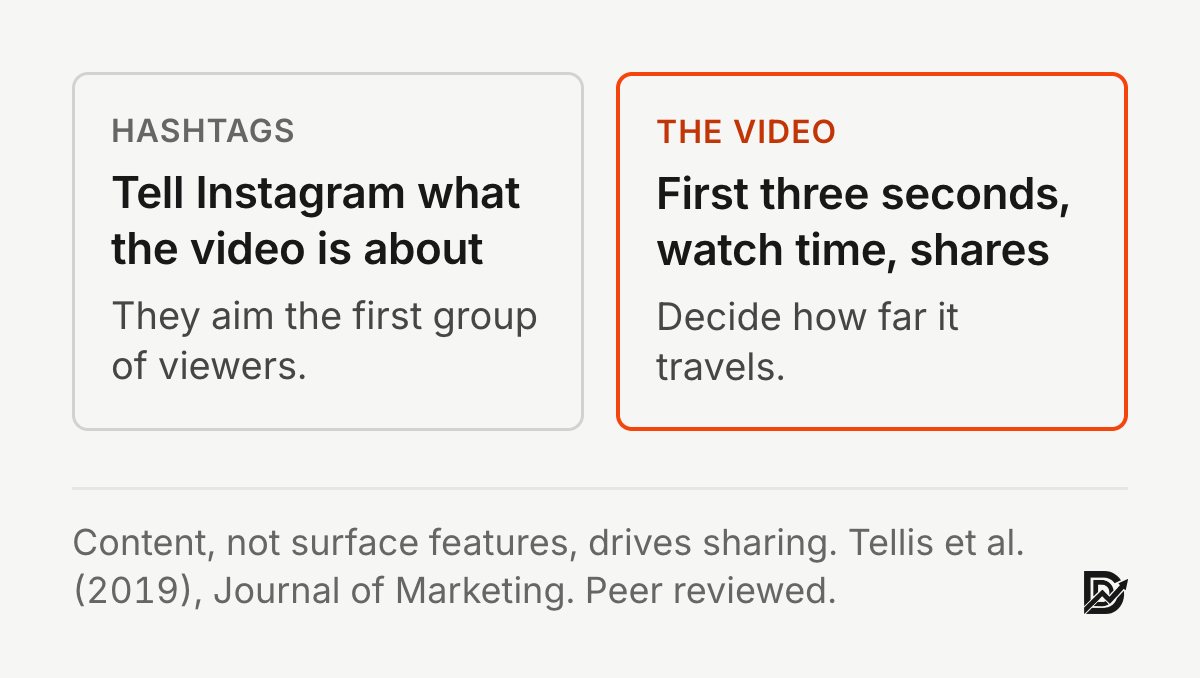
Hashtags tell Instagram what the video is about and aim the first viewers; the first three seconds, watch time and shares decide how far it travels

Choose hashtags that describe the video, not the dream

The old approach was to add the biggest hashtags you could find: #love, #instagood, #viral. Those tell Instagram nothing about the video and put you in a pool of millions of unrelated posts. The approach that helps is specific description.

For a 20-second Reel of a candle maker pouring a morning batch, the useful tags are the ones a viewer who likes that content would recognise: #candlemaking, #handpoured, #behindthescenes, #smallbusinessowner, #shopsmall. Each describes the subject, the format or the audience. A viewer who watches handmade-process videos is who Instagram should find, and those tags say so.

A quick test: would a person searching that hashtag be glad to find this exact video? If not, drop it.
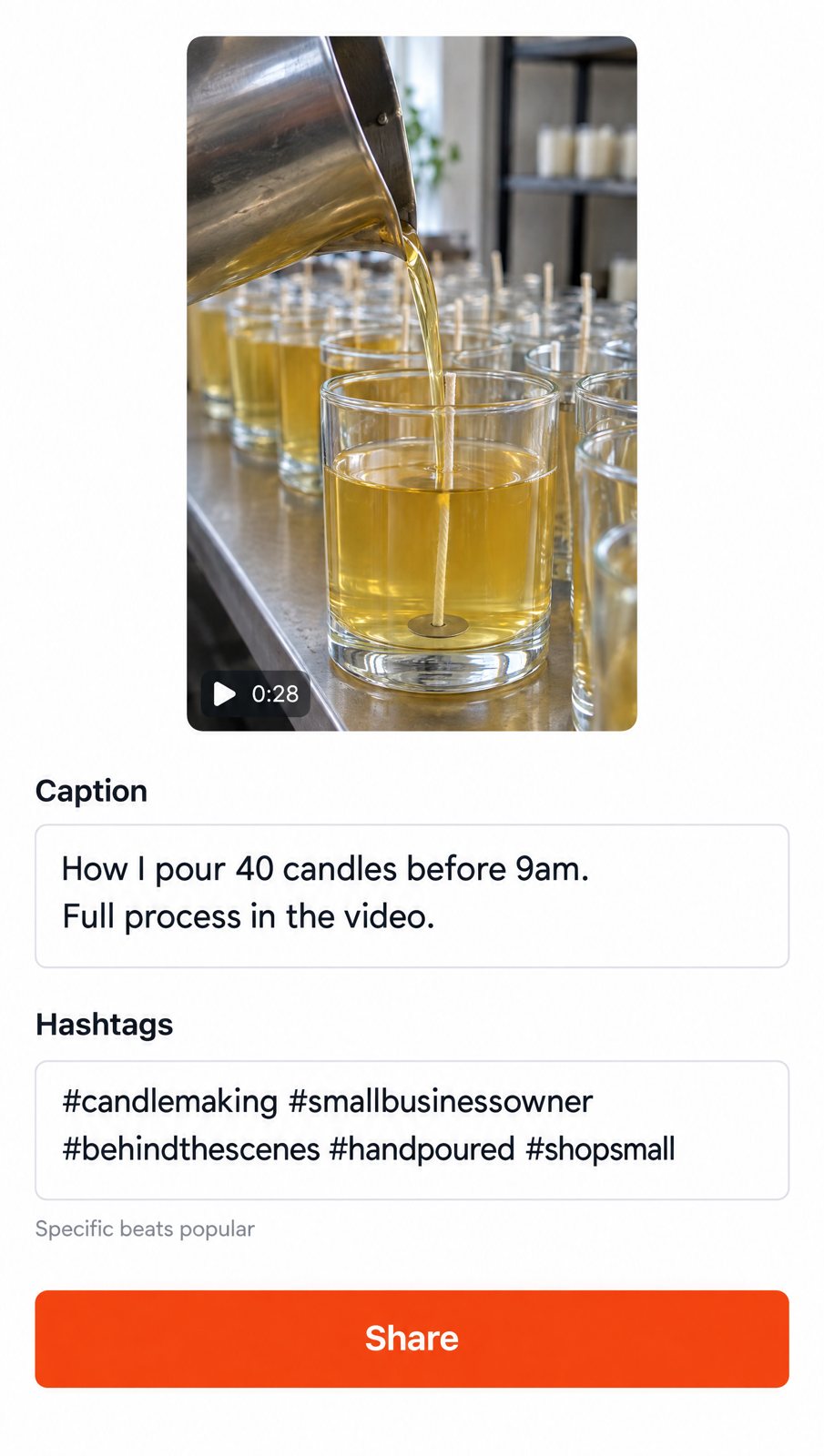
Example Reel composer with a caption about pouring 40 candles before 9am and five specific hashtags: candlemaking, smallbusinessowner, behindthescenes, handpoured, shopsmall

Illustration with example copy: five specific hashtags under a caption written for the viewer.

How many hashtags to use on a Reel

Three to five. Instagram allows up to thirty, and for years the advice was to use all of them, but more tags dilute the signal and look like spam to viewers who open the caption. Five specific tags give Instagram a clear description. Thirty mixed ones give it noise.

Build a short list per content type rather than per post. A candle business might keep one set of five for process videos, one for product reveals and one for customer stories, and swap only one or two tags per post when a specific product or event applies.
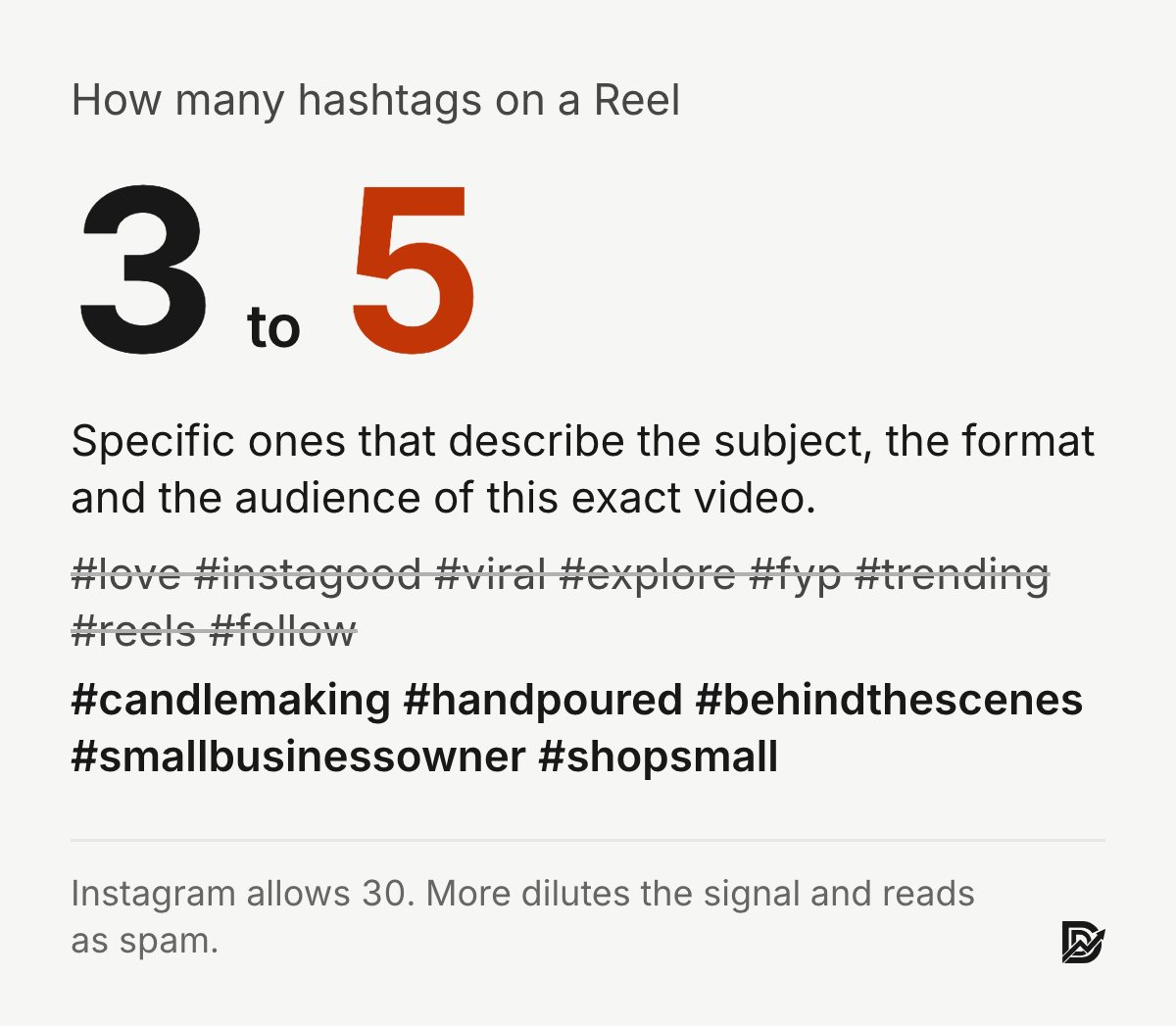
Use three to five specific hashtags per Reel; generic tags like love, instagood and viral crossed out, specific tags like candlemaking and handpoured kept

Where to put them

In the caption, after the text, or in the first comment. Both work; the caption is simpler and keeps everything in one place. Write the caption first, for the person watching, and add the tags after it. A caption that is only hashtags reads as low effort, and the caption text itself is read by Instagram for context just as the tags are.

What matters more than hashtags

Two things decide whether a Reel gets watched and shared, and both happen before anyone sees a hashtag.

The first three seconds. Most viewers decide to stay or scroll in that window. Start with the result, the action or the question, not an introduction. "How I pour 40 candles before 9am" earns a second look; "Hi everyone, welcome back to my channel" does not. Watch your own retention graph in Reels insights: if it drops at three seconds, the opening is the problem, and no hashtag fixes it.

Watch time and shares. A Reel that is watched to the end and sent to a friend is shown to more people. Keep videos as short as the content allows, cut every pause, and end at the natural finish rather than with a sign-off. Ask for a share only when the content is useful enough to share. For what to film and how to structure it, see seven ways to get more views on Reels.

If you are producing Reels for a business, the 1-to-12 Engine shows how to turn one piece of long content into twelve short videos, so you post consistently without filming every day.

A simple Reels hashtag routine

  • Write the caption for the viewer first.

  • Add three to five hashtags that describe the subject, format and audience of this specific video.

  • Keep one saved set per content type; change at most two tags per post.

  • Check Reels insights after a week. Look at the retention graph and shares, not just plays.

  • If a set is not helping, change the video before you change the tags.

Five-step Reels hashtag routine: caption first, three to five descriptive tags, one saved set per content type, check retention and shares, change the video not the tags

Frequently asked questions

Do hashtags still work on Instagram Reels?

Yes, as description. They help Instagram understand what a Reel is about and who might want it. They do not make a Reel go viral on their own, and large generic tags do little. The video's first seconds, watch time and shares matter far more.

How many hashtags should I use on a Reel?

Three to five specific ones. Instagram allows thirty, but more tags dilute the signal and look like spam to viewers who open the caption.

Should hashtags go in the caption or the first comment?

Either. Putting them at the end of the caption is simplest and keeps everything in one place. Write the caption for the viewer first, then add the tags.

What are the best hashtags for Reels?

The ones that accurately describe your video: its subject, its format and the audience it is for. There is no universal best list. A hashtag that would surprise someone searching it is the wrong hashtag.

Why are my Reels getting no views?

Usually the opening. Check the retention graph in Reels insights; if viewers leave in the first three seconds, change how the video starts. Then look at watch time and shares. Hashtags are rarely the cause of low views.

Sources

Peer-reviewed research

  • Tellis, G. J., MacInnis, D. J., Tirunillai, S. and Zhang, Y. (2019). What drives virality (sharing) of online digital content? The critical role of information, emotion, and brand prominence. Journal of Marketing, 83(4). doi:10.1177/0022242919841034

Platform guidance (not peer reviewed)

  • Instagram's own published guidance on Reels distribution and hashtag limits, as of 2026.

Free workbook

The 1-to-12 Engine

Turn one recording into twelve short videos that are still being found months later.

Five steps, five fill-in prompts, a workbook for each. Free.

Related

More B2B guides

Practical guides on B2B websites, conversion and content, written from client work.

Related

More B2B guides

Practical guides on B2B websites, conversion and content, written from client work.

Cover: B2B conversion rate optimization. More qualified leads from the traffic you already have.
B2B Conversion Rate Optimization: Guide, Services, Costs

How B2B conversion rate optimization works on low-traffic sites, what CRO services should include, what US agencies charge in 2026, and how to choose a provider.

Cover: The B2B website redesign playbook, a seven-phase guide by Demand Designer
The B2B Website Redesign Playbook: 7 Phases

A seven-phase B2B website redesign plan for US and global teams: win more qualified leads, keep your search rankings and launch on schedule.

Cover: the anatomy of a B2B landing page that converts, showing the real Y Scouts book funnel landing page Demand Designer built
The Anatomy of a B2B Landing Page That Converts

The seven sections of a B2B landing page, in order: what each must do, the copy that goes in it, and two real pages converting 10.1% and 17.7%.

Cover: website mistakes that cost B2B deals, showing a B2B homepage with three problem areas marked
Seven B2B Website Mistakes That Cost You Enterprise Deals

Enterprise buyers check your website before they talk to sales. Seven B2B website design mistakes that send them to a competitor, each with a fix you can ship this month.

Cover: why your website loses high-value clients, showing a funnel report with a 91% drop-off between pricing and the contact form
Why Your B2B Website Is Losing High-Value Clients

Your site gets the right visitors and still loses them. The five failure patterns behind most B2B websites, how to find which one is yours, and what each fix costs.

Cover: use AI like a teammate, showing an AI chat reviewing landing page drafts against win-loss notes
How to Use AI as a Teammate, Not a Vending Machine

Most marketers prompt AI like a vending machine and get average work back. The briefing method I use instead, with the five-part brief and three real examples.

Cover: digital marketing for subscription businesses, showing a dashboard with recurring revenue, subscribers, churn and channels
Digital Marketing for Subscription Businesses: What Grows Recurring Revenue

A subscription business lives or dies on retention, not signups. The marketing that grows recurring revenue, in order: the signup page, the first 30 days, paid ads and the numbers to watch.

Cover: market your brand on social media, showing a coffee roaster's business profile on a phone
How to Market Your Brand on Social Media: A Plan One Person Can Keep

A beginner's guide to marketing a brand on social media without a team: pick one platform, three content pillars and a cadence you can hold, then measure what sells.

Cover: B2B conversion rate optimization. More qualified leads from the traffic you already have.
B2B Conversion Rate Optimization: Guide, Services, Costs

How B2B conversion rate optimization works on low-traffic sites, what CRO services should include, what US agencies charge in 2026, and how to choose a provider.

Cover: The B2B website redesign playbook, a seven-phase guide by Demand Designer
The B2B Website Redesign Playbook: 7 Phases

A seven-phase B2B website redesign plan for US and global teams: win more qualified leads, keep your search rankings and launch on schedule.

Cover: the anatomy of a B2B landing page that converts, showing the real Y Scouts book funnel landing page Demand Designer built
The Anatomy of a B2B Landing Page That Converts

The seven sections of a B2B landing page, in order: what each must do, the copy that goes in it, and two real pages converting 10.1% and 17.7%.

Cover: website mistakes that cost B2B deals, showing a B2B homepage with three problem areas marked
Seven B2B Website Mistakes That Cost You Enterprise Deals

Enterprise buyers check your website before they talk to sales. Seven B2B website design mistakes that send them to a competitor, each with a fix you can ship this month.

Cover: why your website loses high-value clients, showing a funnel report with a 91% drop-off between pricing and the contact form
Why Your B2B Website Is Losing High-Value Clients

Your site gets the right visitors and still loses them. The five failure patterns behind most B2B websites, how to find which one is yours, and what each fix costs.

Cover: use AI like a teammate, showing an AI chat reviewing landing page drafts against win-loss notes
How to Use AI as a Teammate, Not a Vending Machine

Most marketers prompt AI like a vending machine and get average work back. The briefing method I use instead, with the five-part brief and three real examples.

Cover: digital marketing for subscription businesses, showing a dashboard with recurring revenue, subscribers, churn and channels
Digital Marketing for Subscription Businesses: What Grows Recurring Revenue

A subscription business lives or dies on retention, not signups. The marketing that grows recurring revenue, in order: the signup page, the first 30 days, paid ads and the numbers to watch.

Cover: market your brand on social media, showing a coffee roaster's business profile on a phone
How to Market Your Brand on Social Media: A Plan One Person Can Keep

A beginner's guide to marketing a brand on social media without a team: pick one platform, three content pillars and a cadence you can hold, then measure what sells.

Demand Designer®

Conversion-focused web design, ad creative and video editing for EOS®-run businesses in the United States.

© Demand Designer 2026. All rights reserved.

EOS® is a registered trademark of EOS Worldwide, LLC. Demand Designer is not affiliated with or endorsed by EOS Worldwide.