Social Media Marketing
How to Market Your Brand on Social Media: A Plan One Person Can Keep

Joshua Jackai
6 min

Marketing your brand on social media comes down to a short plan you can keep: one platform, a clear audience, three kinds of content, a cadence that fits the hours you have, and a monthly look at what actually sold. Most small businesses fail at social media not because they post badly but because they post everywhere, inconsistently, and never check whether it brings in customers. This guide builds the plan step by step. It is for owners and marketing leads at small and mid-sized businesses in the US and worldwide, especially those doing it alone.

Illustrative photo.
Step 1: Write down who you are talking to
Not "everyone." A specific person who buys what you sell: "home brewers in the US who order beans online and care where they come from." The description decides every later choice, from the platform to the kind of video you film.
If you are not sure, look at your last 20 customers. Where do they live, what do they do, what did they say when they bought? Their words become your captions. A content plan built on real customer language is specific enough to be recognised, and specific content is what earns a follow.
Step 2: Pick one platform
One. The one your customers already use, not the one you enjoy. A B2B consultancy probably belongs on LinkedIn; a candle business on Instagram; a product with a strong visual process on TikTok. Pick it, commit for six months, and ignore the others until the first one produces customers.
Research on social media marketing strategy published in the Journal of the Academy of Marketing Science describes a range of approaches, from simple one-way broadcasting to building a community of customers who talk to each other (Li, Larimo and Leonidou, 2021). A solo operator should start at the simple end and move up as the account grows. Trying to run a community on four platforms at once is how accounts go quiet.
Step 3: Choose three content pillars
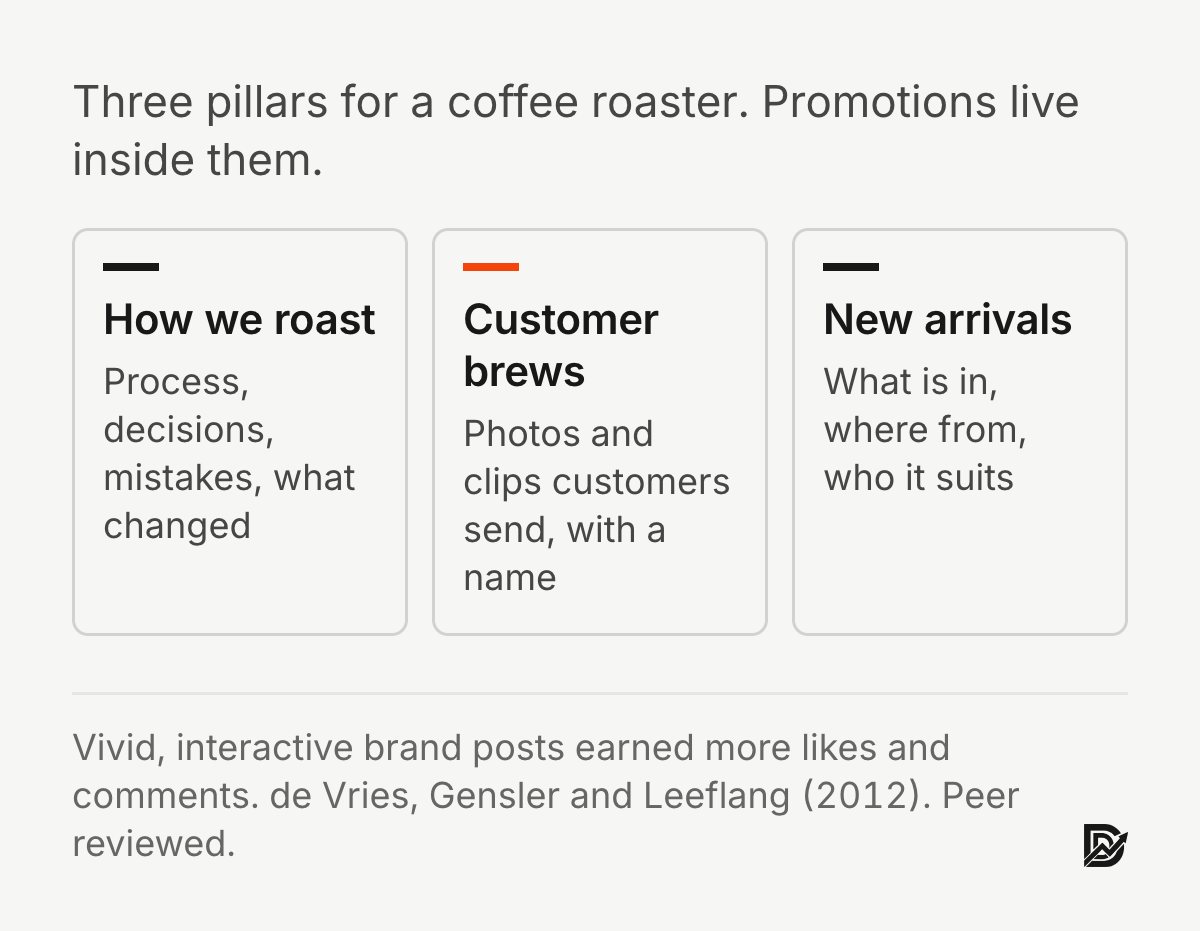
A pillar is a recurring kind of post you can always make. Three is enough. For a coffee roaster:
How we roast. Process, decisions, mistakes, what changed this week.
Customer brews. Photos and clips subscribers send, with permission and a name.
New arrivals. What is in this month, where it is from, who it suits.
Pillars stop the blank-page problem. Every week you make one of each, and the account looks consistent without being repetitive. Notice that none of the pillars is "promotions." The offer appears inside the other three, where it has context.
Content that informs or provokes a feeling travels furthest. A study of brand posts in the Journal of Interactive Marketing found that posts with vivid, interactive content earned more likes and comments than plain announcements (de Vries, Gensler and Leeflang, 2012). A later study in the Journal of Marketing found that the information and emotion in a video drove sharing far more than surface features did (Tellis et al., 2019). Show the process; the sale follows.
Step 4: Set a cadence you can hold for six months
Three posts and two short videos a week is a realistic ceiling for one person. If that is too much, two posts and one video. The number matters less than keeping it, because an account that posts daily for three weeks and then stops looks abandoned to a new visitor.
Batch the work. Film process clips for an hour on Monday, write captions on Tuesday, schedule the week. The 1-to-12 Engine shows how to turn one longer piece of content into twelve short posts, which is the simplest way to keep a cadence without filming every day. For the video side, seven ways to get more views on Reels covers how to open a clip so people keep watching.

Illustration with example copy.
Step 5: Make the profile do the selling
A good post earns a profile visit. The profile has to convert it. Check four things:
The bio says what you sell and for whom, in one line, with the words a customer would use.
The link goes to one page built for social visitors: the product, the booking page or a short offer, not the homepage.
The highlights or pinned posts show your three pillars, so a new visitor sees the range in ten seconds.
The first nine posts look like they belong together. Consistent framing and colour read as a real business.
Step 6: Reply, and borrow your customers' content
Social media rewards accounts that behave like people. Reply to every comment for the first six months. Answer direct messages the same day. When a customer posts your product, ask to share it, credit them by name, and thank them publicly. A study of a retailer's customers in the Journal of Marketing found that people who engaged with the company's social content went on to spend more, even after accounting for their other contact with the brand (Kumar et al., 2016). Engagement is not vanity; it is the early part of a sale.
Step 7: Measure what sells, monthly
Followers and likes are easy to see and nearly useless on their own. Once a month, look at five things:
Profile visits and link clicks, from the platform's own insights.
Visits to your site from social, in Google Analytics 4, with UTM tags on every link you post.
Enquiries or orders where the customer said they found you on social. Ask on your form.
Which pillar produced the posts with the most saves and shares.
Time spent, honestly, so you know what an hour of social is costing.
Then do more of the pillar that produces customers, not the one that produces likes. How to measure social media ROI explains how to turn these numbers into a figure you can defend. When you are ready to turn the plan into a document, how to build a social media strategy picks up where this guide ends.

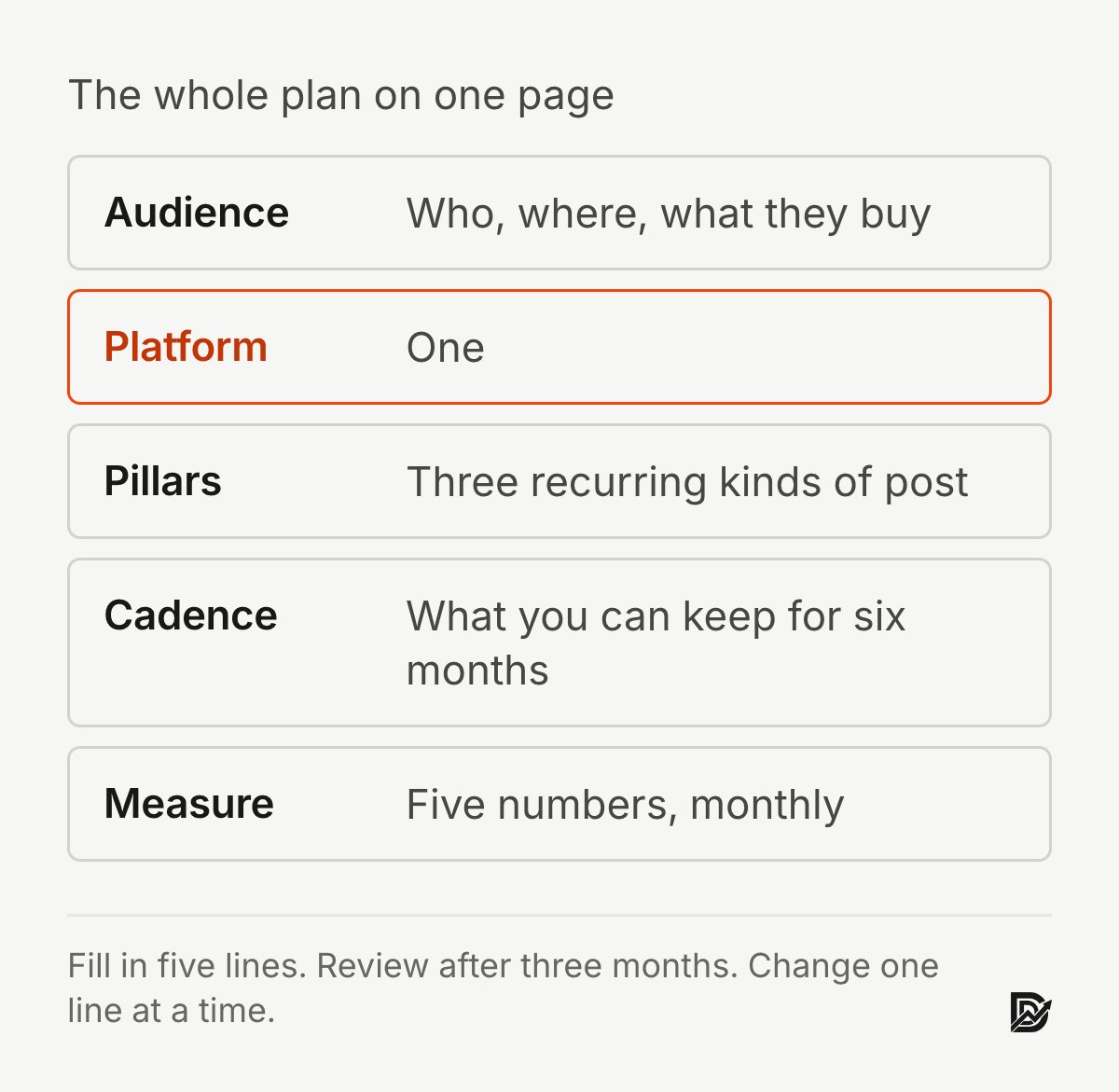
A one-page social media plan
Fill in these five lines and you have a plan:
Audience: who, where, what they buy.
Platform: one.
Pillars: three recurring kinds of post.
Cadence: posts and videos per week you can keep for six months.
Measure: the five monthly numbers above.
Put it where you can see it. Review it after three months, and change one line at a time.
Frequently asked questions
Which social media platform is best for a small business?
The one your customers already use. Look at your last 20 customers and where they spend time. Pick one platform, commit for six months, and add a second only when the first produces customers.
How often should a small business post on social media?
As often as you can keep up for six months. For one person, three posts and two short videos a week is a realistic ceiling; two and one is fine. Consistency matters more than volume.
What should a small business post on social media?
Three recurring pillars: the process behind what you sell, your customers using it, and what is new. Promotions sit inside those, with context, rather than as their own kind of post.
How do I know if social media is working for my business?
Track profile visits, link clicks, site visits from social, and enquiries or orders where the customer said they found you on social. Review monthly and compare the time spent against the customers won.
Do I need to pay for ads to market my brand on social media?
Not at first. Build the profile, the pillars and the cadence organically, so you learn what content sells. Then put money behind the posts that already produce customers.
Sources
Peer-reviewed research
de Vries, L., Gensler, S. and Leeflang, P. S. H. (2012). Popularity of brand posts on brand fan pages: An investigation of the effects of social media marketing. Journal of Interactive Marketing, 26(2). doi:10.1016/j.intmar.2012.01.003
Kumar, A., Bezawada, R., Rishika, R., Janakiraman, R. and Kannan, P. K. (2016). From social to sale: The effects of firm-generated content in social media on customer behavior. Journal of Marketing, 80(1). doi:10.1509/jm.14.0249
Li, F., Larimo, J. and Leonidou, L. C. (2021). Social media marketing strategy: Definition, conceptualization, taxonomy, validation, and future agenda. Journal of the Academy of Marketing Science, 49. doi:10.1007/s11747-020-00733-3
Tellis, G. J., MacInnis, D. J., Tirunillai, S. and Zhang, Y. (2019). What drives virality (sharing) of online digital content? The critical role of information, emotion, and brand prominence. Journal of Marketing, 83(4). doi:10.1177/0022242919841034
Free workbook
The 1-to-12 Engine
Turn one recording into twelve short videos that are still being found months later.
Five steps, five fill-in prompts, a workbook for each. Free.


