Social Media Marketing
How to Build a Social Media Strategy You Can Keep

Joshua Jackai
6 min

A social media strategy is a short written answer to five questions: what social media is for in your business, who you are talking to, where, what you will post, and how you will know it is working. Most companies skip the writing and go straight to posting, which is why their accounts drift between promotions, memes and silence. This guide builds the strategy in eight steps a small team can follow, with the research on which approaches actually produce customers. It is for founders and marketing leads at small and mid-sized businesses in the US and worldwide. If you are starting from nothing, how to market your brand on social media is the simpler one-page version; this guide is for turning that into a plan a team can run.

Illustrative photo.
Step 1: Audit what you have
Before setting goals, look at the last 90 days honestly. For each account, write down: posts published, followers gained, profile visits, link clicks, and any enquiries or sales that mentioned social media. Then list the ten posts with the most saves and shares, and the ten with the least. The pattern in those two lists tells you what your audience wants from you, which is a better starting point than a competitor's feed.
Step 2: Tie the goal to revenue
"Grow our following" is not a goal; it is a hope. A usable goal names the business result and the number: "12 qualified enquiries from social media this quarter," or "400 clicks from Instagram to the product page a month, converting at 3%." Followers and reach become leading indicators for that number rather than ends in themselves.
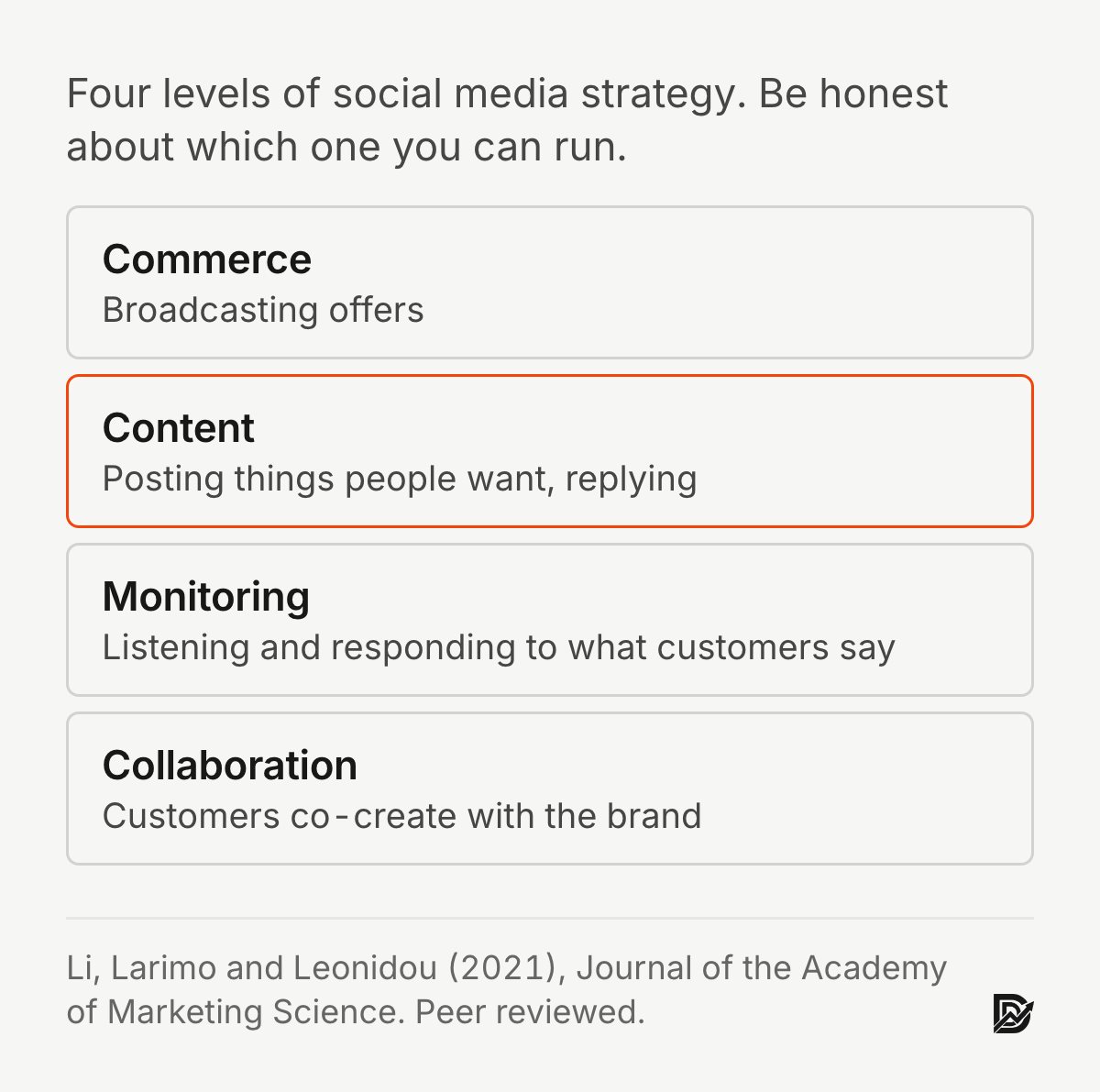
Academic work on social media strategy makes a similar distinction. A review in the Journal of the Academy of Marketing Science describes four levels of strategy, from simple commerce (broadcasting offers) through content and monitoring to a collaborative level where customers co-create with the brand (Li, Larimo and Leonidou, 2021). The higher levels produce more, and demand more. A small team should be honest about which level it can run and set the goal accordingly.
Step 3: Describe one audience
One primary audience, in a paragraph: who they are, what they buy from you, what they already follow, what they complain about. Pull the words from sales calls, reviews and your own customer list, not from a persona template. Every content decision later is tested against this paragraph.
If you sell to two very different groups, pick the one worth more and serve them first. A feed that speaks to everyone speaks to no one.
Step 4: Study five competitors, then do one thing differently
Open the accounts of five companies your buyer would compare you with. Note what they post, how often, which posts get engagement, and what they never do. The gap is your opening. If all five post polished product shots, the process video wins. If all five broadcast, replying to every comment wins. The aim is one visible difference, not a different everything.
Step 5: Choose the platforms that fit, not all of them
Match platform to audience and to the content you can make. B2B services usually belong on LinkedIn first; visual consumer products on Instagram or TikTok; local services on whichever platform their customers already use. Start with one, add a second only when the first produces results against the Step 2 goal, and give each platform its own native format rather than cross-posting the same file everywhere.
Step 6: Build the content plan around three pillars
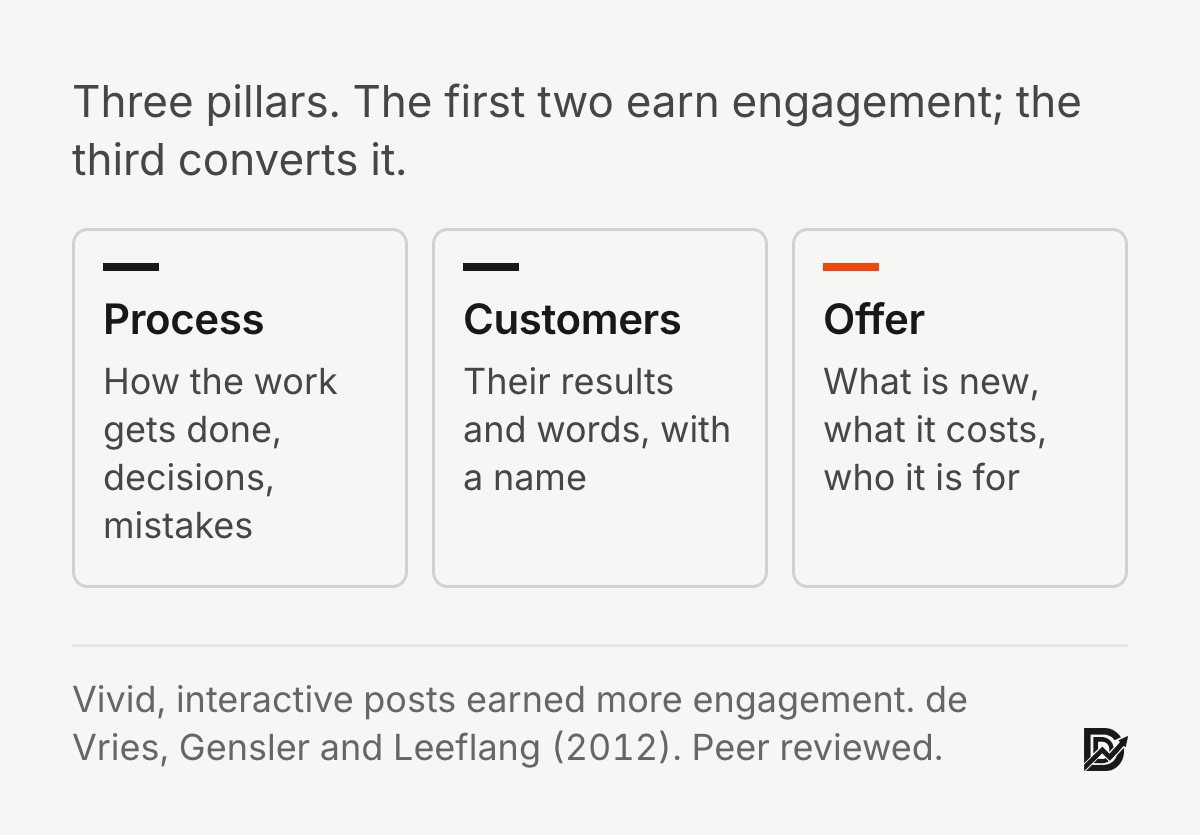
A pillar is a kind of post you can always make. Three is enough:
Process. How the work gets done, decisions, mistakes, what changed this week.
Customers. Their results, their words, their photos, with permission and a name.
Offer. What is new, what is available, what it costs, who it is for.
The research supports leading with the first two. A study of brand posts in the Journal of Interactive Marketing found that vivid, interactive posts earned more likes and comments than plain announcements (de Vries, Gensler and Leeflang, 2012). A study of a retailer's customers in the Journal of Marketing found that people who engaged with the company's own social content went on to spend more, even after accounting for their other contact with the brand (Kumar et al., 2016). Process and customer content earn the engagement; the offer converts it.
Write the pillars into a calendar with a channel and a pillar tag on every slot. For short video, the 1-to-12 Engine shows how to turn one long piece into twelve short posts, which is usually how a small team fills the video slots.
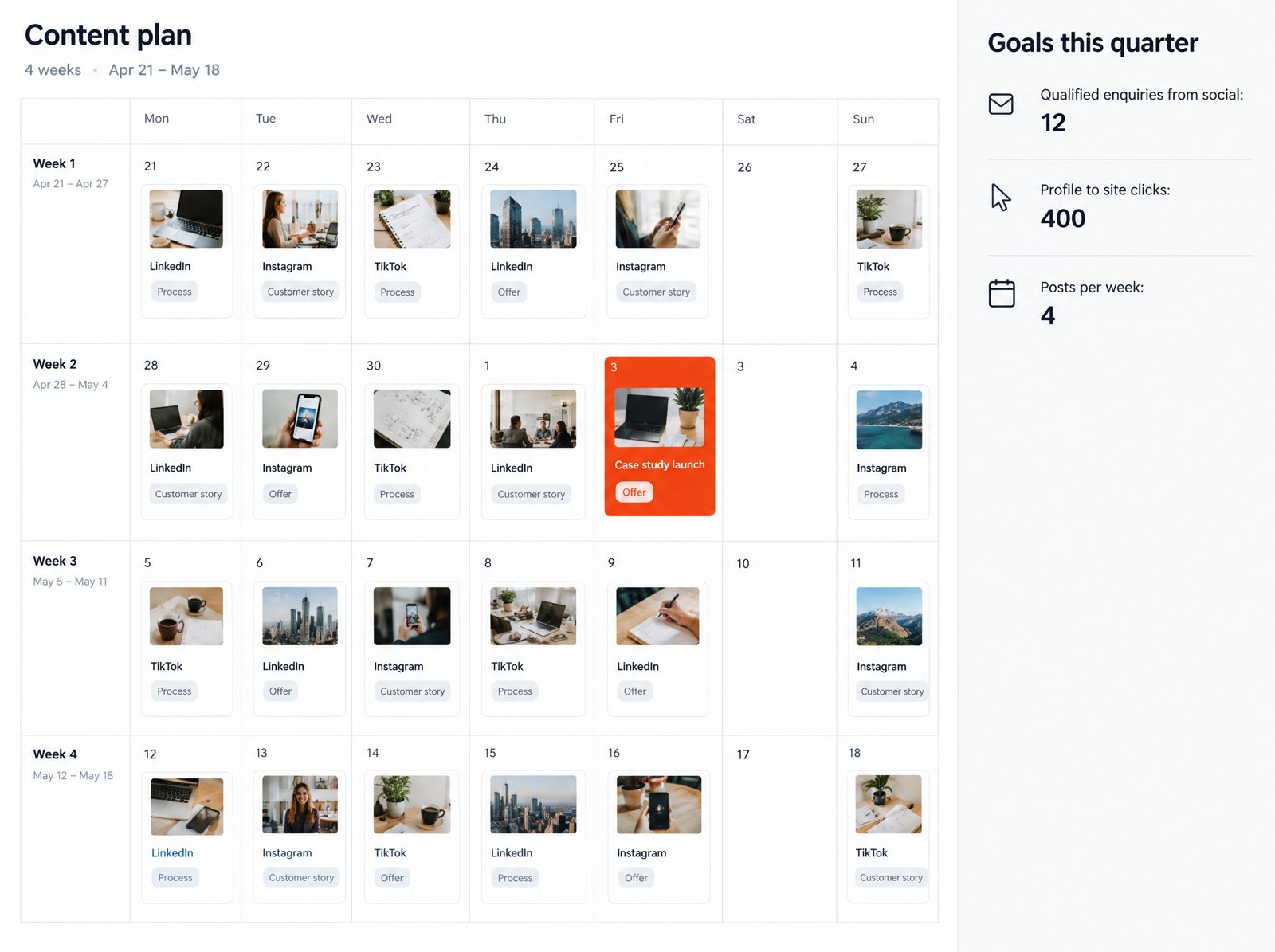
Illustration with example data: a calendar with a pillar tag on every slot and the goal beside it.
Step 7: Set a cadence and a workflow
Decide how many posts and videos a week the team can sustain for six months, then halve it if you are not sure. Three posts and two short videos a week is a realistic ceiling for one person; a team of three can do more, but only if the workflow is written down: who films on Monday, who writes captions, who schedules, who replies. Batch the work weekly. Consistency beats volume, because an account that posts daily for three weeks and then stops looks abandoned to a new visitor.
Include replying in the workflow. Answering comments and messages within a day is part of the strategy, not an afterthought, because it is where engagement turns into conversations.
Step 8: Review monthly and change one thing
Once a month, compare the numbers with the Step 2 goal: enquiries or sales from social, link clicks, profile visits, and saves and shares by pillar. Then change one thing: a pillar's share of the calendar, a posting time, a format. One change at a time, so you can see what moved. How to measure social media ROI explains how to turn these numbers into a return figure, including the staff time, so you know whether the whole effort pays.
The strategy on one page
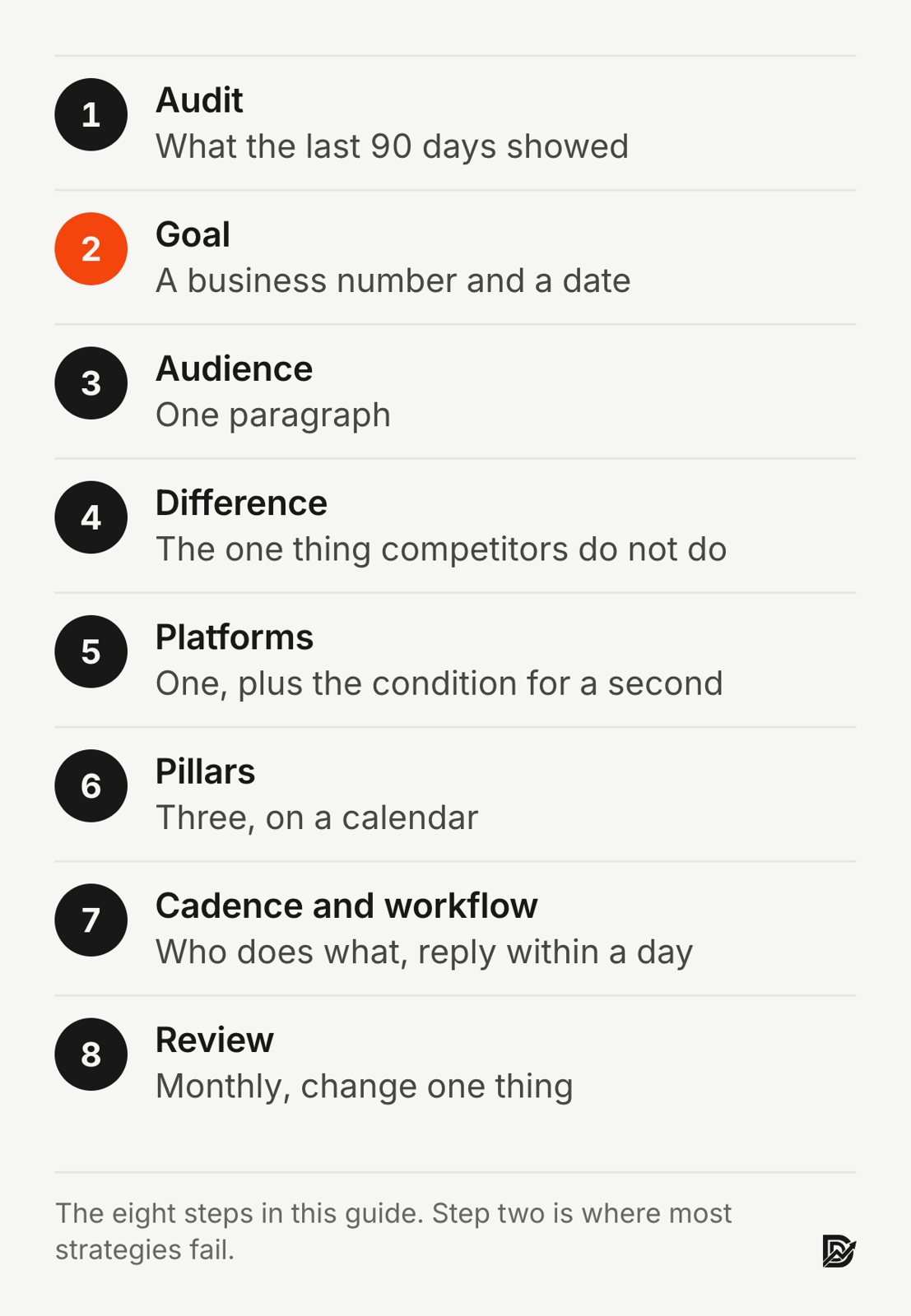
Write these eight lines and you have a strategy a team can run:
Audit: what the last 90 days showed.
Goal: the business number and the deadline.
Audience: one paragraph.
Difference: the one thing competitors do not do.
Platforms: one, plus the condition for adding a second.
Pillars: three, with a calendar.
Cadence and workflow: posts per week, who does what, reply time.
Review: monthly, change one thing.
Pin it where the team can see it. Revisit it every quarter, and rewrite it only when the business goal changes.
Frequently asked questions
What should a social media strategy include?
A goal tied to a business number, one primary audience, the platforms that fit it, three content pillars with a calendar, a cadence and workflow the team can sustain, and a monthly review against the goal. It fits on one page.
How do I set social media goals?
Start from a business result, such as enquiries, bookings or sales, and give it a number and a date. Then identify the leading indicators, such as profile visits and link clicks, that feed it. Followers and reach are indicators, not goals.
How many social media platforms should a small business use?
One to start. Add a second only when the first is producing results against your goal, and give each platform its own format rather than cross-posting the same file.
How often should a business post on social media?
As often as it can keep up for six months. For one person, three posts and two short videos a week is a realistic ceiling. The number matters less than holding it.
How do I know if my social media strategy is working?
Compare monthly results with the goal you set: enquiries or sales from social, link clicks and profile visits, and saves and shares by pillar. If the leading indicators rise but the business number does not after a full sales cycle, the content is engaging the wrong audience or the profile is not converting visits.
Sources
Peer-reviewed research
de Vries, L., Gensler, S. and Leeflang, P. S. H. (2012). Popularity of brand posts on brand fan pages: An investigation of the effects of social media marketing. Journal of Interactive Marketing, 26(2). doi:10.1016/j.intmar.2012.01.003
Kumar, A., Bezawada, R., Rishika, R., Janakiraman, R. and Kannan, P. K. (2016). From social to sale: The effects of firm-generated content in social media on customer behavior. Journal of Marketing, 80(1). doi:10.1509/jm.14.0249
Li, F., Larimo, J. and Leonidou, L. C. (2021). Social media marketing strategy: Definition, conceptualization, taxonomy, validation, and future agenda. Journal of the Academy of Marketing Science, 49. doi:10.1007/s11747-020-00733-3
Free workbook
The 1-to-12 Engine
Turn one recording into twelve short videos that are still being found months later.
Five steps, five fill-in prompts, a workbook for each. Free.


