AI Marketing Systems
How to Use AI as a Teammate, Not a Vending Machine

Joshua Jackai
7 min

Most people use AI like a vending machine. They put in a one-line request, take whatever comes out, and either ship it or give up. The people who get real work from it do something different: they brief it the way they would brief a capable new colleague, with the context, the goal, the constraints and the material it needs. This article explains that shift, gives you the five-part brief I use at Demand Designer, and shows three examples from marketing work. It is for founders and marketing leads at B2B companies in the US and worldwide who already use AI tools and are underwhelmed by the results.

Illustrative photo.
What the research says about who gains from AI
Two careful studies set the frame. In a controlled experiment published in Science, people given access to a generative AI assistant completed professional writing tasks about 40% faster, and the quality of their work rose, with the biggest gains for those whose initial work was weakest (Noy and Zhang, 2023). In a study of more than 5,000 customer support agents published in the Quarterly Journal of Economics, an AI assistant raised the number of issues resolved per hour by about 14% on average, and by more than 30% for the least experienced agents, while the most experienced agents gained little (Brynjolfsson, Li and Raymond, 2025).
Read those together and the lesson is not that AI makes everyone better. It is that AI raises the floor. It makes average work fast and easy to produce. If your competitors have the same tools, average output is no longer an advantage. The advantage goes to the people who can get above-average work out of the tool, and that comes from the brief, not the model.

The vending machine problem
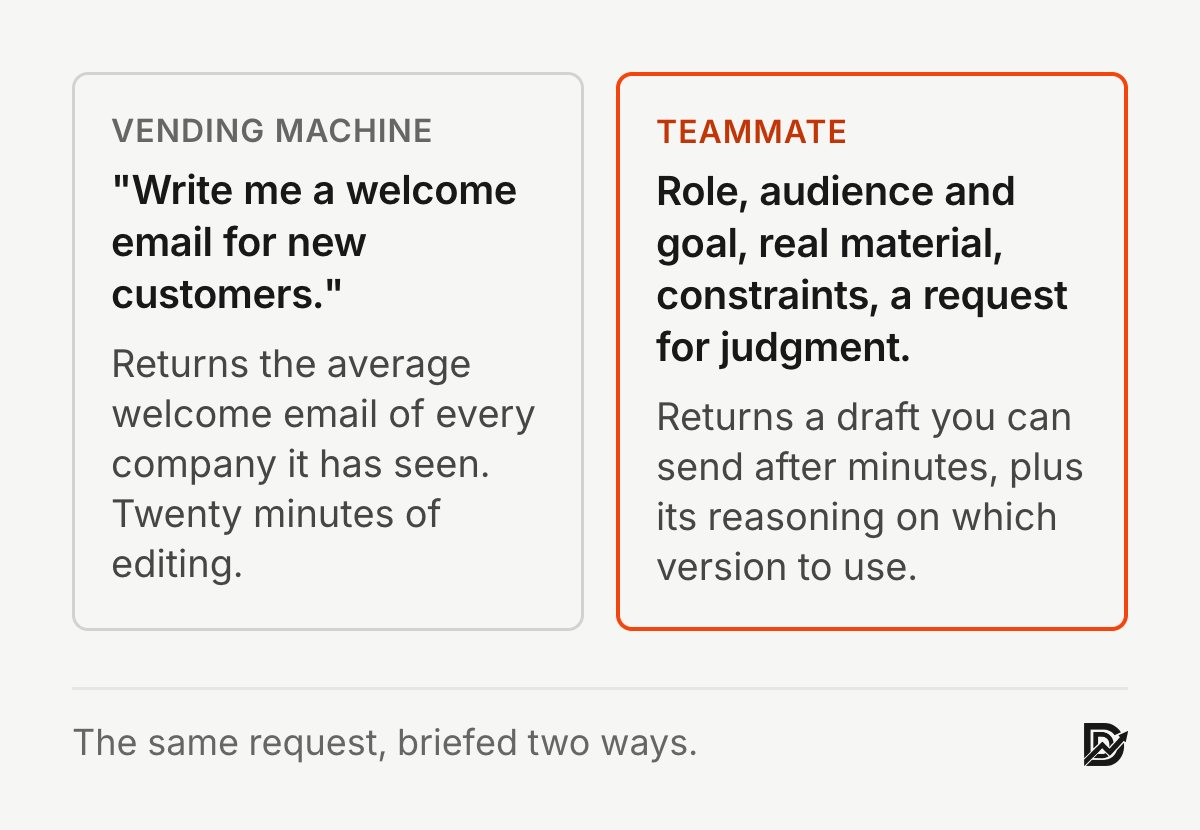
A vending machine request looks like this: "Write me a welcome email for new customers." The tool has no idea who the customers are, what the email is for, what you have already sent, or what good looks like to you. So it returns the average welcome email of every company it has ever seen. Then you spend twenty minutes editing it into something usable, and conclude that AI saves no time.
The problem is not the model. A new hire given that sentence would produce the same generic email, and you would not blame the hire.
The teammate method: brief, do not prompt
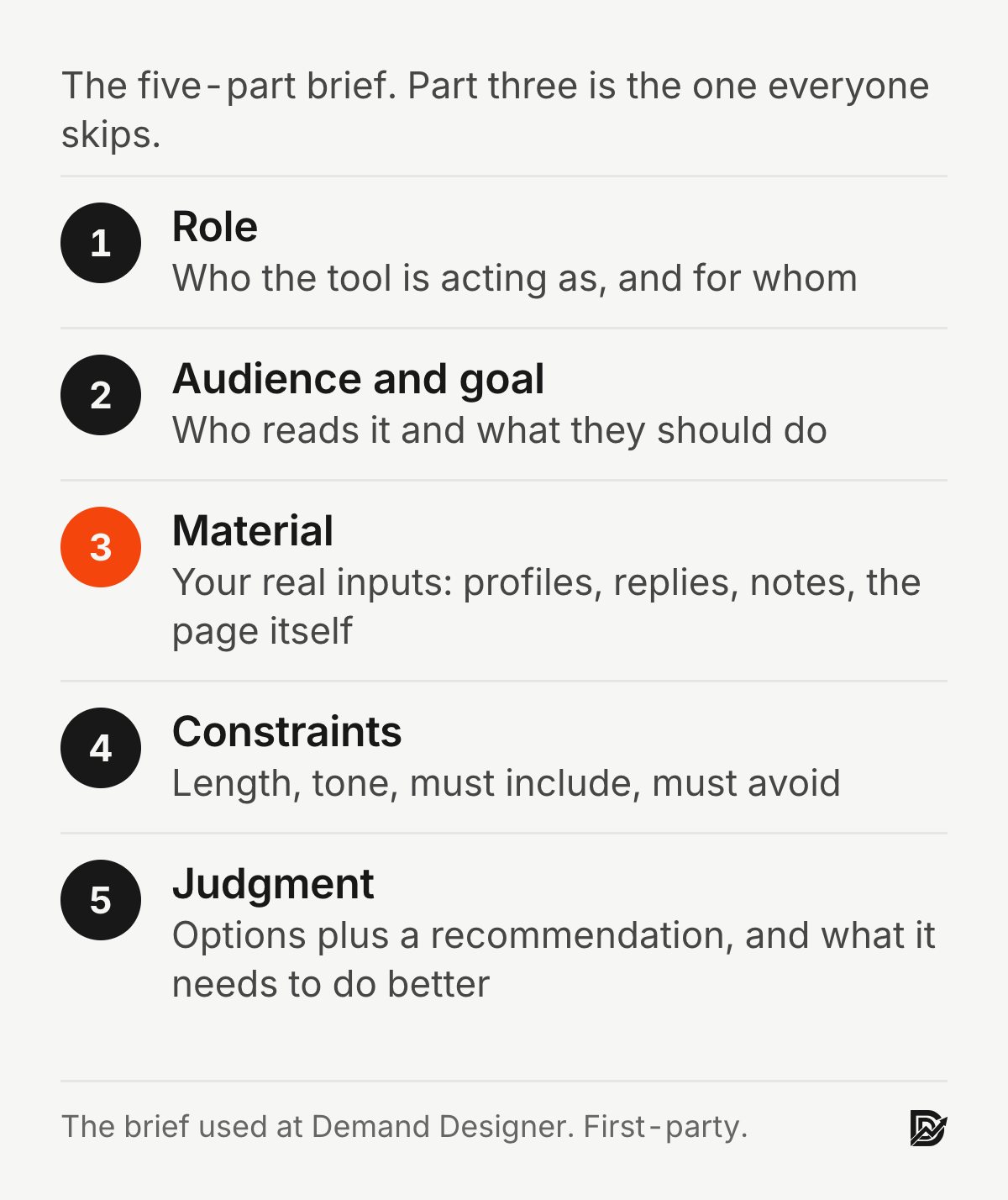
A good brief for a person has five parts. The same five parts work for an AI tool, and they are the difference between an average draft and a draft you can send.
Role. Who the tool is acting as, and for whom. "You are helping me, the owner of a bookkeeping service for US trades businesses."
Audience and goal. Who will read the output and what you want them to do. "Owners of trades businesses with 5 to 30 staff who just switched from a spreadsheet. Goal: get them to upload last month's bank statement within 48 hours."
Material. The real inputs: your customer profile, three real customer replies, the onboarding checklist, last quarter's win-loss notes. Attach them or paste them. This is the part almost everyone skips, and it is the part that makes the output yours.
Constraints. Length, tone, what to avoid, what must be included. "Under 120 words. Plain, direct, no exclamation marks. Mention the secure upload link."
Judgment. Ask for options and a recommendation, not one answer. "Give me two versions and tell me which you would send and why."
Written out, that brief is longer than the vending machine request. It also produces a draft that needs minutes of editing rather than a rewrite, and the tool's reasoning about which version to send is often the most useful part of the reply.
Three examples from marketing work
A landing page review. Vending machine: "Review my landing page." Teammate: paste the page copy, the customer profile, and three objections from recent sales calls, then ask: "Which of these three objections does the page fail to answer, and where on the page would you answer each one?" The output is a ranked list with page locations, which is a work plan rather than an opinion. This is how I run first passes before a B2B conversion rate optimization project.
Content ideas. Vending machine: "Give me ten blog post ideas about marketing." Teammate: paste the 20 questions prospects asked on sales calls this quarter, your three service pages and the five posts that already rank. Then ask: "Which questions do we not answer anywhere yet? For each, give the search phrase a buyer would use and the proof we would need to answer it credibly." The output is a content plan grounded in your own pipeline.
Ad variations. Vending machine: "Write five Facebook ads for my course." Teammate: "Here is the ad that produced a 10.1% landing page conversion for Copy Chief's Escape Velocity campaign, the audience it ran to, and the three pain points from the sales page. Write five variations that keep the structure and change only the opening pain point, then rank them by how directly each pain point maps to the offer." The output is a test plan, and the ranking tells you where to start.
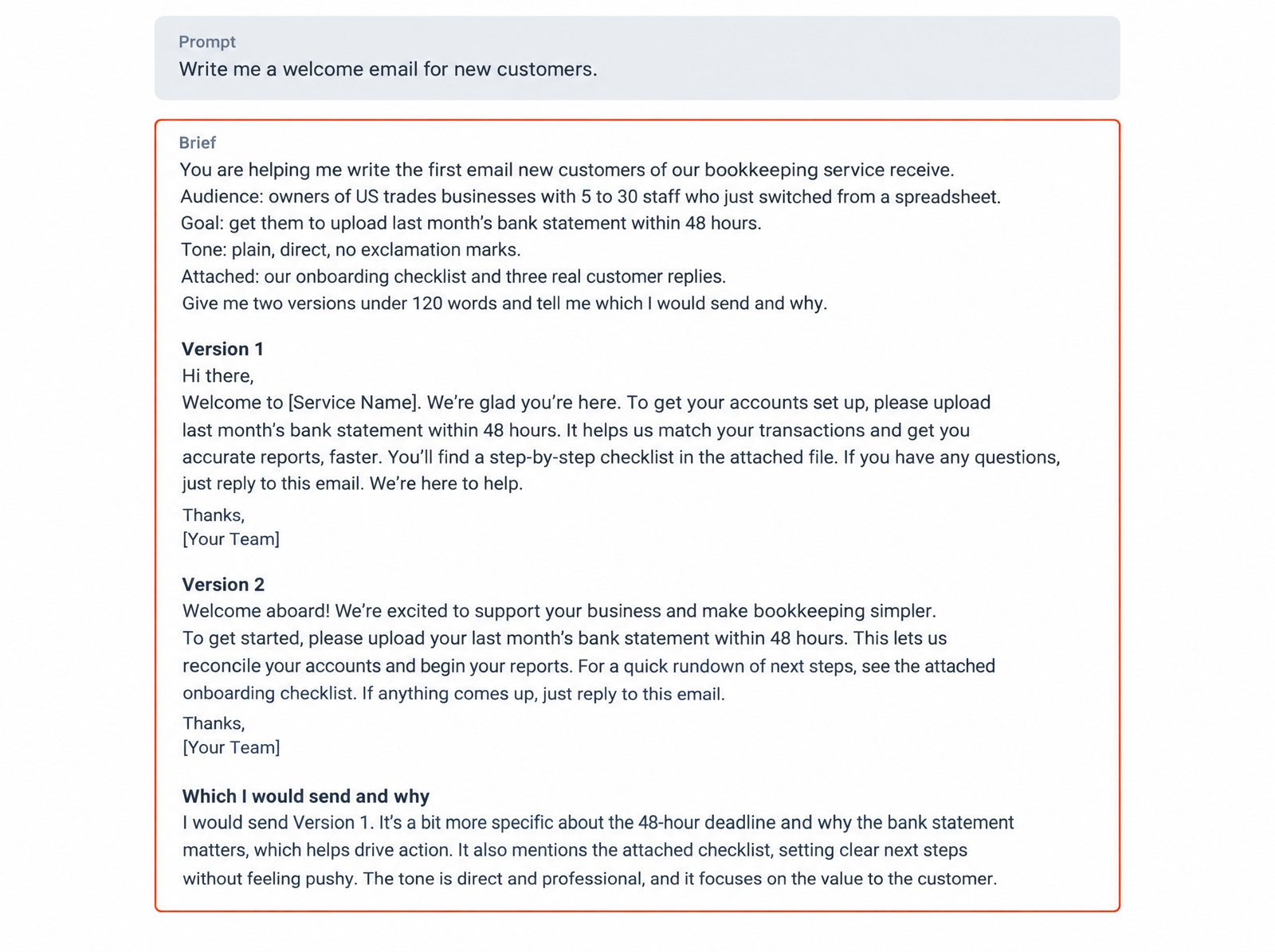
Illustration with example copy: the same request as a prompt and as a brief.
The optimisation trap
The second most common failure is the opposite of the vending machine: rewriting the same prompt for thirty minutes, chasing a perfect single output. If the third attempt is still wrong, the brief is missing something, usually material or a constraint. Stop, add the missing part, and ask the tool what it would need to do better. It will often tell you.
A related trap is using AI to do more of what you already do, faster. More emails, more posts, more variations. The studies above measured speed, and speed is real, but the value in marketing comes from doing the right thing, not from doing the average thing quickly. Use the tool to find what is missing and to think through trade-offs; keep the decisions, and the proof, yours.
Where AI should not be the author
Some work should stay human, not for sentiment but because the output has to be true and specific to you. Case studies, client results, pricing, anything that goes into a proposal, and anything that claims your experience. AI can structure these and tighten them; it cannot supply the facts, and when it tries, it invents them. The same applies to pages that need to sound like a person: AI-generated landing pages do not convert because they average every page like them, and an average page gives a buyer no reason to choose you.
A brief you can copy
Here is the template, ready to fill in:
You are helping me, [role], at [company], which does [what, for whom].
The reader is [audience]. I want them to [action] after reading.
Here is the material: [customer profile, real examples, notes, the page or email in question].
Constraints: [length, tone, must include, must avoid].
Give me [number] options, tell me which you would choose and why, and tell me what you would need to do better.
Save it somewhere you can reach in two seconds. The brief, not the model, is what you will reuse.
Frequently asked questions
What is the difference between a prompt and a brief?
A prompt is a request. A brief is a request plus the context a colleague would need: who the output is for, what it should achieve, the real material to work from, the constraints, and a request for judgment. Briefs take longer to write and far less time to edit.
Does AI actually make marketers more productive?
In controlled studies, yes: writing tasks were completed about 40% faster with quality rising (Noy and Zhang, 2023), and support agents resolved about 14% more issues per hour (Brynjolfsson, Li and Raymond, 2025). The gains were largest for less experienced workers, which is why average output is no longer a competitive advantage.
Which AI tool is best for marketing?
The brief matters more than the tool. Any current assistant that accepts attached files and long context will do well with a five-part brief and poorly without one. Pick the one your team will actually open, and standardise the brief.
Should I let AI write my case studies and proposals?
Let it structure and tighten them, but supply every fact yourself. Results, names, prices and timelines must come from your records. AI tools fill gaps with plausible inventions, and an invented number in a proposal costs more than the time it saved.
How do I stop AI output sounding generic?
Give it your material: real customer language, your own examples, the specific page or email. Add constraints on tone and length, and ask for a recommendation rather than a single answer. Generic output is almost always a sign of a generic brief.
Sources
Peer-reviewed research
Brynjolfsson, E., Li, D. and Raymond, L. (2025). Generative AI at work. The Quarterly Journal of Economics, 140(2). doi:10.1093/qje/qjae044
Noy, S. and Zhang, W. (2023). Experimental evidence on the productivity effects of generative artificial intelligence. Science, 381(6654). doi:10.1126/science.adh2586
First-party data (not peer reviewed)
The Copy Chief Escape Velocity figure is from my own client work.
Free workbook
Pipeline Leak Scorecard
Find the leaks between your traffic and your pipeline. Score your site in about fifteen minutes, with it open in front of you.
12 questions, 8 pages, 15 minutes. Free.


