Paid Ads & Creative
Landing Pages & Funnels
Digital Marketing for Subscription Businesses: What Grows Recurring Revenue

Joshua Jackai
7 min

Digital marketing for a subscription business is different from marketing a one-off product, because the sale is not the finish line. A subscriber who signs up and cancels in month two cost you the full acquisition price and returned a fraction of it. So the marketing that grows recurring revenue starts with the page people sign up on, continues through the first 30 days, and only then turns to buying more traffic. This guide covers each stage in that order, with the numbers to watch. It is for founders and marketing leads at subscription businesses in the US and worldwide, from subscription boxes and memberships to software sold on a monthly plan.

Illustrative photo.
Why retention comes before acquisition
The arithmetic of a subscription is unforgiving. If you pay $60 in ads to win a $30-a-month subscriber, you are in the red until month three, and only in profit after that if the subscriber stays. Research on customer valuation in the Journal of Marketing Research compared the two levers across the companies studied. A one-percentage-point improvement in retention raised the value of the customer base by roughly five times as much as a one-point improvement in acquisition cost (Gupta, Lehmann and Stuart, 2004). Retention compounds; acquisition does not.
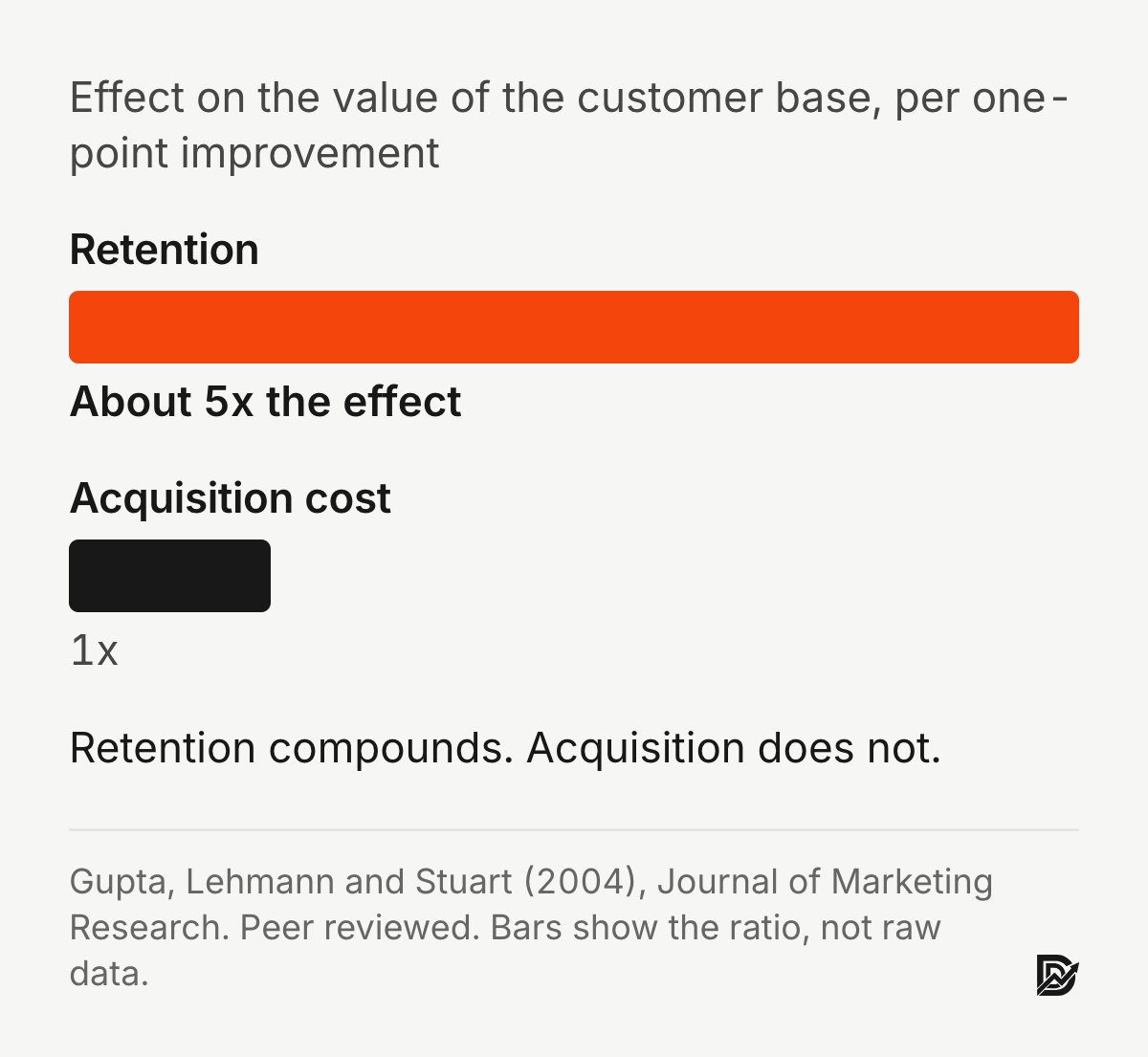
That is why the order below runs from the signup page to the first month to paid traffic. Spending on ads before the first two stages work is the most common way subscription businesses waste money.

Stage 1: A signup page that sets the right expectation
The landing page does two jobs at once. It has to convert visitors into subscribers, and it has to convert the right ones, who understand what they are getting and will still want it in month four.
Say exactly what arrives and when. "Four single-origin coffees, 250 grams each, shipped on the first Tuesday of the month." Vague promises bring vague expectations, and vague expectations churn.
Show the second and third delivery, not only the first. A photo of a typical box, a sample of a past month, a short clip of what members actually do with the product.
Put the price, the cadence and the cancellation terms in plain sight. Hiding "cancel anytime" or the real monthly cost wins a signup and loses a subscriber.
Use proof from existing subscribers, by name where you can, about the experience over time rather than the unboxing.
One button, one plain label: "Start my first box" or "Start a 14-day trial."
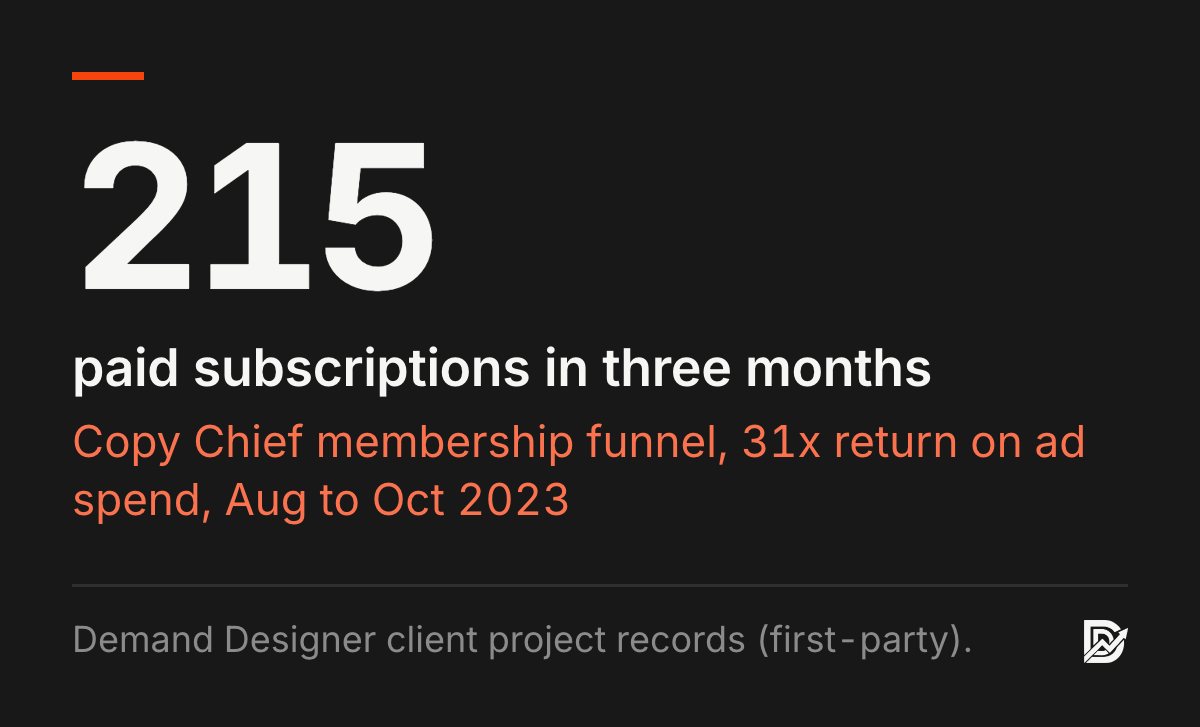
The structure is the same as any good landing page; the anatomy of a B2B landing page walks through the seven sections and applies to consumer subscriptions as well. For a membership funnel I built with Copy Chief, a redesigned ClickFunnels page fed by Meta ads produced 215 paid subscriptions in three months at a 31x return on ad spend. Most of the gain came from the page matching the ad and setting clear expectations, not from the ad budget.
Stage 2: The first 30 days decide most of your churn
Most cancellations happen early, before the subscriber has formed a habit. The first month is where marketing turns into retention work:
A welcome sequence that teaches, not sells. Three to five emails in the first two weeks: what to expect, how to get the most from the first delivery, how to change preferences, who to contact. Plain, direct, no exclamation marks.
A first-delivery moment worth sharing. A handwritten note, a small extra, packaging that opens well. This is where organic social content comes from, because subscribers post it themselves.
One ask for feedback in week three, before the second billing date. A single question: "What would make next month better?" Read every reply.
A payment-failure sequence. A surprising share of "churn" is expired cards. Two polite emails and a one-click update link recover most of it.
Track retention by signup month, so you can see whether a change to onboarding moved the curve for the people who joined after it.
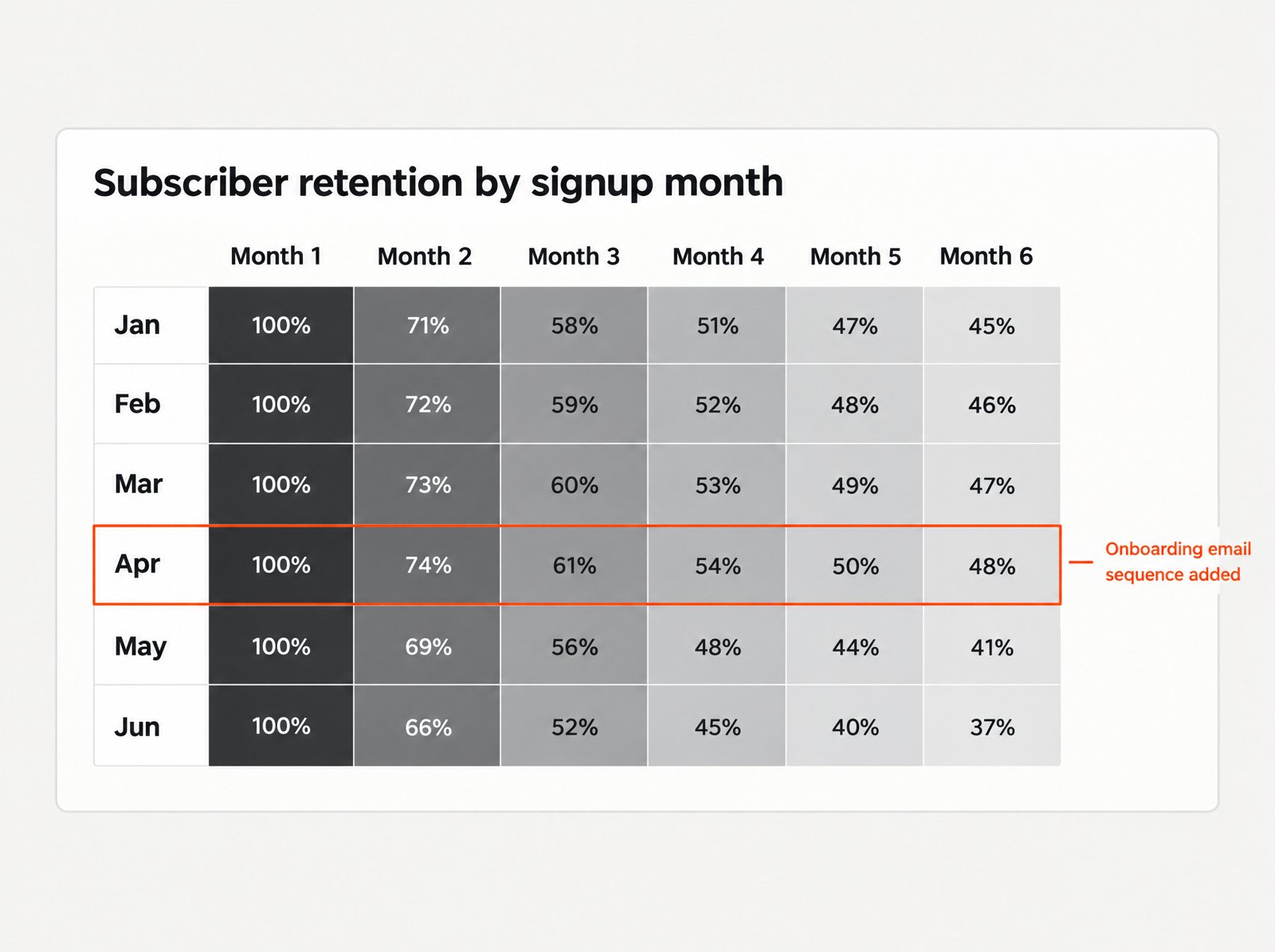
Illustration with example data: retention by signup month shows whether an onboarding change worked.
Stage 3: Paid acquisition that matches the page
Once the page converts and the first month holds, buy traffic. For subscription businesses, Meta and TikTok ads usually lead, because the creative can show the product arriving and being used.
Match the ad to the page. The promise, the price and the visual in the ad should reappear on the landing page. Mismatch is the most common leak in paid subscription funnels.
Lead with the recurring experience, not the discount. A first-month discount wins signups who leave when the price goes up. An ad about what month three looks like wins subscribers.
Judge campaigns on 90-day retained subscribers, not signups. Feed cancellations back to the ad platform where you can, so it optimises for people who stay.
Set a cost-per-subscriber ceiling from your retention numbers, not from what competitors spend. If a subscriber is worth $140 over their average lifetime, a $60 acquisition cost works; $120 does not, however good the signup rate looks.
For deciding when to cut, keep or scale a campaign, the Kill Sheet gives thresholds for five signals and a ten-minute Monday routine. Why AI-generated landing pages do not convert covers the trap of generating a dozen page variations instead of fixing the one that matters.
Stage 4: Organic social and content, built from subscribers
Organic social works for subscription businesses when it shows real subscribers and real deliveries. A study of a retailer's customers in the Journal of Marketing found that people who engaged with the company's own social media content went on to spend more, even after accounting for their other contact with the brand (Kumar et al., 2016). The content that earns that engagement is specific: the process behind the product, a subscriber's own photo, what changed this month and why.
Pick one platform, post three to five times a week, and reuse subscriber content with permission. How to build a social media strategy sets out a plan that one person can keep up, and for short video, seven ways to get more views on Reels covers what to film.
The numbers to watch
A subscription business has a short list of numbers that matter. Review them monthly, in this order:
Monthly recurring revenue and its change month on month.
Retention by signup month, as a table, so you can see whether newer cohorts hold better than older ones.
Cost per new subscriber, by channel.
Subscriber lifetime value, which is average monthly margin divided by monthly churn rate, by channel if you can.
Payment failures recovered, as a share of failed payments.
Everything else, including followers, impressions and signup conversion rate, is a leading indicator for one of these five.

When to bring in outside help
Do the first two stages yourself if you can; they are mostly copy, email and operations. Outside help pays when the landing page needs design and build work, when you are ready to scale paid traffic and need creative produced every week, or when retention is flat and you cannot see why. In each case, ask the provider how they will measure 90-day retained subscribers, not just signups, and walk away from anyone who promises a conversion rate before seeing your numbers. The pricing page shows what each of those pieces costs with me.
Frequently asked questions
What is the most important metric for a subscription business?
Retention by signup month. It tells you whether the product and onboarding hold subscribers, and every other number, including lifetime value and how much you can afford to pay for a subscriber, depends on it.
How do I reduce churn in a subscription business?
Set accurate expectations on the signup page, run a welcome sequence that teaches people how to use what they bought, ask one feedback question before the second billing date, and recover failed payments with a short email sequence. Most early churn comes from mismatched expectations and expired cards, not from the product.
How much should I spend to acquire a subscriber?
Less than the subscriber is worth over their average lifetime, with margin to spare. Work out lifetime value from your own retention and margin, then set a cost-per-subscriber ceiling per channel. Ignore what competitors spend; their retention is not yours.
Which platform is best for marketing a subscription box?
For paid acquisition, Meta and TikTok, because video of the product arriving and being used converts well. For organic, pick the one platform your subscribers already use and post consistently there before adding another.
Should I offer a first-month discount?
Carefully. Discounts win signups who leave when the full price starts. If you use one, make the full price obvious on the page and judge the campaign on subscribers still paying at 90 days, not on signups.
Sources
Peer-reviewed research
Gupta, S., Lehmann, D. R. and Stuart, J. A. (2004). Valuing customers. Journal of Marketing Research, 41(1). doi:10.1509/jmkr.41.1.7.25084
Kumar, A., Bezawada, R., Rishika, R., Janakiraman, R. and Kannan, P. K. (2016). From social to sale: The effects of firm-generated content in social media on customer behavior. Journal of Marketing, 80(1). doi:10.1509/jm.14.0249
First-party data (not peer reviewed)
The Copy Chief membership funnel figures (215 paid subscriptions, 31x return on ad spend, August to October 2023) are from my own client work. Cost and lifetime value examples are illustrative.
Free workbook
Pipeline Leak Scorecard
Find the leaks between your traffic and your pipeline. Score your site in about fifteen minutes, with it open in front of you.
12 questions, 8 pages, 15 minutes. Free.


