Social Media Marketing
Short-Form Video & Reels
How to Grow a Streetwear Clothing Brand on Instagram

Joshua Jackai
6 min

Growing a clothing brand on Instagram comes down to four things: a profile that turns a visit into a follow or a sale, a grid that looks like one label rather than a mood board, a content rhythm built around drops, and customers who post the clothes for you. Followers are not the goal; a following that buys is. This guide covers each part, with the research on why consistency and customer content sell, and a short list of numbers that matter more than the follower count. It is for founders of streetwear and independent clothing brands in the US and worldwide, usually running the account themselves between packing orders.

Illustrative photo.
Why Instagram still works for clothing brands
Clothing is visual, worn in public and tied to identity, which is exactly what Instagram rewards. A study of luxury fashion brands in the Journal of Business Research found that their social media marketing raised brand equity and, through it, customers' preference, loyalty and willingness to pay a premium (Godey et al., 2016). The mechanism applies at any price point: the account builds the brand, and the brand lets you charge what the garment is worth instead of competing on price.
The same study found that entertainment and interaction mattered most. Product photos alone do not do it. The brand's world, and the customers in it, do.
Step 1: Know exactly who buys, and who they follow
"Streetwear fans" is too broad to make content for. Write one paragraph about your actual buyer: age, city, what else they wear, which brands and accounts they already follow, what they do on a Saturday. Then open those accounts. Who comments there, what gets saved, what the comments argue about. That is your audience's taste in their own words, and it is better research than any trend report.
Repeat the exercise for each distinct customer type you have, but build the account for the most valuable one first.
Step 2: Make the profile sell before anyone scrolls
Most profile visits last a few seconds. Four things decide whether they become a follow or a sale:
The bio says what you make and when the next drop is. "Heavyweight basics. 60 pieces per drop. Next drop Friday 6pm." Scarcity that is true works; scarcity that is invented gets found out.
The link goes to the drop or the shop, not a homepage. One tap from the profile to the product.
Highlights show the brand's world: drops, fits, studio, restocks. A new visitor sees the range in ten seconds.
The first nine tiles look like one label. Same backdrop, same light, same colour grade. A grid that looks like one brand reads as a brand that is in control of its details, and customers pay for that.
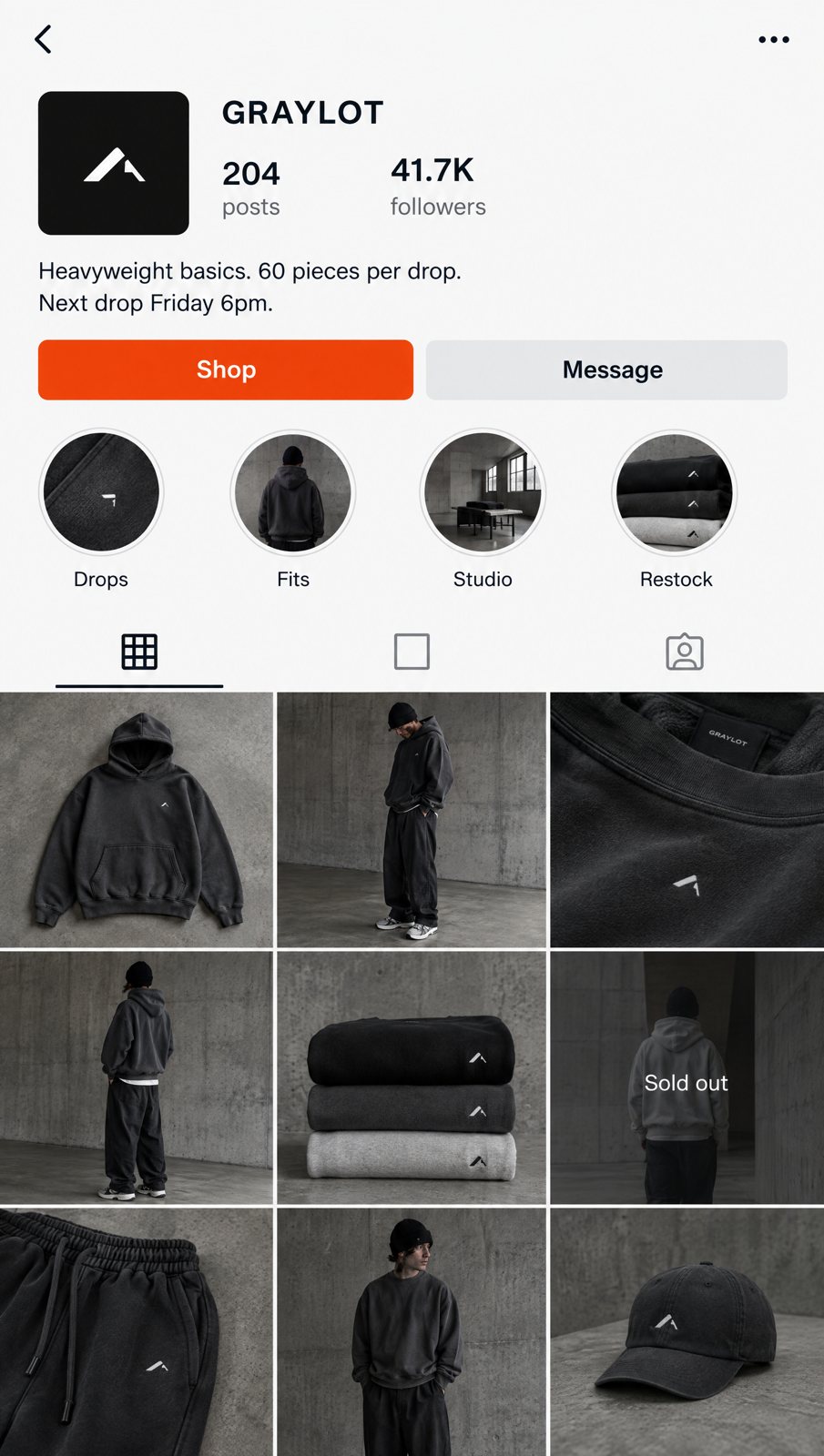
Illustration with example content: a profile that sells before anyone scrolls.

Step 3: Build content around drops, not around posting
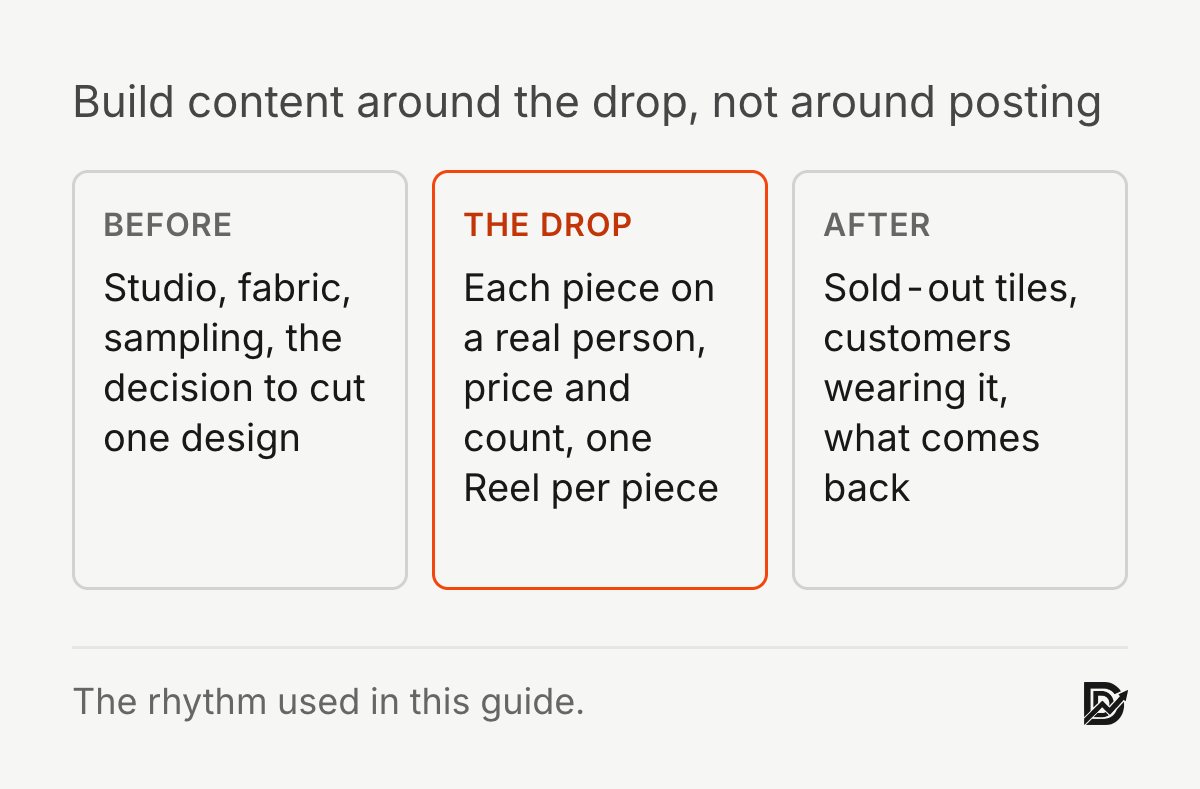
A clothing brand has a natural rhythm that most content calendars ignore: the drop. Each drop is a story with a beginning, a middle and an end, and it fills the calendar without inventing reasons to post.
Before: the studio, the fabric, the sampling, the decision to cut one design. Process content earns saves and comments, and it is the cheapest content you have.
The drop: the pieces, on real people, with the price and the count. One Reel per piece, under 20 seconds, opening on the garment moving.
After: sold-out tiles, customers wearing it, what is coming back and what is not.
Short video carries most of the reach now. Film vertically, cut every pause, open on the garment rather than an intro, and put the price in text on the first frame. Seven ways to get more views on Reels covers the editing, and the 1-to-12 Engine shows how one studio session becomes twelve posts.
Step 4: Turn customers into the content
The most believable photo of your hoodie is one a customer took. Ask every buyer to tag the brand, make it easy with a card in the parcel, and repost with credit and a name. Reply to every tag within a day. A study of a retailer's customers in the Journal of Marketing found that people who engaged with the brand's social content went on to spend more, even after accounting for their other contact with the brand (Kumar et al., 2016). For a clothing brand, the customers who post are also the ones who buy the next drop.
Giveaways can grow the number quickly, but a giveaway audience is there for the free hoodie, and most of it leaves. If you run one, make the prize the product, require a follow and a tag of one friend who would actually wear it, and expect the follower count to fall afterwards. Judge it by sales in the following month, not by the spike.
Step 5: Post what travels, at a pace you can hold
A study of thousands of online videos in the Journal of Marketing found that the information and emotion in the content drove sharing far more than surface features did (Tellis et al., 2019). For a clothing brand, that means the story behind a piece, the honest numbers (how many made, how many left), and the customer in it, rather than another flat lay.
Three posts and three Reels a week, batched from one studio session, is enough. Consistency across months matters more than volume in any one week, because a grid that goes quiet looks like a brand that has stopped.
The numbers that matter more than followers
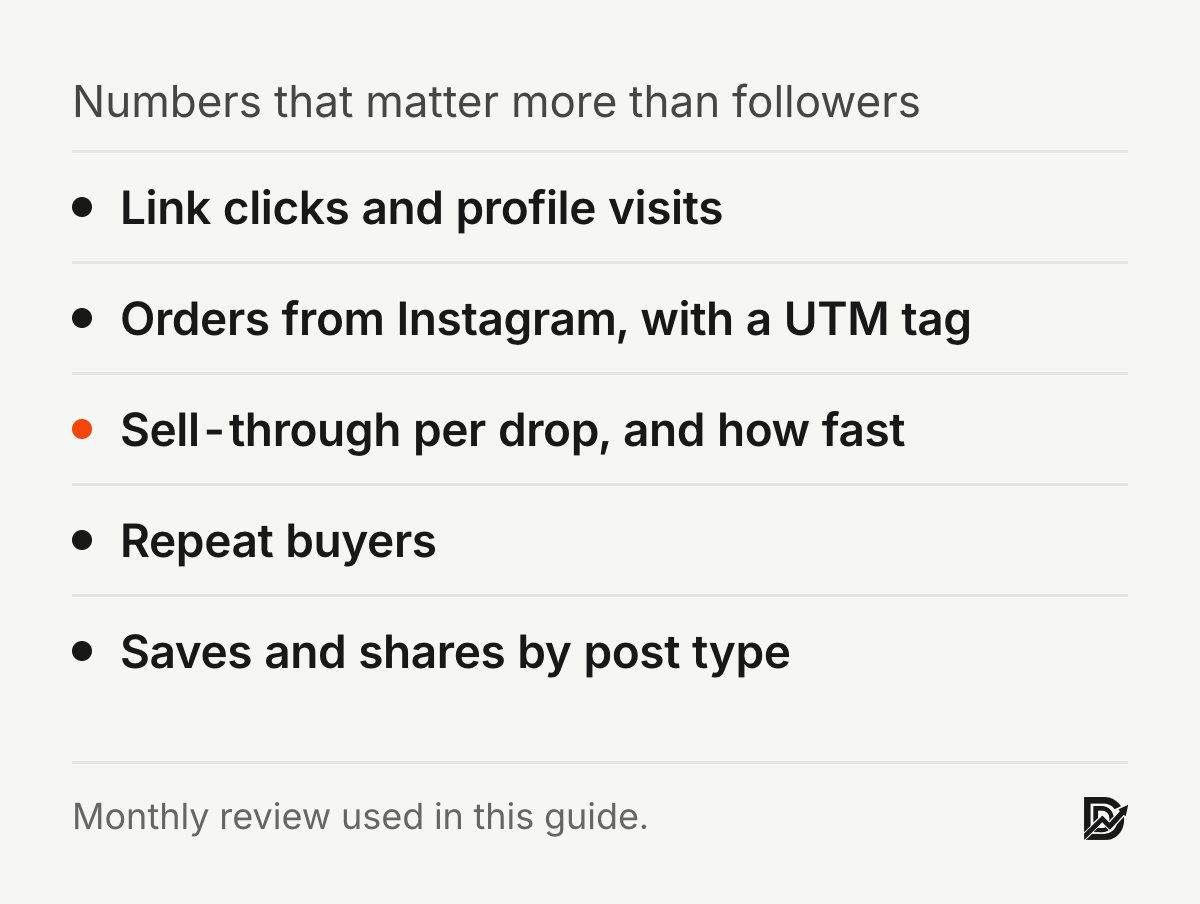
Followers are a vanity metric until they buy. Once a month, look at:
Link clicks and profile visits, from Instagram insights.
Orders from Instagram, with a UTM tag on the bio link so your shop analytics can see them.
Sell-through per drop, and how fast.
Repeat buyers, which tell you whether the brand has a community or an audience.
Saves and shares by post type, to see which content sells rather than which gets likes.
Then make more of what sold. How to market your brand on social media sets this up as a one-page plan, and how to measure social media ROI explains how to count the time you spend against the orders it brings.
Frequently asked questions
How do I grow a clothing brand on Instagram without paying for ads?
Build a profile that converts visits, keep the grid consistent, post around drops with short video, and get customers to post the clothes with credit. Organic growth is slower than paid but produces followers who buy. Add ads only once the organic content shows which posts sell.
How often should a clothing brand post on Instagram?
Three posts and three Reels a week is sustainable for one person if filming is batched. Consistency over months matters more than a burst of daily posts followed by silence.
Do giveaways work for clothing brands?
They grow the follower number quickly and most of that audience leaves. If you run one, make the prize the product, ask for a tag of a friend who would wear it, and judge it by sales the following month rather than the follower spike.
What should a clothing brand post on Instagram?
The process behind each piece, the drop itself on real people with price and count, customers wearing the clothes with credit, and what sold out. Short video of the garment moving outperforms flat lays.
How many followers does a clothing brand need to make sales?
Fewer than most founders think. A few thousand followers who match the buyer and trust the brand will sell out a small drop; a hundred thousand from giveaways will not. Measure orders and sell-through, not the count.
Sources
Peer-reviewed research
Godey, B., Manthiou, A., Pederzoli, D., Rokka, J., Aiello, G., Donvito, R. and Singh, R. (2016). Social media marketing efforts of luxury brands: Influence on brand equity and consumer behavior. Journal of Business Research, 69(12). doi:10.1016/j.jbusres.2016.04.181
Kumar, A., Bezawada, R., Rishika, R., Janakiraman, R. and Kannan, P. K. (2016). From social to sale: The effects of firm-generated content in social media on customer behavior. Journal of Marketing, 80(1). doi:10.1509/jm.14.0249
Tellis, G. J., MacInnis, D. J., Tirunillai, S. and Zhang, Y. (2019). What drives virality (sharing) of online digital content? The critical role of information, emotion, and brand prominence. Journal of Marketing, 83(4). doi:10.1177/0022242919841034
Free workbook
The 1-to-12 Engine
Turn one recording into twelve short videos that are still being found months later.
Five steps, five fill-in prompts, a workbook for each. Free.