Web Design
9 Website Redesign RFP Example Sections: Full 2026 Guide

Joshua Jackai
18 min

By Joshua Jackai, founder of Demand Designer · Published 13 October 2026 · Last updated and fact-checked October 2026
Short answer: A website redesign RFP needs nine sections: background and goals, the current site, scope, SEO and technical rules, content, budget, timeline, submission rules and scoring. Write the budget as a range. Google says to keep old-URL redirects as long as possible, generally at least 1 year, so put the redirect map in scope.
A website redesign RFP (request for proposal) is the document a company sends to shortlisted agencies so each one can price and plan the same project. I am Joshua Jackai, founder of Demand Designer, a US studio that designs and builds B2B websites on HubSpot, Framer and WordPress. I read RFPs from the vendor side, so this guide shows what helps an agency give you a real price.
Key takeaways
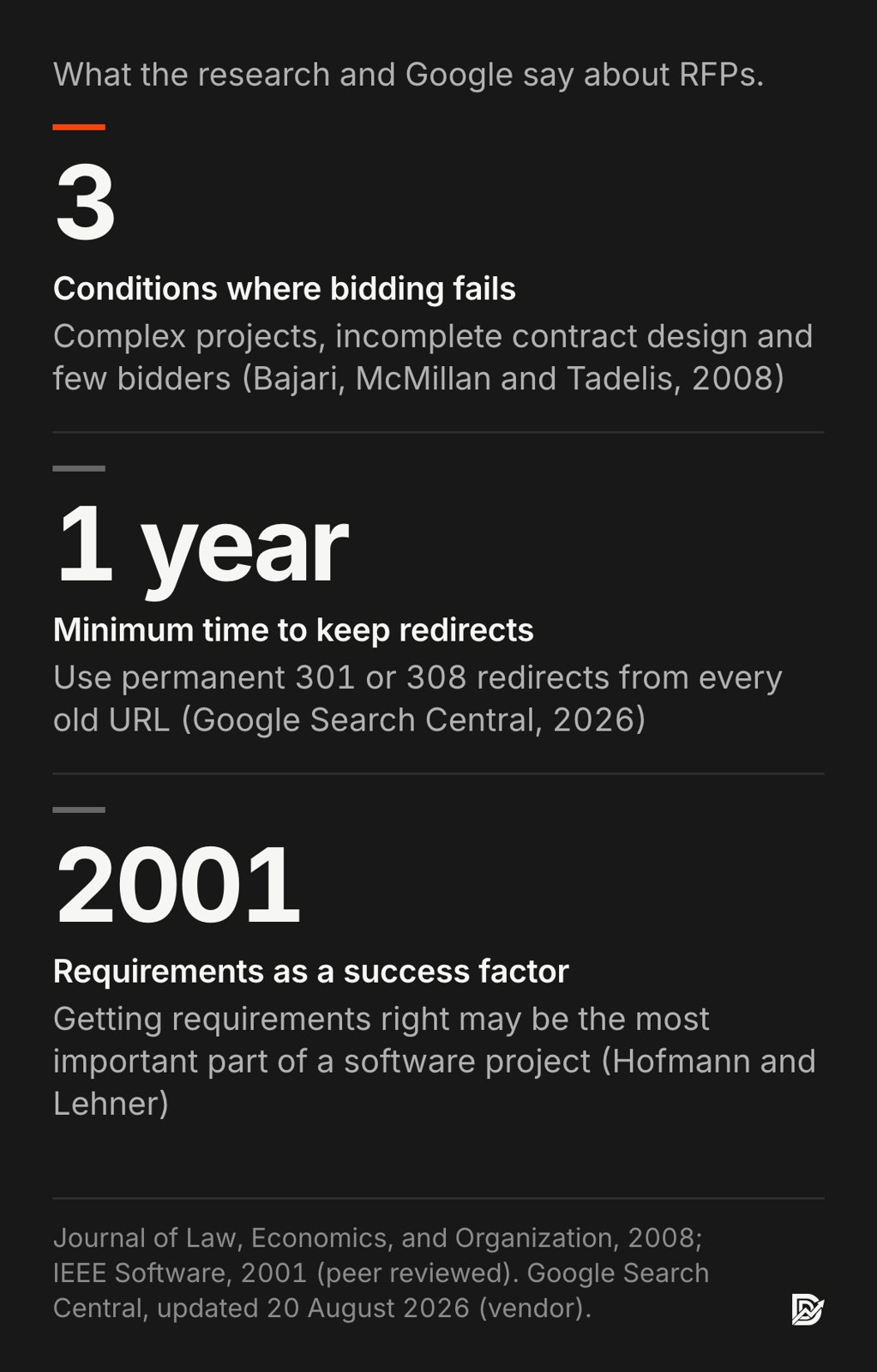
Hofmann and Lehner called getting requirements right possibly the most important part of a software project (IEEE Software, 2001), and the scope section is where an RFP sets them.
Bajari, McMillan and Tadelis studied private building contracts in Northern California from 1995 to 2000 and found bidding works worst on complex, loosely specified jobs (Journal of Law, Economics, and Organization, 2008).
Google recommends 301 or 308 redirects and keeping them as long as possible, generally at least 1 year (Google Search Central, updated 20 August 2026).
My own fixed-price builds run from $3,250 to $14,999, so a stated range saves both sides a wasted call.
Set scoring weights before proposals arrive: Ho, Xu and Dey reviewed supplier selection research published from 2000 to 2008 and mapped the multi-criteria scoring methods buyers use (European Journal of Operational Research, 2010).
Section | Who writes it | What the agency needs from it |
|---|---|---|
1. Background and goals | Head of marketing | The business outcome and how you will measure it |
2. Current site and audience | Marketing ops | Traffic, top pages, platform, who visits |
3. Scope and deliverables | Marketing with sales | Page list, templates, integrations |
4. SEO and technical rules | SEO lead or IT | Redirect map, hosting, security |
5. Content and migration | Content owner | Who writes, how many pages move |
6. Budget and pricing format | Finance and marketing | A range and a price format |
7. Timeline and milestones | Project owner | Launch date and review rounds |
8. Proposal and submission rules | Procurement or marketing | Deadline, format, questions window |
9. Evaluation and scoring | Selection panel | Weighted criteria before proposals arrive |
What does a website redesign RFP example look like?
A website redesign RFP example is a two to four page document with nine short sections. The condensed version here is for Northline Advisors, a fictional 40-person wealth management firm in Denver that I use as the worked example in every section of this guide. Copy it, then replace each number with your own.
Northline Advisors: website redesign RFP (example). Goal: raise consultation requests from the site from 9 to 20 a month by September 2027. Current site: WordPress, 212 indexed URLs, 6,400 sessions a month. Scope: 7 page templates, 30 pages, HubSpot forms with lead source captured, GA4 setup, two hours of training. SEO: a redirect map for every indexed URL, 301 or 308 status. Content: Northline writes the homepage and service pages; 160 blog posts move as they are. Budget: $8,000 to $15,000, fixed price preferred. Launch: 15 March 2027. Proposals: one PDF of up to 12 pages by 5 pm Mountain Time on Friday 13 November 2026. Scoring: experience 30 percent, approach 30 percent, price 25 percent, team 15 percent.
1. Background and goals: best for getting proposals aimed at revenue, not looks
This section tells agencies who you are, why the site is being redesigned now and how you will judge success. It suits every RFP. Write three measurable goals, each with a number and a deadline, because an agency cannot price a goal it cannot measure. Hofmann and Lehner's 2001 IEEE Software paper links requirements practice to project success.
Length: Half a page
Must include: Company size, market, buyers, the reason for the redesign
Goals: Three, each with a metric, a baseline and a target date
Avoid: "Modern and professional" as a goal
Most RFPs I receive describe the company well and the goal badly. "Refresh our brand online" gives me nothing to price against. "Raise demo requests from organic visits from 18 to 30 a month by June 2027" tells me which pages matter, which forms need work and what the analytics setup must track.
Example wording: Northline Advisors (a fictional 40-person wealth management firm in Denver, used here only as an example) serves business owners preparing to sell. Our site was built in 2019 on WordPress. We are redesigning because our services changed and our site no longer explains them. Goal 1: raise consultation requests from the site from 9 to 20 a month by September 2027. Goal 2: cut the bounce rate on the three service pages from 68 percent to under 50 percent by September 2027. Goal 3: by launch, two marketing editors can publish a page without a developer.
The third goal is a platform goal, not a design goal, and it changes which CMS an agency will propose. Say it here so every proposal answers it. Hofmann and Lehner's 2001 study in IEEE Software treats the requirements process as a success factor in its own right (IEEE Software, 2001), and goals are the first requirement an agency reads.
"Most RFPs I receive describe the company well and the goal badly," wrote Joshua Jackai, founder of Demand Designer.
2. Current site and audience: best for agencies pricing the real starting point
This section shows the agency what exists today: platform, traffic, page count, top pages and who visits. It suits any site with history worth keeping. A ten-line analytics snapshot lets every agency price from the same facts instead of guessing, and Google's site-move guidance starts from a full list of existing URLs.
Platform: CMS, hosting, plugins or apps in use
Size: Number of indexed pages and blog posts
Traffic: Monthly sessions and the top 10 landing pages
Audience: Two or three buyer types in plain words
Known problems: What visitors and staff complain about
An agency that cannot see your numbers will price for risk. I add time to any quote where I do not know how many pages exist, because a 40-page site and a 400-page site are different projects even when the homepage looks the same.
Example wording: We run WordPress 6 on managed hosting with 14 active plugins. Search Console shows 212 indexed URLs, 160 of them blog posts. We average 6,400 sessions a month; the top 10 landing pages are listed in Appendix A. Our buyers are owners of companies with 20 to 200 staff, their CFOs and their attorneys.
Google's guidance for a move starts with the same step: "It's important to map your old site's URLs to the URLs for the new site" (Google Search Central). Giving agencies the URL list in the RFP means that mapping is priced in from day one instead of discovered after launch. The same guide, updated on 20 August 2026, recommends 301 or 308 status codes for those permanent redirects (Google Search Central, 2026).
3. Scope and deliverables: best for comparing proposals line by line
Scope lists exactly what the agency will deliver: page templates, page count, integrations, forms and training. It suits every RFP and decides whether proposals are comparable. Scope is where an RFP writes down its requirements, and a 30-page site with 7 templates is a very different job from a 300-page site with 20.
Templates: Homepage, service, case study, blog, landing page, contact
Integrations: CRM, marketing automation, scheduling, analytics
Forms: How many, which fields, where submissions go
Out of scope: Name it so nobody prices it
Ownership and handover: You own the code, content and accounts at launch; state the warranty period and support terms
"Getting requirements right might be the single most important and difficult part of a software project," wrote Hubert Hofmann and Franz Lehner (IEEE Software, 2001).
A website build is not identical to the software projects they studied, but the logic carries over. When scope is vague, each agency fills the gaps differently, and you end up comparing a $6,000 proposal for twelve templates with a $40,000 proposal for a custom design system. Neither is wrong; they are answers to different questions.
Example wording: Deliverables: 7 page templates (home, service, industry, case study, blog post, landing page, contact); 30 pages built; HubSpot CRM form integration with lead source captured on every form; GA4 and Google Tag Manager setup; two hours of CMS training recorded for staff. Out of scope: copywriting for the blog archive, photography, paid media.
List out-of-scope items. They stop an agency from padding the price for work you never wanted, and they stop scope creep after signing, since both sides can point to the line. If you are unsure whether something belongs in scope, list it as an optional line item and ask for a separate price.
4. SEO and technical rules: best for keeping the traffic you already earned
This section sets the rules that protect rankings and meet IT standards: redirects, URL structure, hosting, security and accessibility. It suits any site with organic traffic. Google recommends permanent 301 or 308 redirects from every old URL and keeping them for at least 1 year, so the RFP should make the redirect map a named deliverable.
Redirects: One-to-one map from every old URL, 301 or 308 status
Accessibility: WCAG 2.2 AA as the target
Speed: A load-time target for phones
Hosting and security: SSL, backups, who owns the accounts
Analytics: Tracking carried over and tested before launch
"Keep the redirects for as long as possible, generally at least 1 year," wrote Google's Search Central team in its site-move guide (Google Search Central).
How do you redesign a website without losing SEO? Keep ranking URLs unchanged where possible, redirect every old URL to its closest new page with a 301 or 308, carry over titles and headings on ranking pages, and test analytics before launch. I put all three in my own launch checklist because a redesign that drops organic leads for three months costs more than the redesign.
Example wording: The agency will deliver a redirect map covering all 212 indexed URLs before launch. It will keep URLs for the 40 pages with organic traffic unchanged where possible, carry over title tags and meta descriptions for those pages, meet WCAG 2.2 AA, and confirm in a staging review that every form fires a GA4 conversion.
State who owns the domain, hosting and analytics accounts after launch. The answer should be you. Ask each agency to name who checks the redirects in the first 30 days after launch, since Google's 2026 guidance treats the move as something to monitor, not a single event (Google Search Central, 2026).
5. Content and migration: best for avoiding a launch delayed by copy
This section says who writes new copy, who moves old pages and how many pages are involved. It suits every redesign, since content is where most launch dates slip in my projects. Name an owner and a page count, and price writing separately. Bajari and Tadelis's 2001 model treats every change after signing as a cost.
Writer: In-house, agency or a mix
Migration: Pages moved as is, rewritten or retired
Assets: Photos, video, logos and brand guide supplied by you
Approvals: Who signs off copy and how fast
I see this pattern often: the design is approved in week four, then the build waits on copy until week ten. An RFP that says "client will supply all copy" without a date is the most common cause of a late launch in my work.
Example wording: Northline will write copy for the homepage and three service pages; the agency will edit it for the web and write the industry pages. 160 blog posts move as they are; 22 old pages retire with redirects. Our COO approves copy within five business days of each draft.
If you want the agency to write, say how many pages and how long they should be. A quote for "website copy" without a count is a guess. Bajari and Tadelis's 2001 model predicts that changes after signing carry renegotiation costs (RAND Journal of Economics, 2001), and unplanned copy work is the change I see most.
"An RFP that says 'client will supply all copy' without a date is the most common cause of a late launch in my work," wrote Joshua Jackai, founder of Demand Designer.
6. Budget and pricing format: best for getting proposals you can afford
This section states your budget range and the pricing format you want, fixed price or time and materials. It suits every RFP. A range does not weaken your position; it removes agencies that cannot work within it. My own fixed-price builds run $3,250, $4,850, $6,950, $9,750 and $14,999, and buyers who state a range get a fitted proposal.
Range: A low and a high number
Format: Fixed price, time and materials, or a phased mix
Payment terms: Deposit, milestones, final payment
Ongoing costs: Hosting, licences and support priced separately
Bajari and Tadelis modelled the choice between fixed-price and cost-plus contracts (RAND Journal of Economics, 2001). Their 2001 model predicts that fixed price gives the seller a strong reason to control cost, but every change after signing has to be renegotiated, and those changes cost more on complex jobs. The model fits a pattern I see in practice: fixed price works when scope is tight, and loose scope pushes both sides toward cost-plus or time-and-materials billing.
Example wording: Our budget for design and build is $8,000 to $15,000. We prefer a fixed price for the scope in Section 3, with optional items priced separately. Please list hosting, licences and monthly support as separate annual costs, and price the 3 optional items in Appendix B one by one (my price table shows how I list them).
Across my own table, the top build costs about four and a half times the entry build, so the range in this section does most of the sorting before any sales call happens.
7. Timeline and milestones: best for a launch date you can plan around
The timeline gives the target launch date, the milestones before it and how long you need to review each one. It suits every RFP. How long does a redesign take? In my projects a 30-page B2B site takes 6 to 12 weeks, and Snappy Kraken went from Figma to HubSpot in 21 days on a smaller scope.
Launch date: Fixed or flexible, and why
Milestones: Discovery, design, build, content load, QA, launch
Review time: Business days per round
Blackout dates: Holidays and busy seasons
Ask agencies to propose their own schedule against your date rather than dictating every phase. My website redesign timeline guide breaks the 6 to 12 weeks into phases. Their schedule shows whether they understood the scope. A proposal that promises a 60-page site in three weeks either misread the RFP or plans to cut corners.
Example wording: We want to launch by 15 March 2027, before our spring client event. Please propose milestones for discovery, design, build, content, QA and launch. We can review each milestone within five business days. Our office is closed 21 December to 2 January. The agency will hand over a staging link at least 10 business days before launch for our own testing.
Review time is the line buyers forget. Two rounds of design feedback with a committee of six can add a month, and the RFP should say how many rounds the price includes. A review schedule is where your own team's time gets a date, and it is the part of the timeline only you control.
"A proposal that promises a 60-page site in three weeks either misread the RFP or plans to cut corners," wrote Joshua Jackai, founder of Demand Designer.
8. Proposal and submission rules: best for proposals that arrive in a comparable shape
This section tells agencies when, where and how to respond: deadline, format, page limit, a questions window and the decision date. It suits any RFP sent to more than one agency. Bajari, McMillan and Tadelis found in 2008 that strict bidding can cut buyers off from the seller's expertise, which is why I add a questions window.
Deadline: Date, time and time zone
Format: PDF, page limit, required sections in order
Questions: A window and a promise to share answers with all bidders
Decision date: When you will tell everyone the outcome
Contact: One named person
"Auctions may stifle communication between buyers and sellers, preventing the buyer from utilizing the contractor's expertise when designing the project," wrote Patrick Bajari, Robert McMillan and Steven Tadelis (Journal of Law, Economics, and Organization, 2008).
A questions window fixes most of that. Agencies ask the questions that change price, you answer once, and everyone prices from the same facts. Ask for two or three case studies with numbers, a named project lead and a sample timeline. Skip the request for free design mockups; I decline them myself, because without discovery a mockup is a guess. Ask instead how they would run discovery in the first two weeks, which tells you more about how they think. Bajari, McMillan and Tadelis studied building contracts, not websites (Journal of Law, Economics, and Organization, 2008), but their point that open bidding blocks the contractor's input is why I suggest a short discovery call before the deadline. A shortlist of three to five agencies is not an auction, and it should not feel like one.
Example wording: Send proposals as one PDF of no more than 12 pages to Dana Ruiz (marketing director) by 5 pm Mountain Time on Friday 13 November 2026. Questions close 4 November; we will send all answers to every bidder on 6 November. We will choose a partner by 1 December and tell every bidder the result.
9. Evaluation and scoring: best for a decision the whole team can defend
This section lists the criteria you will score proposals on and the weight of each, decided before proposals arrive. It suits any selection panel of two or more people. Ho, Xu and Dey's 2010 review of supplier selection research covers studies from 2000 to 2008, and weighted multi-criteria scoring is a standard approach in that work.
Criteria: Four to six, written before you read a proposal
Weights: Percentages that add up to 100
Scale: 1 to 5 per criterion, with what a 5 looks like
Panel: Each member scores alone, then you compare
Publish the weights in the RFP. Agencies then put effort where you care most, and your panel cannot drift toward the best-looking deck. I see four criteria in most strong RFPs: relevant experience, approach to your goals, price against value, and team fit.
Example wording: Proposals will be scored on relevant B2B experience (30 percent), approach to the goals in Section 1 (30 percent), price and value (25 percent) and team and communication (15 percent). Each criterion is scored 1 to 5 by each of three panel members; we will interview the top two.
A score is a guide, not a verdict. If the top two are within a few points, the interview decides. Ho, Xu and Dey's review covers methods such as the analytic hierarchy process and weighted scoring (European Journal of Operational Research, 2010); their review is about supplier selection in general, not agencies, so I borrow only the weighted-scoring idea, and for a website a simple weighted sum is enough. Keep the score sheets, since they explain the choice to anyone who asks later.
"Publish the weights in the RFP," wrote Joshua Jackai, founder of Demand Designer.
How do the nine RFP sections compare by effort and impact?
The nine sections differ in how long they take to write and how much they move the price. Scope, budget and the redirect rules change quotes the most, so spend your drafting time there. Background and scoring take about an hour each and submission rules about 30 minutes in my experience.
Section | Time to write (my estimate) | Moves the price | Skip at your risk |
|---|---|---|---|
Background and goals | 1 hour | Medium | Proposals aim at looks |
Current site | 1 to 2 hours | Medium | Agencies price for unknowns |
Scope | Half a day | High | Proposals cannot be compared |
SEO and technical | 2 hours | High | Rankings drop after launch |
Content and migration | 2 hours | High | Launch waits on copy |
Budget | 30 minutes | High | Wrong-size proposals |
Timeline | 1 hour | Medium | Missed launch event |
Submission rules | 30 minutes | Low | Proposals in ten formats |
Scoring | 1 hour | Low | A decision nobody can defend |
What are the 7 steps in an RFP process?
An RFP process runs in seven steps: define goals, gather the site facts, write the RFP, shortlist three to five agencies, answer questions, score proposals and interview the top two before signing. Teams I have worked with usually finish in six to eight weeks.
Agree on the goals and budget inside your team.
Pull the site facts: platform, URL count, traffic and top pages.
Write the RFP using the nine sections.
Send it to three to five agencies you have already checked.
Run a questions window and share every answer with every bidder.
Score proposals against the published weights.
Interview the top two, check references and sign.
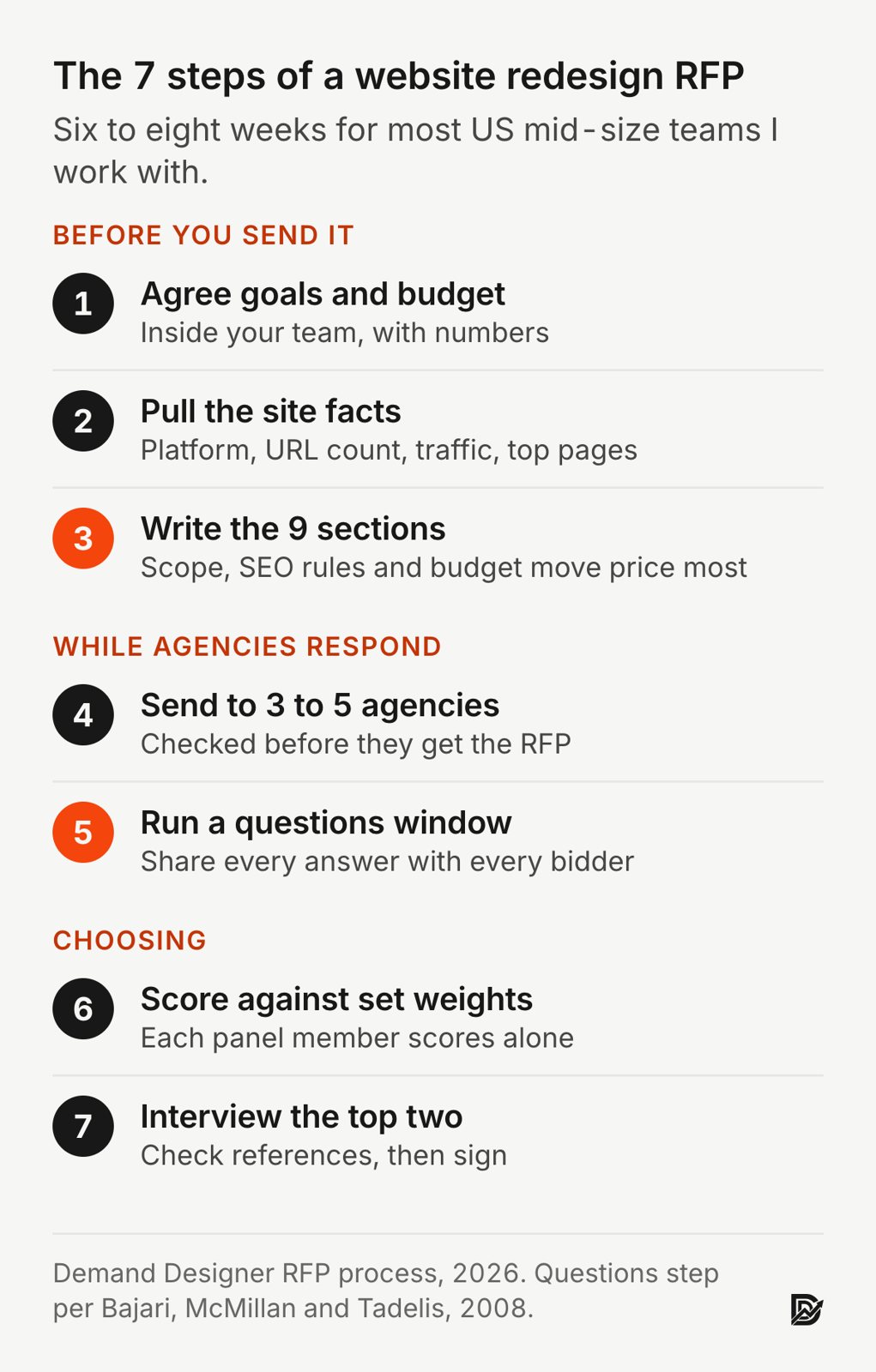
The questions step comes from Bajari, McMillan and Tadelis's 2008 finding that auctions can cut buyers off from contractor expertise (Journal of Law, Economics, and Organization, 2008).
Sending an RFP to twenty agencies feels thorough but buries your panel in reading. Three to five well-chosen agencies give you enough contrast to compare. Bajari, McMillan and Tadelis's 2008 analysis of contracts from 1995 to 2000 also notes that the number of available bidders shapes whether open bidding works (Journal of Law, Economics, and Organization, 2008).
How should you score website redesign proposals?
Score each proposal from 1 to 5 on each criterion, multiply by the criterion's weight and add the results for a total out of 5. Have each panel member score alone first. The worked example uses the four weights from Section 9 (30, 30, 25 and 15 percent).
Here is a worked example with three proposals. Agency A scores 5, 4, 3 and 4: weighted total 4.05. Agency B scores 4, 5, 4 and 4: weighted total 4.30. Agency C scores 3, 3, 5 and 3: weighted total 3.50. Agency C is cheapest, yet it finishes last because experience and approach carry 60 percent of the weight. That is the point of setting weights before you open a single proposal.
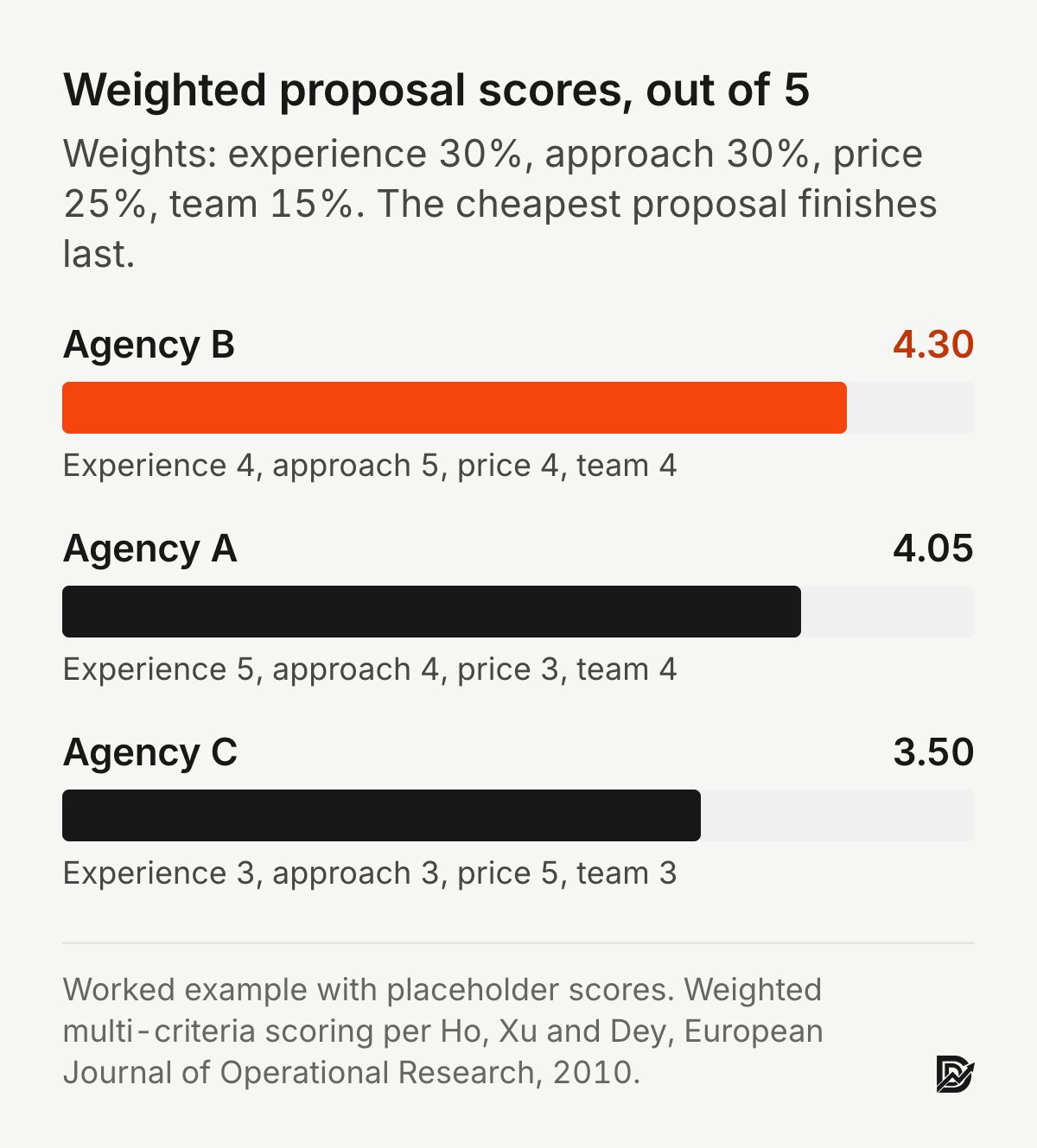
Criterion | Weight | Agency A | Agency B | Agency C |
|---|---|---|---|---|
B2B experience | 30% | 5 | 4 | 3 |
Approach to goals | 30% | 4 | 5 | 3 |
Price and value | 25% | 3 | 4 | 5 |
Team and communication | 15% | 4 | 4 | 3 |
Weighted total | 100% | 4.05 | 4.30 | 3.50 |
Are RFPs a waste of time?
RFPs waste time when they are long, vague and sent to twenty agencies. They pay off when they are short, specific and sent to a few qualified firms. Bajari, McMillan and Tadelis's 2008 study of building contracts found competitive bidding performs worst on complex, loosely defined projects, which describes a vague redesign brief.
"Auctions may perform poorly when projects are complex, contractual design is incomplete, and there are few available bidders," the same authors wrote (Journal of Law, Economics, and Organization, 2008).
Their data came from private building contracts in Northern California from 1995 to 2000 (Journal of Law, Economics, and Organization, 2008), not websites, so I read it as direction rather than proof. It matches what I see: when an RFP leaves the design open, agencies price wildly different projects. A shorter RFP with tight scope, followed by a paid discovery phase with the winner, often beats a 40-page document.
What is the difference between an RFP, an RFQ and an RFI?
An RFI (request for information) asks agencies who they are and how they work. An RFQ (request for quotation) asks for a price on work you have fully defined. An RFP asks for an approach and a price on a defined goal. For a website redesign, use an RFP, because the approach matters as much as the price.
In my experience, public bodies often run all three in sequence: an RFI to build the list, an RFP to choose the partner, and RFQs later for small fixed add-ons. A private B2B company rarely needs more than the RFP.
"A private B2B company rarely needs more than the RFP," wrote Joshua Jackai, founder of Demand Designer.
How much does a website redesign cost in 2026?
Demand Designer's fixed-price builds run from $3,250 to $14,999 (my price table, October 2026); other agencies price differently, and custom enterprise builds sit outside that range. Your RFP range should sit inside the price band of the agencies you invite. Cost moves with page count, templates, integrations and who writes the content.
A 2001 model by Bajari and Tadelis (RAND Journal of Economics, 2001) explains why loose scope pushes quotes up: every unknown becomes a future change the seller has to price.
The full breakdown of my 5 build prices by platform and scope is in my website redesign cost guide, and the phases behind a timeline are in the website redesign process. If you are early and still deciding whether you need a redesign at all, start with the signs you need a website redesign.
Frequently asked questions
Who usually writes an RFP for a website redesign?
The head of marketing usually owns the RFP and writes the goals and scope. Sales adds buyer questions, IT adds hosting and security rules, finance sets the budget range and procurement handles submission rules in larger companies. One person should edit the final document so it reads as one voice.
How long should a website redesign take?
A 30-page B2B website redesign usually takes 6 to 12 weeks from signed contract to launch in my projects. Larger sites with custom integrations take three to six months in my projects. Content approval and review rounds cause most delays, so set review times in the RFP.
How do I announce a website redesign?
Announce a redesign after the site is live and tested, not before. Email current clients with two or three things that are now easier to do on the site, post the same message on LinkedIn and update your email signature. Check every redirect before you send traffic.
Can AI write a website redesign RFP?
AI can draft the structure and wording of an RFP from your notes in minutes, and the nine sections here work as a prompt outline. It cannot know your traffic, budget, goals or URL count. Fill those facts in yourself, then read every line before you send it to agencies.
How I answer a website redesign RFP
I answer RFPs the way I would want one written: goals in numbers, every template listed, a fixed price and an out-of-scope list. Snappy Kraken, a marketing platform for financial advisors, moved its site from Figma to HubSpot in 21 days on that model, and the work contributed to a 30 percent rise in marketing qualified leads.
For Advisor Websites, a website provider for financial advisors, my work contributed to a 58 percent rise in organic traffic. Both started with a scope tight enough to price once.
If you are writing an RFP because the current site is not producing leads, score it first with the Pipeline Leak Scorecard. It takes about 15 minutes with your site open, and the leaks it finds become the goals in Section 1.
Sources
Peer reviewed
Bajari, P., McMillan, R. and Tadelis, S. (2008 online; print issue 2009). Auctions versus negotiations in procurement: An empirical analysis. Journal of Law, Economics, and Organization, 25(2). doi:10.1093/jleo/ewn002
Bajari, P. and Tadelis, S. (2001). Incentives versus transaction costs: A theory of procurement contracts. RAND Journal of Economics, 32(3). doi:10.2307/2696361
Ho, W., Xu, X. and Dey, P. K. (2010). Multi-criteria decision making approaches for supplier evaluation and selection: A literature review. European Journal of Operational Research, 202(1). doi:10.1016/j.ejor.2009.05.009
Hofmann, H. F. and Lehner, F. (2001). Requirements engineering as a success factor in software projects. IEEE Software, 18(4). doi:10.1109/MS.2001.936219
Industry and vendor
Google (2026). Site moves with URL changes. Google Search Central, last updated 20 August 2026, read 13 October 2026. Vendor guidance. developers.google.com
Demand Designer price table, October 2026. First-party pricing.
Free workbook
Pipeline Leak Scorecard
Find the leaks between your traffic and your pipeline. Score your site in about fifteen minutes, with it open in front of you.
12 questions, 8 pages, 15 minutes. Free.


