Web Design

Joshua Jackai
13 min

By Joshua Jackai, founder of Demand Designer. I build B2B websites on HubSpot, Framer and WordPress. Published 5 October 2026. HubSpot prices, plan limits and company figures were last checked on 5 October 2026 and will date.
HubSpot CMS, sold since April 2024 as Content Hub, is worth it for a B2B company whose sales team works leads inside HubSpot's CRM and whose marketers publish every week. It is not worth it for a brochure site.
I have built on HubSpot for clients, including the Snappy Kraken homepage that went from Figma to a live HubSpot build in 21 days. I also build on Framer and WordPress, so I have no stake in you choosing HubSpot. This article answers the questions people ask Google about it, in order, with research where research exists and labelled vendor figures where it does not.

Illustrative photo.
Is HubSpot CMS worth it?
HubSpot CMS is worth it when the website's job is to hand qualified leads to a sales team that already lives in HubSpot. The pages, forms, CRM record and follow-up email then share one database.
The research on customer relationship management systems has been consistent for twenty years: the software is the smallest part. Chen and Popovich's review in Business Process Management Journal framed CRM as people, process and technology together, and concluded that projects which treat it as a technology purchase tend to fail (Chen and Popovich, 2003, doi:10.1108/14637150310496758). A later case study of a B2B firm's marketing automation in Industrial Marketing Management found the same pattern. The automation paid off when it sat on a content process that marketing and sales had agreed on, and did little on its own (Järvinen and Taiminen, 2016, doi:10.1016/j.indmarman.2015.07.002). Rouziès and colleagues' framework for sales and marketing integration lists shared information systems as one of the levers that moves the two teams toward common goals (Rouziès et al., 2005, doi:10.1080/08853134.2005.10749053).
None of those studies is about HubSpot. They are the closest peer-reviewed evidence on why CRM-linked systems pay off or fail, and I use them as a lens. Read through that lens, HubSpot CMS is worth it as the website half of a sales and marketing system you have already decided to run, and not worth it as a website that happens to have a CRM attached.
My own experience matches that. Snappy Kraken is a fintech marketing company whose sales team sold inside HubSpot. Moving the site onto the same platform contributed to a 30 percent rise in marketing qualified leads and a 28 percent rise in click-through rate, measured in the client's reporting. A Y Scouts landing page I built in HubSpot turned 938 views into 166 form submissions, a 17.7 percent conversion rate, because the form wrote straight into the record their recruiters worked from. I read both results as a CRM effect more than an editor effect, because the form landed in the system where someone would act on it. I cannot isolate that from the other changes made at the same time.

The real Snappy Kraken homepage, built in HubSpot by Demand Designer, shown in an illustrative scene.
Is HubSpot really worth it?
Yes, if you can name the person who will open the CRM record a website form creates, and what they will do within a day. If you cannot name that person, you are buying a website with a CRM bill.
My decision framework for website platforms treats that named-person question as the second of its three tests, and it is the one that decides whether HubSpot fits a company.
Is HubSpot worth the cost?
HubSpot is worth the cost when Content Hub costs less than the connectors, plugins and manual exports it replaces. For teams of five or more marketers and sellers on the CRM, it usually is. For two people, it rarely is.
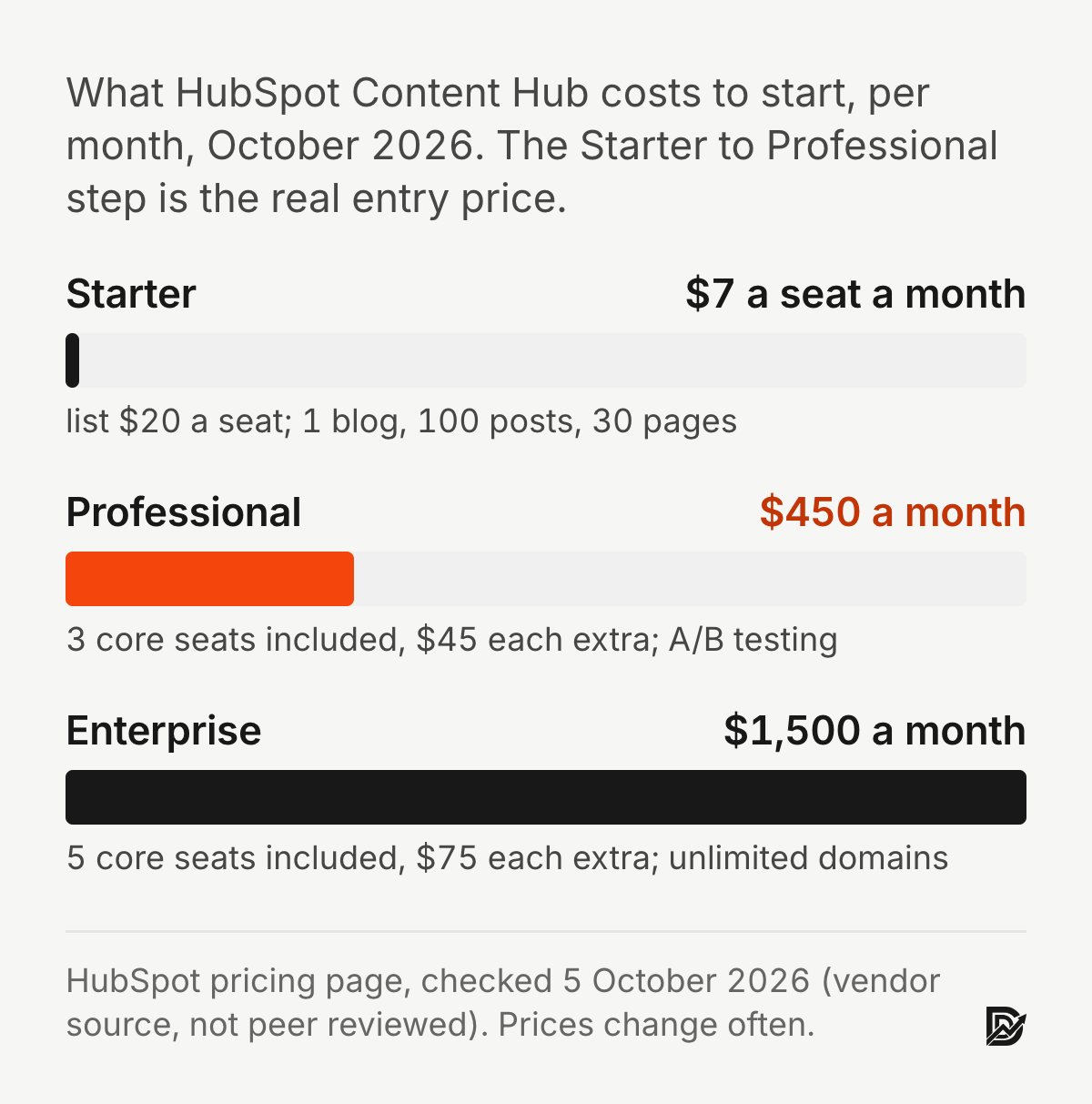
The cost figures and sample quotes are in my HubSpot website cost guide, so I will not repeat them here. The short version from HubSpot's own pricing page in October 2026: Content Hub Starter starts at $7 a seat a month, a discount on the $20 list price at the time of writing. Professional starts at $450 a month with three core seats included. Enterprise starts at $1,500 a month with five seats. These are vendor prices and they change several times a year. The team-size rule above is my experience from quoting, not data.
What are the disadvantages of HubSpot?
HubSpot's main disadvantages are a seat-based price that climbs with headcount, a theme system that resists deep visual customisation, A/B testing locked to Professional and above, and packaging that changes often enough to confuse the people paying for it.
Price grows with headcount, not with value. The gap between Starter and Professional is the one most buyers trip on. Starter at $7 a seat is a trial price for one blog, 100 posts, 30 landing pages and 30 website pages. Professional at $450 a month with three seats, plus $45 for each extra seat, is where the features that make HubSpot worth it live. That step is the real entry price, and I quote it as such.
The theme system is rigid. HubSpot themes and modules keep marketers inside guardrails. That is a feature for a team of five editors and a limitation for a brand with a strong art direction. Evenbound, a HubSpot partner agency, puts it plainly in its own guide: "If you have specific requests and want to move things around in ways that your template doesn't support, you might need some developer help to do it." HubSpot templates also use HubL, HubSpot's own templating language. A developer from another platform has something new to learn first.
A/B testing is a Professional feature. Controlled experiments are the most reliable way to learn what a page change did. Kohavi and colleagues' survey in Data Mining and Knowledge Discovery sets out why experiments beat opinion, and how many visitors a test needs before it says anything (Kohavi et al., 2009, doi:10.1007/s10618-008-0114-1). On Content Hub Starter, HubSpot offers no A/B testing at all, so a Starter team learns about its pages by opinion.
The packaging moves. CMS Hub became Content Hub in April 2024 with new AI features, and legacy CMS Hub customers kept their old packaging unless they upgraded. HubSpot's own partner documents list Content Remix, Brand Voice, podcasts and AI translation as Content Hub only. Credits now sit on every tier as well: 500 on Starter, 3,000 on Professional, 5,000 on Enterprise in October 2026. None of this is a product fault, but it means the plan you priced last year is not the plan on sale today.
Is HubSpot too complicated?
HubSpot is too complicated for a team that will use the website editor and nothing else. It is about right for a team that will also use the CRM, forms, email and reporting from one system.
The research on feature-rich products explains the frustration people describe. In a series of experiments published in the Journal of Marketing Research, Thompson, Hamilton and Rust found that people choose the product with more features before they use it. Once they have lived with it, they prefer the simpler one. They called it feature fatigue (Thompson, Hamilton and Rust, 2005, doi:10.1509/jmkr.2005.42.4.431). HubSpot is bought on the long feature list and judged six months later on the five features the team opens daily.
That does not make it the wrong purchase. It makes it a purchase to size honestly: pay for the hub the team will open every day, and leave the rest switched off.
Is HubSpot difficult to use?
HubSpot's page editor is not difficult to use; a marketer with no code knowledge can publish a landing page in an afternoon. The difficulty sits in the setup around it: properties, lists, workflows and permissions.
Davis's technology acceptance model, the most cited framework for whether people adopt software, found that perceived usefulness predicted use more strongly than perceived ease of use (Davis, 1989, doi:10.2307/249008). Venkatesh and Davis confirmed this across four longitudinal field studies: usefulness stayed the strongest driver of use at every point in time, from first training to months later (Venkatesh and Davis, 2000, doi:10.1287/mnsc.46.2.186.11926). In plain terms, teams put up with a hard setup when the result clearly helps them close deals, and abandon an easy tool that does not. HubSpot's problem is never that the editor is hard. It is that the usefulness only appears when sales uses the data, which brings you back to the first section.
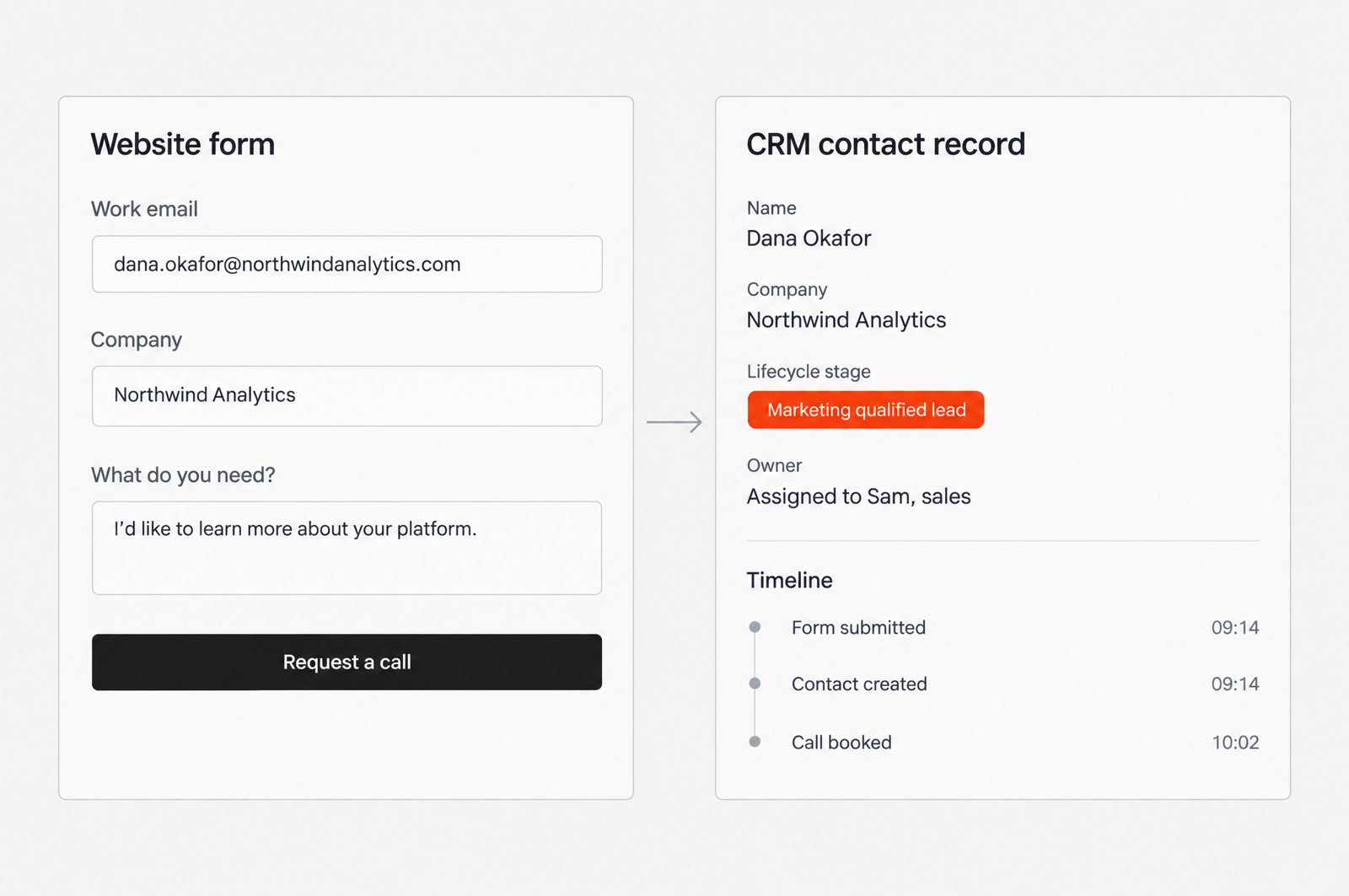
Illustration with example data.
How difficult is it to learn HubSpot?
In my client work, a marketer learned the HubSpot page editor in one afternoon of pairing, and the CRM administration side took the client's team several months of use. HubSpot Academy's free courses cover both sides.
Where teams get stuck is not the learning but the deciding: which properties matter, which lifecycle stages mean what, and who owns a lead after the form fires. Those are business decisions wearing a software costume, and no course answers them for you.
What are the current problems with HubSpot?
The current problem most buyers hit, as of October 2026, is the jump from Starter to Professional, with credits adding a metered cost on top. The second is a theme system that needs a developer for anything unplanned.
I have separated what HubSpot states from what customers and partners say. The cost complaints come from HubSpot partners writing about churn, which is a strange genre: agencies that sell HubSpot explaining why clients leave it. Lynton, a HubSpot partner, wrote in June 2026 that "HubSpot is two to five times more expensive than every alternative at comparable feature tiers." The same piece listed consumption credits and onboarding fees of $3,000 to $7,000 as new cost layers on top of the subscription. Treat that as an industry source with an interest in the answer, and as a claim about list prices rather than about value.
One problem I will add from my own builds: the gap between the editor's capability and a designer's intent. A design that works in Figma often needs a developer to build a custom module before a marketer can use it in HubSpot. On Snappy Kraken we built the modules once, and the marketing team edited pages afterwards without touching code. That is the right pattern, but it is a development cost on day one that a Framer or WordPress build does not always carry. My front-end build case study shows what that module work looked like.
Why are so many people leaving HubSpot?
The reason HubSpot partners most often give for customers leaving is price: the bill grows with seats while the features a team uses stay flat. The second reason is fit, when the company's process does not match HubSpot's templates.
Keaveney's study of why customers switch service providers was built from more than 800 critical incidents and published in the Journal of Marketing. It found that pricing, meaning high prices, increases, or unfair pricing, was among the most frequently named reasons, alongside core service failures and poor responses to those failures (Keaveney, 1995, doi:10.1177/002224299505900206). HubSpot's churn stories fit the first: price increases. Lynton's June 2026 piece makes a sharper observation about how quiet the leaving is: "Nobody tweets the exit." People recommend alternatives without announcing a departure, which is what a slow, cost-driven drift looks like from outside.
Why do customers stay on HubSpot despite the complaints?
Customers stay on HubSpot mainly because switching is expensive. Burnham, Frels and Mahajan found that procedural, financial and relational switching costs raised customers' intention to stay, over and above satisfaction (Burnham, Frels and Mahajan, 2003, doi:10.1177/0092070302250897).
A website, a CRM and three years of contact history on one platform add up to a large switching cost. In my reading, that is why "leaving HubSpot" is a slow story that gets written about more than it happens.
Bhattacherjee's expectation-confirmation model adds the mechanism: people keep using a system when their early expectations are confirmed and the system still seems useful, and they stop when the expectation set at purchase was not met (Bhattacherjee, 2001, doi:10.2307/3250921). Buyers who expected the all-in-one promise to work without changing their sales process are the ones who leave. Buyers who went in to change the process stay.
Does HubSpot have a future?
HubSpot has a future by every public measure. Its second quarter 2026 results, reported on 5 August 2026, show revenue of $911.7 million, up 20 percent, and 306,446 customers, up 14 percent.
Average subscription revenue per customer was $11,800, up 4 percent.
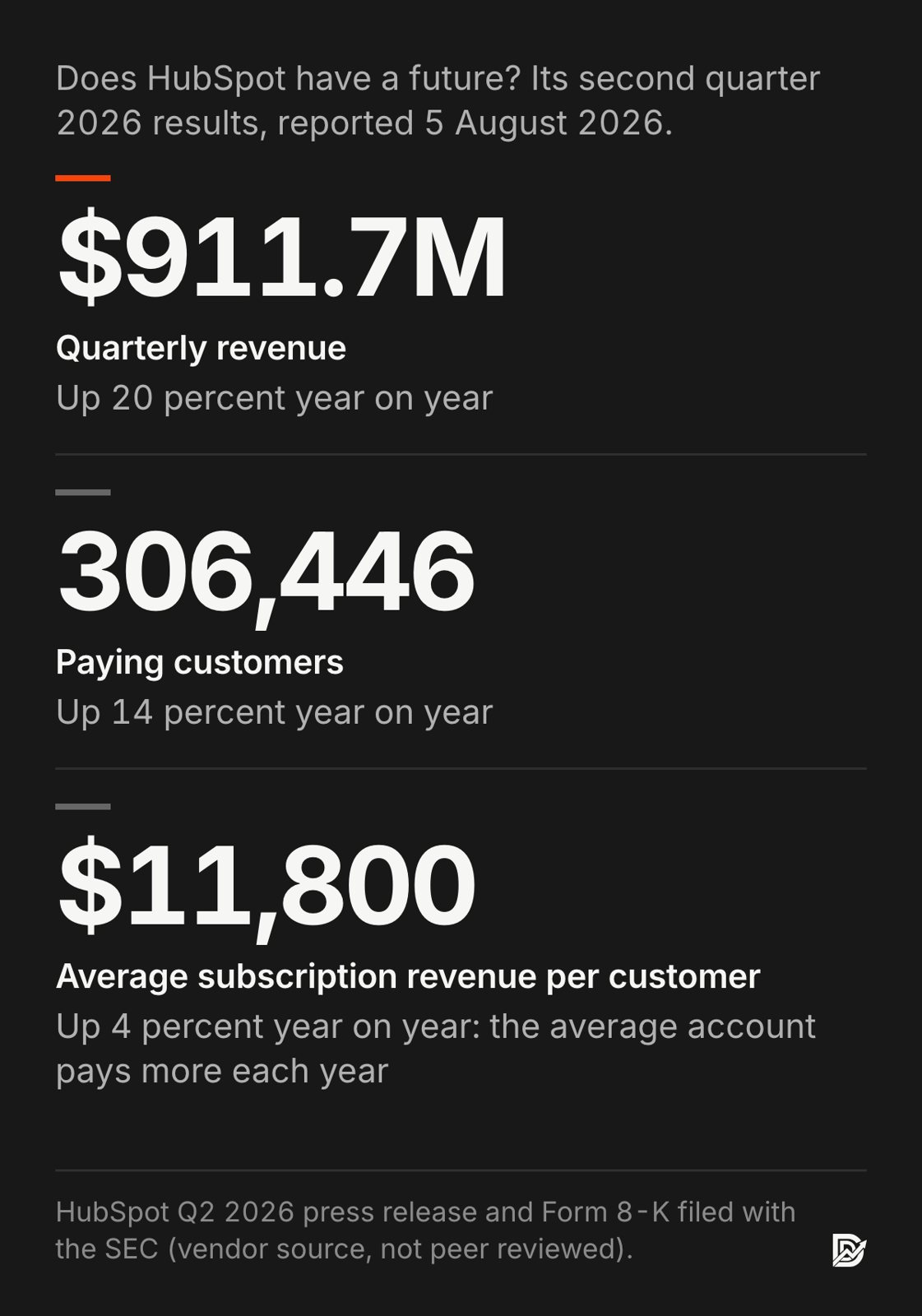
Those figures come from HubSpot's own press release and the matching Form 8-K filed with the SEC. They are a vendor source, and they are unaudited quarterly figures. A company adding customers at 14 percent a year and raising revenue per customer at the same time is not a platform to worry about disappearing. The question for you is narrower: whether the CMS inside it will keep getting investment. Since the Content Hub relaunch, HubSpot has shipped AI content tools, Content Remix, podcasts and translation into the CMS tier. That tells me the content side is a growth bet rather than a legacy product kept alive for existing customers.
One caution in the same release. Average subscription revenue per customer rose 4 percent year on year across all HubSpot products, not only Content Hub, while customer count rose 14 percent. Across the base, the average account is paying more than a year ago, and if you are the average account, your bill is on that curve.
Which companies use HubSpot?
HubSpot reported 306,446 customers at the end of June 2026. The two I know from the inside are Snappy Kraken, a fintech marketing company, and Y Scouts, an executive search firm. Both ran marketing and sales from HubSpot.
I am not going to list logos I cannot vouch for. What I can say from my own client work is the shape of a company HubSpot suits. In my experience it has roughly 10 to 200 staff, a sales team of two or more working a pipeline, a marketing lead who publishes weekly, and a deal size large enough that a form submission deserves a phone call. Both the companies above fit that, and both were run on EOS®, the Entrepreneurial Operating System®, where a weekly scorecard needs lead numbers, and HubSpot's reporting fed that directly. EOS is a registered trademark of EOS Worldwide, LLC, with which I am not affiliated.
Does HubSpot have a website builder?
Yes. HubSpot Content Hub includes a drag-and-drop website and landing page builder with themes, modules, a blog, forms and SEO recommendations, on every tier including Starter. Professional adds A/B testing, smart content that changes by visitor, and memberships.
The builder is good for its intended user, a marketer editing within a theme. Starter caps you at 30 website pages, 30 landing pages and one blog of 100 posts, and the Starter blog has to sit on the same subdomain as the pages (HubSpot pricing page, October 2026). Professional and Enterprise raise the page and post limits to 10,000 each, and Enterprise adds unlimited domains.
Compared with WordPress, Webflow or Framer, the platforms I build on in my web design work, HubSpot's builder is less flexible and more connected. My four-platform comparison goes through that trade in detail. The academic version of the same trade is old, and it comes from enterprise resource planning rather than marketing software. Light, Holland and Wills compared integrated ERP suites with best-of-breed tools. Suites buy integration at the cost of fit, and best-of-breed buys fit at the cost of integration work (Light, Holland and Wills, 2001, doi:10.1108/14637150110392683). HubSpot is the suite in that sentence.
Can HubSpot host a website?
Yes, HubSpot hosts every site built in Content Hub on its own infrastructure, with an SSL certificate included. There is no separate hosting bill and no server to maintain.
Huble's 2026 hosting guide lists the free SSL certificate and automatic mobile responsiveness among what the price covers.
Included hosting is one of the real savings in HubSpot's price, and it is worth counting against a WordPress quote that leaves hosting, security and updates to you. Hosting on HubSpot also means the site's data lives in HubSpot's system. Opara-Martins, Sahandi and Tian surveyed 114 people on vendor lock-in in cloud services and found that most customers were unaware of the proprietary standards that block portability and interoperability until they tried to move (Opara-Martins, Sahandi and Tian, 2016, doi:10.1186/s13677-016-0054-z). In my builds, HubSpot content exported cleanly but templates and modules written in HubL had to be rebuilt on the next platform. Plan the exit before you need it, even if you never use it.
Do I need a company website for HubSpot?
No. HubSpot's CRM, Marketing Hub and Sales Hub work with a website on any platform through a tracking code and embedded forms. Content Hub is the optional piece that moves the website itself onto HubSpot.
Plenty of companies run a WordPress or Framer site with HubSpot forms on it and the CRM behind it. That setup gives you most of the one-database benefit at a fraction of the Content Hub price, and I recommend it when the design matters more than the editing convenience. My WordPress to HubSpot migration guide has a one-question test for when the full move pays, and it is the same test as this article's first section.
How do I decide whether a client should build on HubSpot CMS?
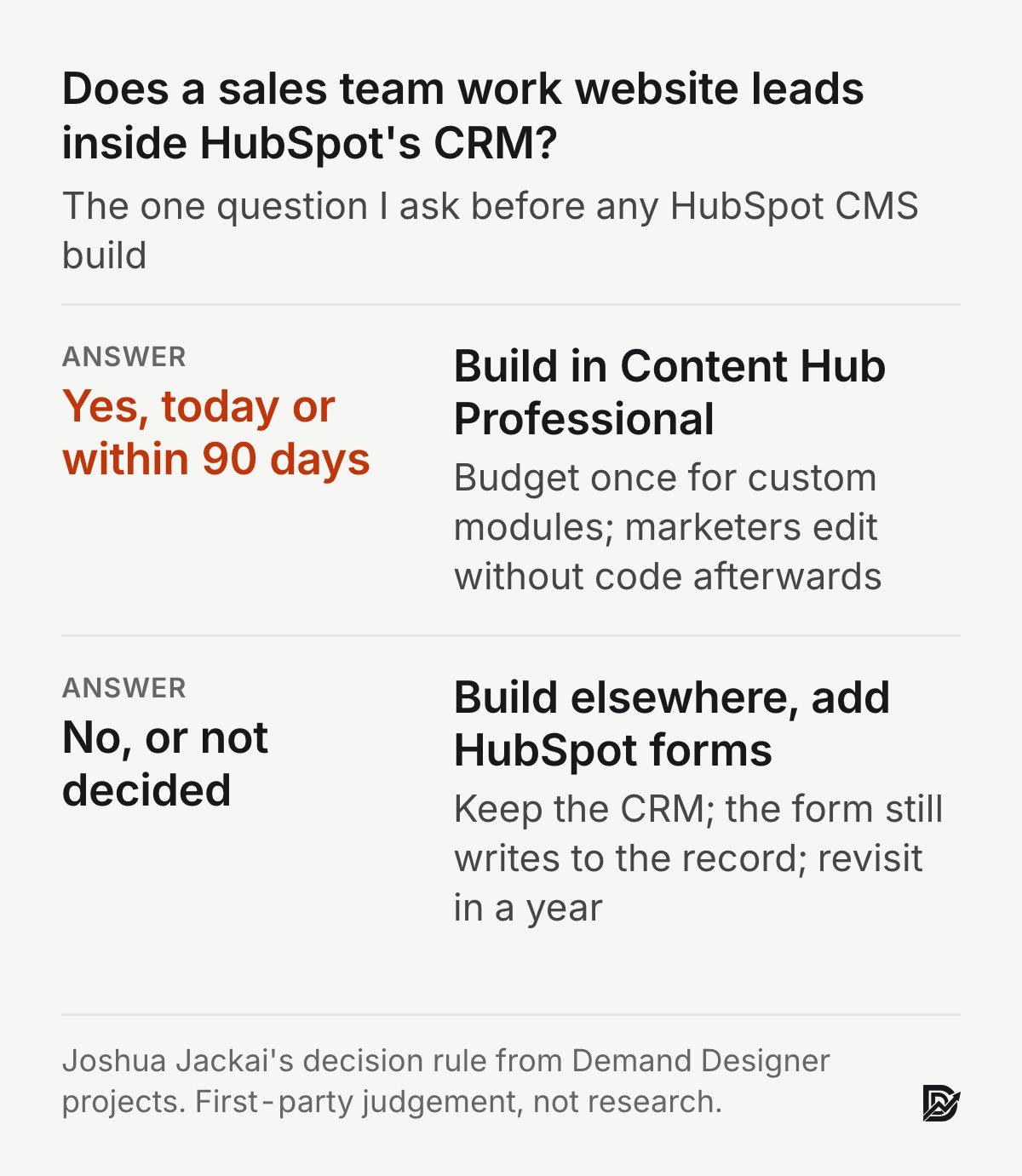
I ask one question: does a sales team work website leads inside HubSpot's CRM today, or within 90 days? If yes, build in Content Hub Professional and budget once for custom modules. If no, build elsewhere and add HubSpot forms.
The switching cost research is the reason I ask before the build rather than after. A company should choose HubSpot on purpose, because leaving it later is expensive, and drifting into it because the CRM was already there is how the churn stories in this article start.
If you want to see where your current site leaks leads before deciding on any platform, the Pipeline Leak Scorecard walks through it in about fifteen minutes, with your site open in front of you.
Sources
Peer-reviewed research
Bhattacherjee, A. (2001). Understanding information systems continuance: An expectation-confirmation model. MIS Quarterly, 25(3). doi:10.2307/3250921
Burnham, T. A., Frels, J. K. and Mahajan, V. (2003). Consumer switching costs: A typology, antecedents, and consequences. Journal of the Academy of Marketing Science, 31(2). doi:10.1177/0092070302250897
Chen, I. J. and Popovich, K. (2003). Understanding customer relationship management (CRM): People, process and technology. Business Process Management Journal, 9(5). doi:10.1108/14637150310496758
Davis, F. D. (1989). Perceived usefulness, perceived ease of use, and user acceptance of information technology. MIS Quarterly, 13(3). doi:10.2307/249008
Järvinen, J. and Taiminen, H. (2016). Harnessing marketing automation for B2B content marketing. Industrial Marketing Management, 54. doi:10.1016/j.indmarman.2015.07.002
Keaveney, S. M. (1995). Customer switching behavior in service industries: An exploratory study. Journal of Marketing, 59(2). doi:10.1177/002224299505900206
Kohavi, R., Longbotham, R., Sommerfield, D. and Henne, R. M. (2009). Controlled experiments on the web: Survey and practical guide. Data Mining and Knowledge Discovery, 18(1). doi:10.1007/s10618-008-0114-1
Light, B., Holland, C. P. and Wills, K. (2001). ERP and best of breed: A comparative analysis. Business Process Management Journal, 7(3). doi:10.1108/14637150110392683
Opara-Martins, J., Sahandi, R. and Tian, F. (2016). Critical analysis of vendor lock-in and its impact on cloud computing migration: A business perspective. Journal of Cloud Computing, 5(4). doi:10.1186/s13677-016-0054-z
Rouziès, D., Anderson, E., Kohli, A. K., Michaels, R. E., Weitz, B. A. and Zoltners, A. A. (2005). Sales and marketing integration: A proposed framework. Journal of Personal Selling & Sales Management, 25(2). doi:10.1080/08853134.2005.10749053
Thompson, D. V., Hamilton, R. W. and Rust, R. T. (2005). Feature fatigue: When product capabilities become too much of a good thing. Journal of Marketing Research, 42(4). doi:10.1509/jmkr.2005.42.4.431
Venkatesh, V. and Davis, F. D. (2000). A theoretical extension of the technology acceptance model: Four longitudinal field studies. Management Science, 46(2). doi:10.1287/mnsc.46.2.186.11926
Industry and vendor sources (not peer reviewed)
HubSpot, Content Hub pricing, checked 5 October 2026: Free up to 2 users; Starter from $7 a seat a month (list $20), 500 credits, one blog, 100 posts, 30 landing pages, 30 website pages; Professional from $450 a month with 3 core seats (extra seats $45), 3,000 credits, A/B testing, 10,000 pages and posts; Enterprise from $1,500 a month with 5 core seats (extra seats $75), 5,000 credits, unlimited domains.
HubSpot, "HubSpot Reports Q2 2026 Results", 5 August 2026, and the matching Form 8-K exhibit filed with the SEC: revenue $911.7 million, up 20 percent; subscription revenue $894.0 million; 306,446 customers, up 14 percent; average subscription revenue per customer $11,800, up 4 percent.
HubSpot partner documents, "Feature Packaging for Content Hub and CMS Hub Legacy Customers" and "Content Hub FAQs", 2024: Content Remix, Brand Voice, podcasts, content embeds and AI translation are Content Hub only; legacy CMS Hub customers keep prior packaging until they upgrade.
Lynton, "Why Companies Are Leaving HubSpot in 2026", 10 June 2026, updated 2 July 2026: the "two to five times more expensive" claim, credits and onboarding fees of $3,000 to $7,000 as added cost layers, and the "Nobody tweets the exit" observation. Lynton is a HubSpot partner agency; read as interested industry commentary.
Evenbound, "The HubSpot CMS Hub: Everything You Need to Know", agency guide, quoted on template flexibility and HubL; and Huble, "How much does it cost to host your website with HubSpot?", 2026 agency guide, used for the SSL and hosting point. Both sell HubSpot services.
Snappy Kraken and Y Scouts results are from client reporting on my own projects: Figma to live HubSpot build in 21 days, contributing to a 30 percent rise in marketing qualified leads and a 28 percent rise in click-through rate; a HubSpot landing page with 938 views, 166 submissions and a 17.7 percent conversion rate. First-party, not research.
Free workbook
Pipeline Leak Scorecard
Find the leaks between your traffic and your pipeline. Score your site in about fifteen minutes, with it open in front of you.
12 questions, 8 pages, 15 minutes. Free.


