Web Design

Joshua Jackai
15 min

By Joshua Jackai, founder of Demand Designer. Published October 2026. Prices and product details were checked in October 2026 and will date.
Hiring a web designer is worth it when one new client is worth more than the designer's fee, and it is not worth it when you need a placeholder this week. That is the short version. The long version is this article, written for marketing leads and founders at B2B companies weighing three routes: a designer, an AI builder, or doing it themselves.
I build websites for a living, so I have an interest here. I have tried to keep the opinion in the sections that are opinion and the evidence in the sections that are evidence, and to say which is which.
Illustrative photo.
Is it worth hiring a web designer?
Yes, hiring a web designer is worth it for a B2B company where one new client is worth $5,000 or more, because the website has to earn a buying group's trust before anyone replies to an email.
Below that, the answer depends on what a client is worth to you.
The research on how fast people judge a page is not kind to the quick option. The title of one study in Behaviour & Information Technology states its finding: "Attention web designers: You have 50 milliseconds to make a good first impression!" People formed a reliable opinion of a page's visual appeal in that time, and those snap ratings matched the ratings they gave after a longer look (Lindgaard et al., 2006, doi:10.1080/01449290500330448). A Stanford study of 2,684 people assessing live sites found that the design look of a site was the factor mentioned most often when they judged whether to trust it, in 46.1 percent of comments (Fogg et al., 2003, doi:10.1145/997078.997097). In an experiment with cash-machine interfaces, people who rated a design as more attractive also rated it as easier to use, before and after using it (Tractinsky et al., 2000, doi:10.1016/S0953-5438(00)00031-X).
These studies tested general and consumer sites, not B2B vendors, so read them as direction rather than proof for your market. The direction is consistent: the look of the site is doing sales work whether or not anyone planned it. Pay a designer and you spend money. Skip one and you spend trust, which is harder to see on an invoice. The rest of this article puts numbers and evidence on each route so you can pick with your eyes open.
How much do most website designers charge?
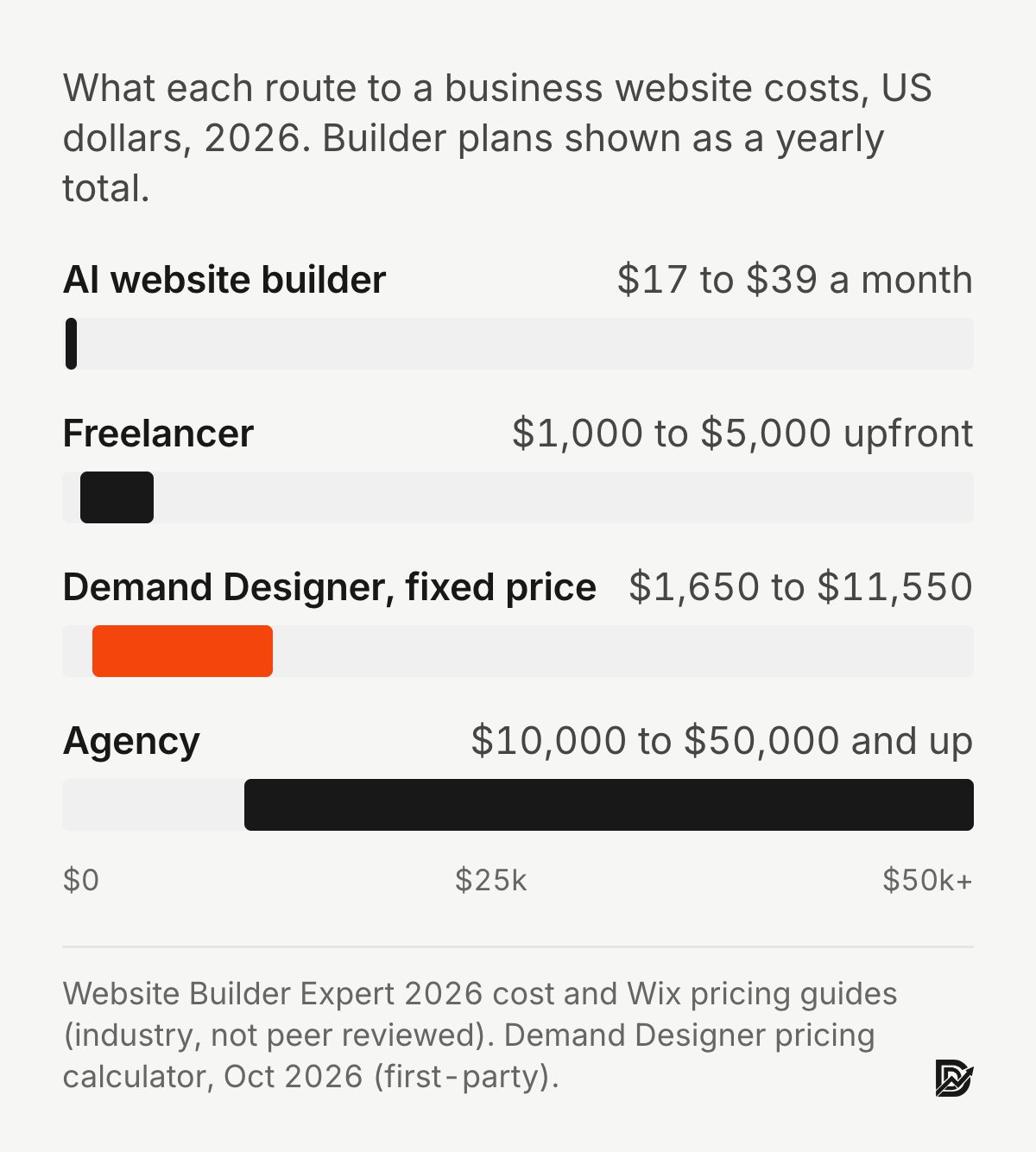
Most freelance web designers charge $1,000 to $5,000 upfront for a small business site, or $50 to $200 an hour. Agencies charge $10,000 to $50,000 and up.
The spread is wide because "a website" can mean a five-page brochure or a lead-generation system with CRM routing.
The freelance figures come from Website Builder Expert's 2026 cost guide and Fiverr's own web designer cost guide, which puts hourly rates at $30 to $200. The agency range comes from Bootstrap Creative's 2026 B2B guide, which I compared with other agency price lists in my B2B website cost guide. All of these are industry figures, not research, and they move. The price tracks who builds the site and what the site has to do.
How much do freelancers charge for website design?
Freelance web designers charge $30 to $200 an hour by Fiverr's 2026 guide, and most small projects land between $1,000 and $5,000. The low end is usually a template with your content placed in.
The high end is custom design with a process behind it.
The hourly figure tells you less than the project figure. A $40-an-hour designer who takes 80 hours costs about the same as a $160-an-hour designer who takes twenty, and the second one has usually done the job before. When I quote, I quote the project, because the client is buying the result and not my time.
How much does it cost to hire someone to build a website?
A B2B marketing site costs $1,000 to $5,000 from a freelancer and $10,000 to $50,000 from an agency, by the guides above.
My own fixed prices run from $1,650 for a one-page site to about $11,550 for a ten-page lead-generation site.
The full list is on my pricing calculator: a five-page site is about $3,750, and projects over $15,000 get scoped on a call. Agencies price the same work higher partly because their overhead is higher and partly because the scope often includes strategy workshops and account management. The two prices are different products, and the useful question is which product your pipeline needs. The cost guide walks through that.
How much should I pay someone to design a website?
Pay against the value of one new client, not against the cheapest quote. The number that matters is the price of the site divided by what one new client is worth.
That ratio is how many extra clients the site has to win to pay for itself.
Suppose a client is worth $8,000 to you and the site brings in one extra client a quarter. One extra client in the first quarter returns $8,000 against a $4,000 build, so the build has paid for itself inside three months and everything after that is return. The same rule tells you when to pay less. If your average sale is $200 and you sell online, a $4,000 custom site needs twenty extra sales to break even, and a builder plan may be the right call.
How much does it cost to design a website on Fiverr?
Fiverr's own cost guide puts small business website design at $500 to $5,000, and freelance website projects on the platform at $100 to over $5,000, depending on scope (Fiverr, 2025 guide).
The low prices are real, and so is what they buy: a theme installed with your text pasted in.
That can be fine for a side project or a placeholder. For a B2B site that has to convince a buying committee, the gaps tend to show up later: no plan for what the page asks the visitor to do (the subject of my guide to B2B conversion rate optimization), no tracking of where leads come from, and nobody responsible when the form breaks. Those are the parts of a site that generate pipeline, and they are the parts a $500 gig leaves out.
Can ChatGPT build me a website?
Yes, ChatGPT can build a website in two ways, and neither produces a finished business website. ChatGPT writes the code for a site you host yourself, or ChatGPT Sites generates and hosts simple sites on paid Work plans.
The code route works on any plan: ChatGPT writes the HTML, CSS and JavaScript, and you copy it to your own hosting. ChatGPT Sites arrived in public beta in July 2026.
The second route is the one people are asking about, so here is what has been reported about it. As of October 2026, Playcode's explainer on the beta lists OpenAI's own examples for ChatGPT Sites as dashboards, project trackers, launch calendars, prototypes, internal portals and interactive reports. There is no store, no checkout and no paid bookings, and the feature was not available in the EU, Switzerland or the UK at launch. My read: it is a tool for teams building internal pages, not a tool for launching a public B2B site. Check OpenAI's own help pages before you plan around it, because beta features change.
Can ChatGPT actually create a website?
ChatGPT can create the files for a website that works. ChatGPT cannot decide what the site should say to your buyer, which proof belongs on the first screen, or where the leads should go once the form is submitted.
Those decisions are the website; the files are the container.
I use language models in my own process every week, for first drafts, research summaries and code, and the drafts always need rewriting before a client sees them. The models are good at producing a plausible version of anything. The problem for a B2B site is that "plausible" is the median of every site the model has seen, and the median B2B site is the one your buyer has already stopped reading. The judgment about what to leave out still has to come from a person who knows the buyer.
Is it possible for AI to build an entire website automatically?
Yes. Wix, Durable, Hostinger and a dozen other builders generate a complete site from a short description in minutes, with hosting included.
Wix's paid plans run $17 to $39 a month billed annually on the Light, Core and Business tiers (Website Builder Expert, Wix pricing, September 2026).
An AI builder asks a few questions, picks a layout from a known set, writes copy in the same register for everyone, and places stock imagery. The result is a site that exists, which for some businesses is the whole goal. If you need a URL for a business card by Friday, this is the fastest answer. If you need a site that outsells the three competitors on your buyer's shortlist, it is the wrong tool, because the part the generator skipped is the thinking.
Illustration with example data.
What is the best AI to create a website?
For a live site today with hosting included, start with Wix's AI builder. It is on every plan, including the free one, and paid plans start at $17 a month billed annually.
For code you host yourself, ChatGPT or Claude will write it.
I am not going to rank the builders further, because the ranking changes every quarter and because it is the wrong question for most B2B teams. The builders differ in price and polish. They do not differ in the thing that decides whether the site produces leads, which is what the page says to a specific buyer and what it proves. That is not a feature any of them sells.
Is AI replacing web designers?
AI is replacing the part of web design that was already a commodity: installing a template and filling it with text.
AI is not replacing the part that was always scarce, which is deciding what a specific buyer needs to see and in what order.
This answer has two halves. The first half is bad news for a lot of designers. If your service was "I will set up a theme and put your content in it," a $17-a-month plan now does that in minutes, and the market knows. The second half is the reason I am still in business. The companies that call me have usually tried the quick route. Their site exists, it looks fine, and it is not producing pipeline, and they cannot work out why from inside the builder. If that describes your site, start with the signs a site needs a redesign. The job is diagnosis and decision, and the tools made that job more valuable, not less, by making the generic version free.
How can you tell if a site is AI generated?
Mostly you cannot tell by looking. No study I found tested whole websites, but the evidence on faces, text and images points one way: people are poor at spotting generated content.
What gives a generated site away is sameness, not quality.
In a PNAS study, participants could not reliably tell AI-synthesized faces from real photographs, and they rated the synthetic faces as slightly more trustworthy (Nightingale and Farid, 2022, doi:10.1073/pnas.2120481119). In a study published at the Association for Computational Linguistics, readers distinguished GPT-3 text from human writing at about the rate of a coin flip (Clark et al., 2021, GPT-3 era, doi:10.18653/v1/2021.acl-long.565). A representative survey across the United States, Germany and China found people could not reliably identify generated images, audio or text (Frank et al., 2024, doi:10.1109/SP54263.2024.00159). An eye-tracking study with paired car and building images found that people were often using a shortcut rather than detecting anything: accuracy was 91 percent when the AI image was the futuristic one and 55 percent when the AI image was the ordinary one (de Winter et al., 2025, doi:10.1177/10711813251363209).

So "does this look AI-made" is the wrong test, and your buyer is not running it either. The test your buyer runs is "have I seen this before." What I look for when I review a site: a stock photo of a team that was never the client's, a three-icon feature grid, "transform" or "seamless" in the headline, no named customer, no named person, and no number a competitor could not also claim. None of those prove a machine wrote the page. All of them mean nobody decided anything.
One caution from the research. A study of general web users in the International Journal of Human-Computer Studies found that people rated websites as most appealing when they were visually simple and close to the typical layout for their type (Tuch et al., 2012, doi:10.1016/j.ijhcs.2012.06.003). Familiar structure is not the problem. The problem is when the words, the pictures and the proof are also interchangeable, because then the buyer has no reason to remember which tab was yours. I wrote more about that in why AI-generated landing pages do not convert.
Can I design my own website for free?
Yes, you can design and publish a website for free. Wix, Canva and several other builders publish a site for nothing, with limits: a subdomain instead of your own domain, and in Wix's case a banner ad on every page.
The free address looks like yourname.wixsite.com rather than yourcompany.com.
Your own domain and no ads start at about $17 a month on Wix (Website Builder Expert, September 2026). Free is a real option, and for a personal project or a first test of an idea I would use it. For a B2B company the free tier has a cost that does not appear on the plan page. I have not found a peer-reviewed study on builder subdomains, so this part is my observation: a platform banner on a company site is the first thing a buyer's colleague is likely to question when the link gets forwarded. The wider evidence is that people judge credibility largely on design (Fogg et al., 2003).
Can Canva create a free website?
Yes. Canva publishes up to five websites for free on a my.canva.site address, and connecting your own domain needs a paid Canva plan, according to Canva's help pages. It is a presentation tool that publishes to the web.
For a portfolio, an event page or an internal brief it does that well. What it is not is a business website platform. There is no blog system, no CRM connection, no structured way to build landing pages for campaigns, and limited control over the things that affect search visibility. If a Canva page is what you can ship this week, ship it, and treat it as a placeholder with a review date on it.
Does Wix create your website for you?
Yes. Wix's AI builder asks about your business, generates a full site with pages and copy, and lets you edit the result in the normal editor.
It is available on the free plan and on every paid plan, and it produces a working site in minutes.
What Wix leaves unset is the same thing every generator leaves unset: which buyer the site is for and what that buyer needs to believe before booking a call. If you sell a $20,000 engagement to a buying committee, the B2B website mistakes that stall enterprise deals are mostly decisions a builder cannot make for you.
Is it hard to create a website from scratch?
Building the pages is no longer hard. The builders have made the mechanics easy, and a determined person can have a presentable site in a weekend.
What stays hard is everything the builder cannot see: who the site is for, what they need to believe, what to leave out, and how to know afterward whether it is working.
Choosing where to build is its own decision, covered in my website platforms guide. There is one more thing to know before you build your own, and it comes from consumer psychology rather than web design. People overvalue the things they make themselves. The original studies called it the IKEA effect (Norton, Mochon and Ariely, 2011, doi:10.1016/j.jcps.2011.08.002). A 2025 meta-analysis of 55 studies with 5,454 participants found a moderate effect on how much people valued what they had assembled, and the effect held up across the moderators the authors tested, including product type (Pelled, Demetriades and Walter, 2025, doi:10.1002/mar.70064). Applied to websites, it means the person who built the site is the least reliable judge of it. You will like your own site more than your buyers do, which is a reason to get a second opinion from someone who was not in the room.
Is web design still worth it in 2026?
Yes, web design is still worth paying for in 2026, for any company whose buyers check the website before they talk to sales. What changed is the floor.
A site that merely exists is free now, so the only web design worth paying for produces something a free site cannot: a buyer who arrives at the call already convinced.
For designers, the same shift means the template-and-content service is gone and the diagnosis service is worth more. For buyers of web design, it means you should expect a designer to talk about your pipeline and your buyer before they talk about colours. If the first conversation is about the look, you are buying the part AI already gives away.
Do you still need a website in 2026?
Yes, a B2B company still needs a website in 2026, because buyers at other companies form a view of a vendor before they make contact.
In my own client work, the buyer has usually read the site before the first call. Without a site you have handed that first conversation to whatever LinkedIn, a directory or a chatbot says about you.
The research on initial trust points the same way. In a study in The Journal of Strategic Information Systems, people's perception of a website's quality strongly predicted how much they trusted an unfamiliar vendor and whether they intended to transact with it, before any direct experience (McKnight, Choudhury and Kacmar, 2002, doi:10.1016/S0963-8687(02)00020-3). That study looked at consumers, not B2B buying groups, but the mechanism is the same: when someone does not know you yet, the site stands in for you.
Is having your own website worth it?
Yes, owning your own website is worth it because it is the only channel where you set the rules.
A LinkedIn page, a marketplace listing or a profile on a review site can change its layout, its reach or its terms without asking you. Your domain does not.
There is also the plain matter of where the leads land. On your own site you can see which page a visitor read, which campaign sent them and what they did next, and route the lead to the right person. On a rented profile you get a notification and a name. For a B2B company that needs to report where pipeline comes from, that difference alone pays for the domain and hosting many times over. The proof a buyer looks for once they arrive is covered in how to build trust on a website.
Which route should a B2B team pick?
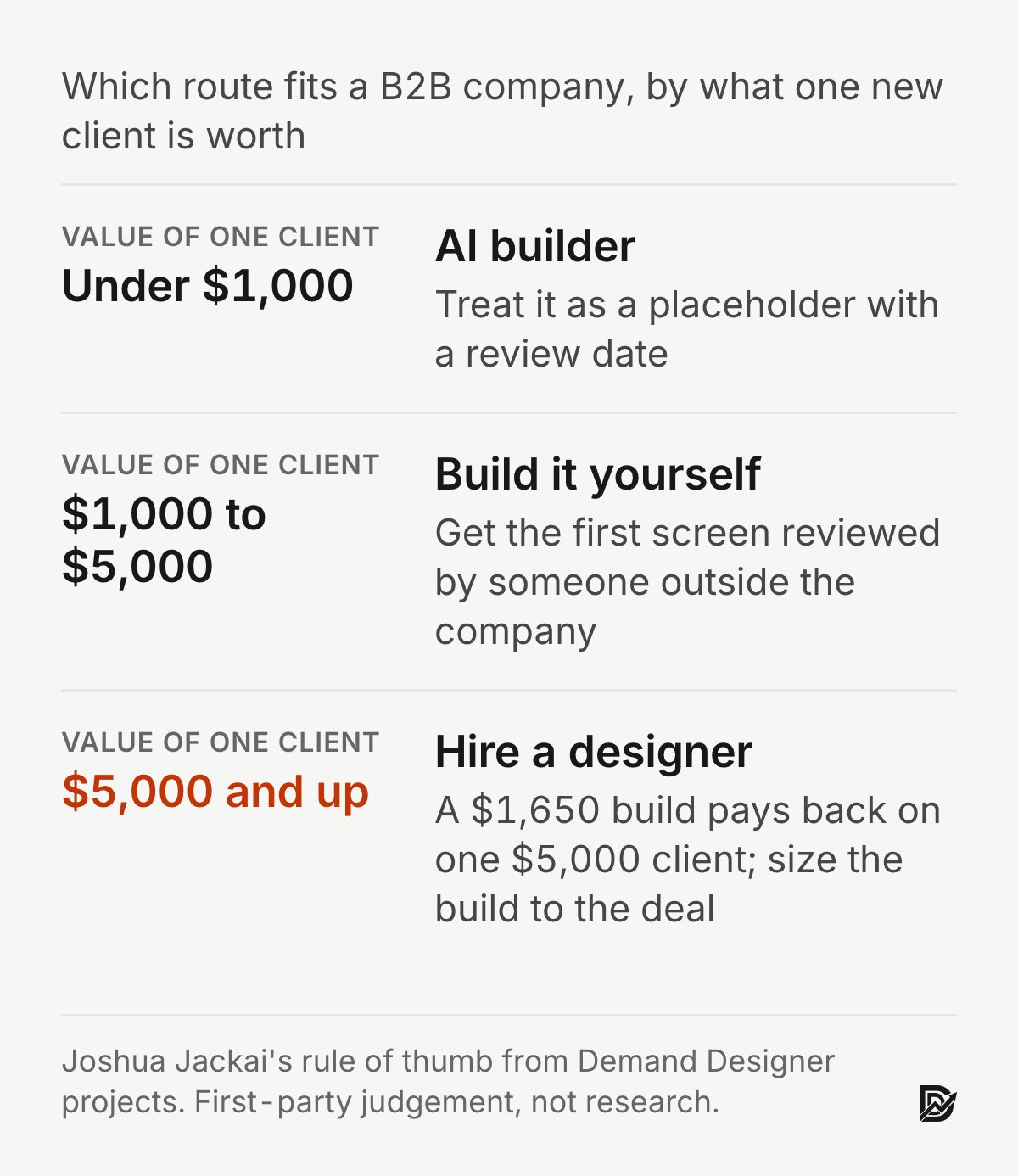
Pick by the value of one new client and by what the site has to do in the next 90 days.
The thresholds below are my rule of thumb from Demand Designer projects, not research, and they include the cases where I tell companies not to hire me.
A client is worth under $1,000, or you need a URL this week: use an AI builder. Wix or a similar plan at $17 to $39 a month. Treat it as a placeholder, and spend the money you saved on getting in front of buyers.
A client is worth $1,000 to $5,000 and you have someone with time and taste: build it yourself on a proper platform, but get the structure and the first screen reviewed by someone outside the company before launch. The IKEA effect is working against you.
A client is worth $5,000 or more, or your buyers compare you against two other vendors: hire a designer who will talk about your pipeline before your palette. A $1,650 build pays back on one $5,000 client. An $11,550 build needs two or three, so size the build to the deal. At that client value, the free site is the expensive one.
Two examples from my own work, so you can see what the paid route is supposed to produce. For Snappy Kraken, a B2B software company, I took approved designs to live HubSpot pages in 21 days, and the redesigned pages contributed to a 30 percent rise in marketing-qualified leads and a 28 percent higher click-through rate, per the client's reporting. For Advisor Websites, the rebuilt site came with a 58 percent increase in organic traffic and a 28 percent rise in lead conversion, again per client reporting. Those are results from two projects, not a study, and I show them because they are the kind of number a free site does not move.
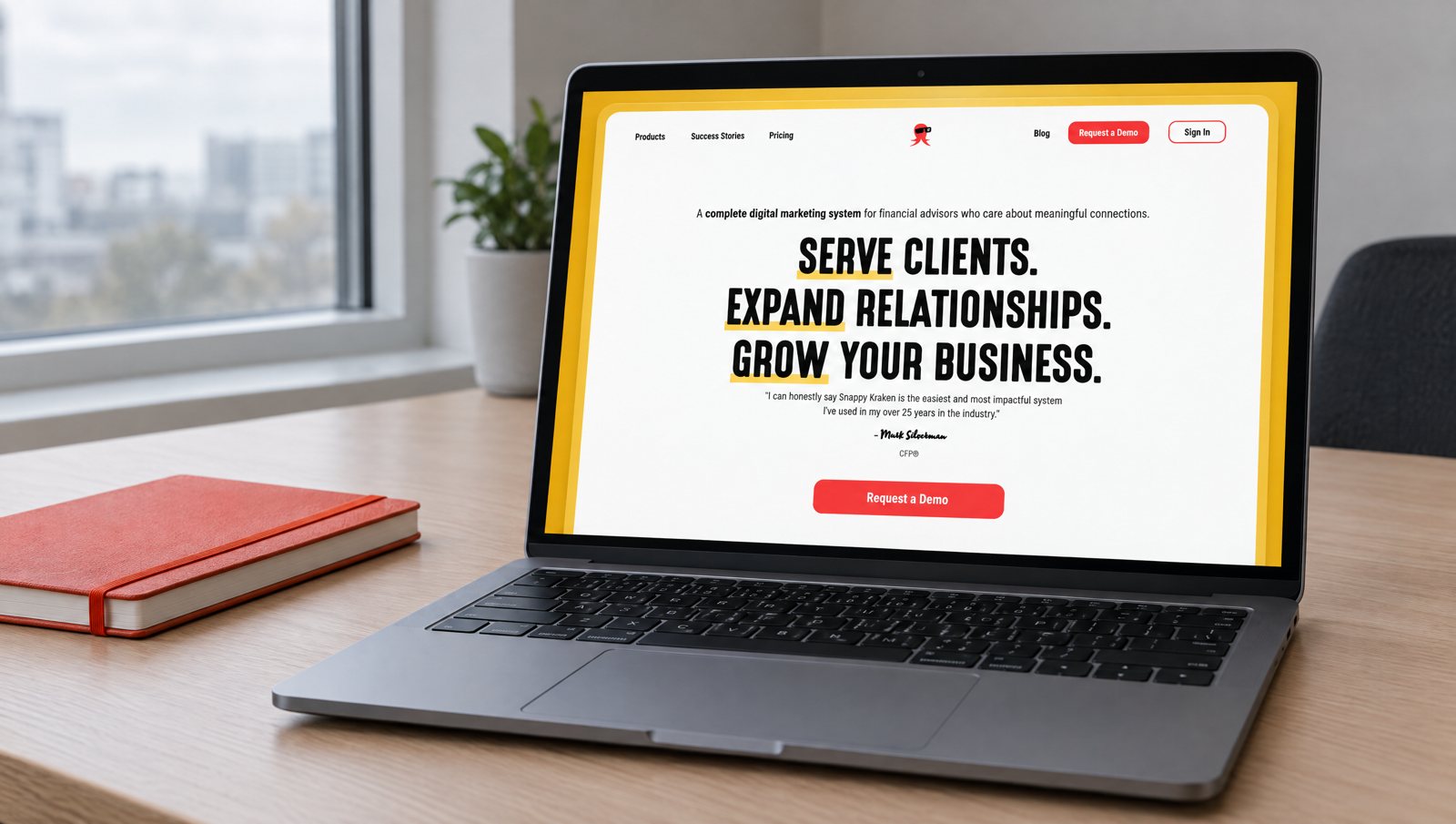
The real Snappy Kraken homepage, designed by Demand Designer, shown in an illustrative scene.
If you are not sure which bracket you are in, the Pipeline Leak Scorecard is twelve questions you answer with your current site open. It takes about fifteen minutes and it ranks where the site is losing buyers now, which is a better basis for the hire-or-build decision than any price list, including mine.
Sources
Peer-reviewed research
Clark, E., August, T., Serrano, S., Haduong, N., Gururangan, S. and Smith, N. A. (2021). All that's "human" is not gold: Evaluating human evaluation of generated text. Proceedings of the 59th Annual Meeting of the Association for Computational Linguistics. doi:10.18653/v1/2021.acl-long.565
de Winter, J., Pfeifer, J., Dodou, D. and Eisma, Y. (2025). Detecting Midjourney-generated images: An eye-tracking study. Proceedings of the Human Factors and Ergonomics Society Annual Meeting, 69(1). doi:10.1177/10711813251363209
Fogg, B. J., Soohoo, C., Danielson, D. R., Marable, L., Stanford, J. and Tauber, E. R. (2003). How do users evaluate the credibility of Web sites? Proceedings of the 2003 Conference on Designing for User Experiences. doi:10.1145/997078.997097
Frank, J., Herbert, F., Ricker, J., Schönherr, L., Eisenhofer, T., Fischer, A., Holz, T. and Dürmuth, M. (2024). A representative study on human detection of artificially generated media across countries. 2024 IEEE Symposium on Security and Privacy. doi:10.1109/SP54263.2024.00159
Lindgaard, G., Fernandes, G., Dudek, C. and Brown, J. (2006). Attention web designers: You have 50 milliseconds to make a good first impression! Behaviour & Information Technology, 25(2). doi:10.1080/01449290500330448
McKnight, D. H., Choudhury, V. and Kacmar, C. (2002). The impact of initial consumer trust on intentions to transact with a web site: A trust building model. The Journal of Strategic Information Systems, 11(3-4). doi:10.1016/S0963-8687(02)00020-3
Nightingale, S. J. and Farid, H. (2022). AI-synthesized faces are indistinguishable from real faces and more trustworthy. Proceedings of the National Academy of Sciences, 119(8). doi:10.1073/pnas.2120481119
Norton, M. I., Mochon, D. and Ariely, D. (2011). The IKEA effect: When labor leads to love. Journal of Consumer Psychology, 22(3). doi:10.1016/j.jcps.2011.08.002
Pelled, A., Demetriades, S. and Walter, N. (2025). Labor leads to love, right? A meta-analysis of the IKEA effect. Psychology & Marketing, 43(2). doi:10.1002/mar.70064
Tractinsky, N., Katz, A. S. and Ikar, D. (2000). What is beautiful is usable. Interacting with Computers, 13(2). doi:10.1016/S0953-5438(00)00031-X
Tuch, A. N., Presslaber, E. E., Stöcklin, M., Opwis, K. and Bargas-Avila, J. A. (2012). The role of visual complexity and prototypicality regarding first impression of websites. International Journal of Human-Computer Studies, 70(11). doi:10.1016/j.ijhcs.2012.06.003
Industry and vendor sources (not peer reviewed)
Website Builder Expert, "How Much Should a Website Cost in 2026?", updated December 2025: builder plans $2.99 to $299 a month; freelance designers $1,000 to $5,000 upfront, $50 to $200 an hour.
Website Builder Expert, "Wix Pricing 2026", updated September 2026: free plan with Wix ads and a Wix subdomain; Light $17, Core $29, Business $39, Business Elite $159 a month billed annually; AI builder on all plans.
Fiverr, "How Much Does it Cost to Hire a Web Designer?", 2025 guide: $30 to $200 an hour; small business website design $500 to $5,000; freelance projects $100 to over $5,000. Fiverr sells these services, so read it as a vendor source.
Bootstrap Creative, "B2B Website Development Cost", 2026 guide: most professional B2B sites $10,000 to $50,000 and up. An agency source, compared with others in my B2B website cost guide.
Canva Help Center, "Canva Websites" and "Publishing websites on your own domain", checked October 2026: free users publish up to five sites on my.canva.site; custom domains need Canva Pro, Teams or Education.
Playcode, "Can ChatGPT Build a Website? What Changed in 2026", July 2026: ChatGPT Sites public beta on paid Work plans, OpenAI's stated use cases, and the launch limits quoted above. Playcode sells a competing builder.
Demand Designer prices (from $1,650 for one page, about $3,750 for five pages, about $11,550 for a ten-page lead-generation site) are from my own pricing calculator, October 2026. Snappy Kraken and Advisor Websites results are from client reporting on my own projects.
Free workbook
Pipeline Leak Scorecard
Find the leaks between your traffic and your pipeline. Score your site in about fifteen minutes, with it open in front of you.
12 questions, 8 pages, 15 minutes. Free.


