Web Design
8 Signs You Need a Website Redesign: Complete 2026 Guide

Joshua Jackai
18 min

Published September 2026 · Last updated and fact-checked 25 October 2026
Short answer: You need a website redesign when the problems are structural and more than one is true at once. Eight signs predict it: falling conversions, a weak mobile experience, slow pages, content only a developer can change, broken analytics, a brand mismatch, declining search traffic and a template that fights new pages. Users tolerate about 2 seconds of waiting (Nah, 2004).
I have rebuilt B2B sites for a long time, and most owners who ask me whether they need a redesign are asking the wrong question. A site that looks dated can be working fine, and a handsome site can lose money every month. This guide gives you eight signs that tend to precede a rebuild, a test you can run on each in about ten minutes, and the cheaper fix to try first.
I am Joshua Jackai, founder of Demand Designer, a solo web design studio. I sell redesigns, so I have a bias, and I have tried to point it the other way: for each sign I say when a fix in place is the better answer. I wrote this for founders and heads of marketing at B2B companies selling in the United States, many of them running on EOS (not affiliated with EOS Worldwide).
Key takeaways
People judge a page's visual appeal within 50 milliseconds (Lindgaard et al., 2006), so a site that no longer matches your business costs you before anyone reads a word.
Users tolerated about 2 seconds of waiting without feedback on a simple task (Nah, 2004), which is the bar a slow page has to clear.
Longer page delays lowered both user performance and site ratings in a controlled experiment (Galletta et al., 2004).
46.1% of comments in a Stanford credibility study mentioned the look of the site (Fogg et al., 2003).
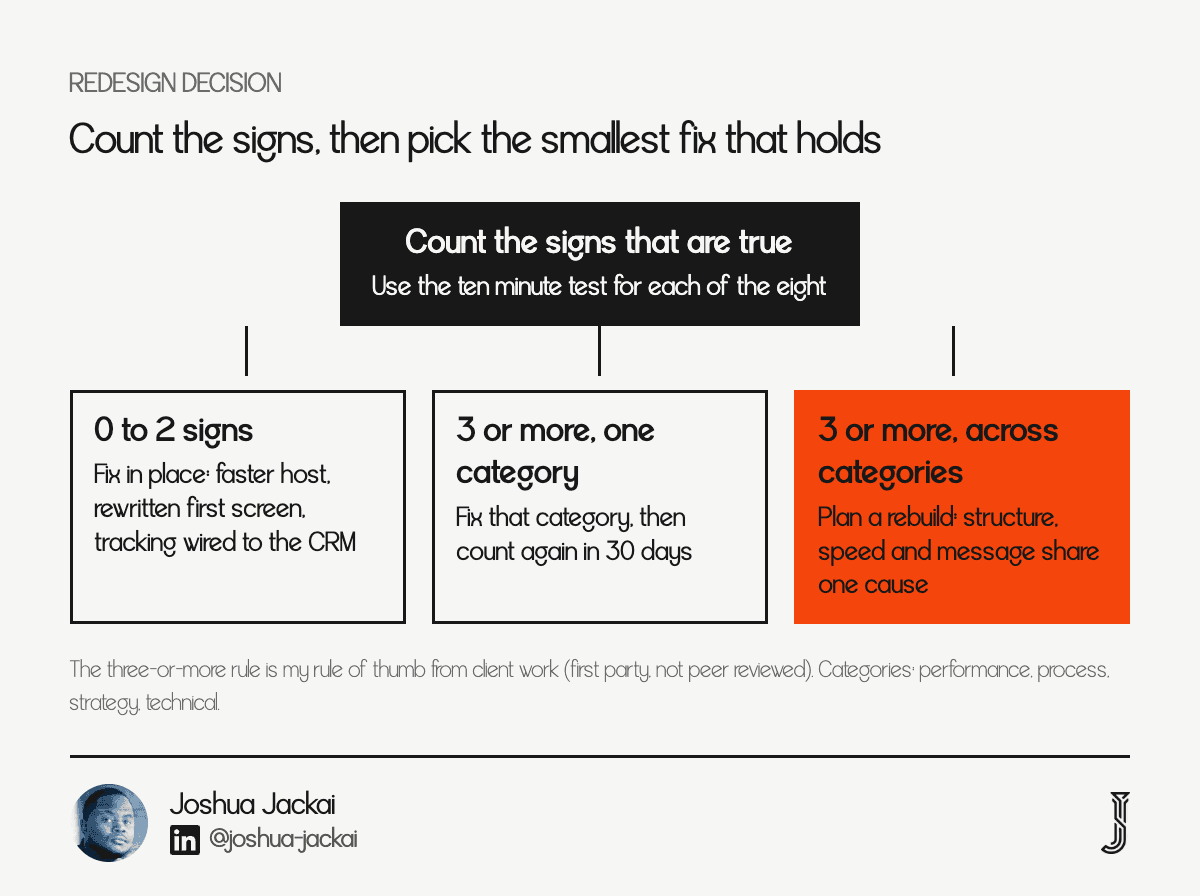
One or two signs usually call for a targeted fix; three or more across different categories make the case for a rebuild. Demand Designer builds are $3,250 to $14,999 (Demand Designer price list, October 2026).
A site converting at 1% that should convert at 3% loses two thirds of its potential pipeline every month, which is my arithmetic, not a study.
Sign | Ten minute test | Fix in place first | Source |
|---|---|---|---|
1. Conversions fall while traffic holds | Compare conversion rate by source, last 90 days against the 90 before | Rewrite the first screen and the form | Kohavi et al., 2008 |
2. Mobile is an afterthought | Complete your own form on a phone, on mobile data | Fix tap targets and the mobile menu | Social Media Today, reporting Google |
3. Pages load slowly | Run a mobile speed test on your top 5 pages | Compress images, change host | Nah, 2004; Galletta et al., 2004 |
4. You cannot update content | Time how long a one-line edit takes | Move to a CMS the team can edit | Erlikh, 2000 |
5. Analytics are broken | Submit your own form and find the lead in your reports | Wire the form to the CRM | Monat, 2011 |
6. The site no longer matches the business | Read the home page aloud against your current pitch | Rewrite the headline and offer | Lindgaard et al., 2006; Fogg et al., 2003 |
7. Search traffic declines steadily | Check 12 months of clicks in Search Console | Refresh pages that slipped | Demand Designer client work |
8. Adding anything feels like surgery | Count the days to add one service page | Clear out unused templates | Banker et al., 1993 |
1. Conversions fall while traffic holds: the clearest sign
If visits are steady and enquiries are dropping, the site has stopped persuading. This is the sign I trust most, because traffic proves people still arrive and conversion proves what happens next. Measure it by source before you decide anything, since a drop in paid traffic quality looks identical on a total.
Test: conversion rate by source, last 90 days against the previous 90
Threshold: a drop that holds across two or more sources
Fix in place first: rewrite the first screen and shorten the form
Rebuild when: the page structure cannot hold the proof a buyer needs
Time to check: 10 minutes in your analytics
Conversion is a ratio, so it can fall for reasons that are not the site: a new campaign, a pricing change, a seasonal dip. The way to separate them is to split by source and by device. If organic and direct visitors convert worse than they did, the site is the likely cause. If only one paid campaign fell, the targeting is.
Kohavi, Longbotham, Sommerfield and Henne wrote the survey most teams cite on running controlled experiments on live websites (Data Mining and Knowledge Discovery, 2008). The practical lesson is to test one change at a time, so you know which fix worked. A site that cannot take a test, because every change needs a developer, is already showing you sign 4.
"A site converting at 1% that should convert at 3% loses two thirds of its potential pipeline every month," Joshua Jackai, founder of Demand Designer, wrote in this guide.
When I review a falling conversion rate, I look at the first screen before anything else. It should say who the page is for, what the company does for them and what to do next, in that order. If a buyer needs to scroll to learn those three things, the page is asking for patience that visitors rarely give.
2. The mobile experience is an afterthought: the sign you can test now
If a buyer cannot finish your form on a phone, a large share of your visitors cannot reach you. Open the site on your phone, on mobile data, and complete the main form yourself. Do it before you read the next item, because the result is usually plain within two minutes.
Test: submit your own form on a phone, on mobile data
Threshold: any step that needs pinching, zooming or a second try
Fix in place first: larger tap targets, a simpler mobile menu
Rebuild when: the mobile layout is a squeezed copy of the desktop one
Time to check: 5 minutes with a phone
Many B2B sites were designed on a large monitor and shrunk afterwards. Navigation menus with nested dropdowns, tables that scroll sideways and forms with eight fields all survive on desktop and fail on a phone. The fix is rarely cosmetic, because the layout has to be planned around a narrow screen from the start.
Social Media Today reports a Google finding that 61 percent of people leave a site that does not display properly on their phone (Social Media Today). That is an industry report of a Google study, not a peer-reviewed source, so treat the number as direction. Your own analytics are better evidence: compare mobile and desktop conversion rates. A large gap is the sign.
When I scope a redesign, I ask to see the mobile version first, because it shows what the team believed about their visitors. A phone-first layout forces a decision about what matters on one screen. That discipline usually improves the desktop page as well, which is why I plan the narrow layout first.
"Many B2B sites were designed on a large monitor and shrunk afterwards," Joshua Jackai, founder of Demand Designer, wrote in this guide.
3. Pages take too long to load: the sign that compounds
Slow pages cost you visitors before the message loads, and the cost grows with each added script. Run a mobile speed test on your five most visited pages and note the load time. Then compare it with what research says users will accept.
Test: mobile speed test on your top 5 pages
Threshold: a page that takes longer than about 3 seconds to show its main content
Fix in place first: compress images, remove unused scripts, change host
Rebuild when: the platform itself is the cause and cannot be tuned
Time to check: 10 minutes
Nah found that web users' tolerable waiting time without feedback was about 2 seconds for a simple task (Nah, Behaviour and Information Technology, 2004). Galletta, Henry, McCoy and Polak varied page delays in a controlled experiment and measured how users performed, how they felt about the site and whether they intended to return (Journal of the Association for Information Systems, 2004). Longer delays lowered users' performance and their ratings of the site.

Both studies are from 2004, so the exact thresholds belong to that era of connections. The direction has held: waiting costs attention. On most sites I audit, the cause is a heavy theme, an unoptimised hero image or a stack of third-party scripts. Those are fixable. When the platform itself is the cause, slow by design and not tunable, speed becomes a reason to move.
Treat speed as a budget. Every script, font and image spends some of it, and a page that starts over budget has nothing left for the content a buyer came to read. Set a limit for each page before the build, then check it again before launch, not only on the day the site goes live.
"Slow pages cost you visitors before the message loads," Joshua Jackai, founder of Demand Designer, wrote in this guide.
4. You cannot update content without help: the sign that quietly stops publishing
If a one-line edit needs a developer, the site stops changing, and a site that does not change stops answering buyers. Time yourself: how long does it take to change a heading, add a case study or fix a typo? If the answer is days, the process is the problem.
Test: time a one-line edit from request to live
Threshold: more than one working day
Fix in place first: give the team an editor or a CMS on the current platform
Rebuild when: the platform has no editor the team can use safely
Time to check: the next time you need an edit
Erlikh's 2000 review of legacy enterprise systems put maintenance at 85 to 90 percent of life-cycle cost, which is direction, not a website forecast (Erlikh, IT Professional, 2000). The lesson for a marketing site is that the cheap part of a website is the launch. The long cost is every change after it, and who can make those changes decides how much they cost.
On Framer and HubSpot the marketing team can edit pages directly. On a hand-coded site or an older theme, each edit goes through a developer. I have seen a company wait three weeks to change a pricing line. That delay costs more than the edit, because the page is wrong in public while it waits.
"If a one-line edit needs a developer, the site stops changing," Joshua Jackai, founder of Demand Designer, wrote in this guide.
A useful rule for any rebuild is that the person who owns the message should be able to change it. On a recent build I kept the editor simple on purpose: a handful of page types, clear fields and no layout controls to break. A smaller editor is a safer one, and safe editing is what keeps a site current.
5. Analytics are broken or absent: the sign that hides all the others
If you cannot trace a lead to the page and channel it came from, every other decision is a guess. Test it by submitting your own form and then finding that submission in your reports, with its source. If it is missing or labelled "direct", tracking is broken.
Test: submit your own form, then find the lead and its source in your reports
Threshold: the lead is missing, duplicated or has no source
Fix in place first: wire the form to your CRM with source fields
Rebuild when: the platform cannot pass data to the CRM at all
Time to check: 15 minutes
Tracking is often the cheapest fix on this list. A form that posts to an inbox instead of the CRM, a tag manager that fires twice, a thank-you page that analytics cannot see: each is repairable without a redesign. A redesign becomes the answer only when the platform cannot be connected.
Monat developed a model that predicts the probability an industrial sales lead will convert to a booking, based on observable lead characteristics (Marketing Intelligence and Planning, 2011). The point for a website is simple: you can only qualify what you capture. A form that records the visitor's source, company size and need gives sales something to work with. A form that records only an email address does not.
Before any rebuild, I write down the three questions the site must answer from its own data: where leads come from, which page they converted on and what happened to them in the CRM. If the new site cannot answer those three, I treat the build as unfinished, however good the pages look.
"You can only qualify what you capture," Joshua Jackai, founder of Demand Designer, wrote in this guide.
6. The site no longer matches the business: the sign people feel first
When your positioning, pricing or audience has moved and the site still describes the old company, visitors form a judgment before they read the new story. Read the home page aloud against how you pitch today. If a salesperson has to correct the website on calls, the mismatch is real.
Test: read the home page headline aloud next to your current pitch
Threshold: the pitch and the page disagree on who you serve or what you sell
Fix in place first: rewrite the headline, offer and proof
Rebuild when: the structure was built for a different business model
Time to check: 20 minutes with a colleague
Lindgaard, Fernandes, Dudek and Brown found that people form visual-appeal judgments within 50 milliseconds (Behaviour and Information Technology, 2006). Fogg and colleagues asked users what shaped their credibility judgments of sites; the look of the site was "mentioned most frequently, being present in 46.1% of the comments" (DUX 2003).
Together they say that appearance does the first round of selling, before the copy. For a B2B company that has moved upmarket, an old visual style signals a smaller company than the one you are. If the gap is only words and photography, rewrite them. If the structure cannot carry the new offer, for example a single services page when you now sell three products, you have a rebuild.
The look of the site was "mentioned most frequently, being present in 46.1% of the comments," Fogg and colleagues reported (DUX 2003).
Photography is the quickest tell. Stock images of handshakes and open-plan offices say that nobody has looked at the site since it launched. Real people, real screens and real work say the company is active. I ask clients for ten honest photos before I design a single section.
7. Search traffic is in steady decline: the sign that needs a trend, not a dip
One bad month after an algorithm update is noise; twelve months of slow decline is a signal. Open Google Search Console, set the range to 12 months and compare clicks by page. Pages that lost the most are your starting list.
Test: 12 months of clicks and impressions by page in Search Console
Threshold: a decline across many pages, not a single drop
Fix in place first: refresh the pages that slipped, fix internal links
Rebuild when: thin pages, duplicate URLs and a weak structure cannot be fixed in place
Time to check: 15 minutes
Search decline is usually structural: thin pages, weak internal linking, slow speed and a site that has not added useful content. Redesigning the look does nothing for it. Rebuilding the structure can. At Advisor Websites, a financial-advisor website platform, my work contributed to a 58% rise in organic traffic and a 28% rise in lead conversion (Advisor Websites project, first party, not peer reviewed).
That result came from planning the structure and the content together, not from restyling pages. The risk in the other direction is real: a redesign that drops redirects or titles loses traffic. I cover how to avoid that in the website redesign process, including the baseline I measure at 90 days.
Search recovers slowly after a change, so judge it on a longer horizon than conversion. I compare clicks and impressions at day 30, 60 and 90 against the baseline, and I keep a redirect sheet for every old URL. A trend line is more honest than any single week, which can swing for reasons nobody controls.
"A trend line is more honest than any single week," Joshua Jackai, founder of Demand Designer, wrote in this guide.
8. Adding anything feels like surgery: the sign of a structure that ran out
If a new service page means fighting the template, the structure has run out of room. Count the days it takes to add one page with a form. Then ask what you avoided adding because it looked hard. The second answer is usually the more telling one.
Test: days to add one new service page, from brief to live
Threshold: more than a week, or work you have stopped asking for
Fix in place first: delete unused templates and tidy the components
Rebuild when: every new page needs custom work on the layout
Time to check: 10 minutes, plus one honest question
Banker, Datar, Kemerer and Zweig studied software complexity and maintenance costs, and found that complexity raises what it costs to maintain a system (Communications of the ACM, 1993). A website is a small software system, and its layout code behaves the same way. Each one-off tweak makes the next change harder.
"Each one-off tweak makes the next change harder," Joshua Jackai, founder of Demand Designer, wrote in this guide.
A good rebuild fixes this by turning the design into a small set of reusable components, so a new page is an assembly job. The test of a good rebuild is that adding a page takes an afternoon. I use this as a rule of thumb from my own builds, not as a published benchmark: if your next page takes more than a week, the structure is the cost.
The deeper cost is what you stop asking for. Teams that have lived with a rigid template stop proposing new pages, new offers and new proof, because each one means a fight. When I see a short site map for a company with a long list of services, the template is usually the reason, not a lack of ideas.
How do the eight signs compare?
Use the comparison to count your own signs and see which category they fall into. Conversion, mobile and speed are performance signs; content and analytics are process signs; brand and search are strategy signs; structure is a technical sign. Three or more across categories make the case for a rebuild.
Sign | Category | Usually fixable in place? | Typical fix cost | Rebuild when |
|---|---|---|---|---|
1. Conversions fall | Performance | Often | Hours to days | Structure cannot hold proof |
2. Mobile afterthought | Performance | Sometimes | Days | Mobile is a squeezed desktop layout |
3. Slow pages | Performance | Often | Hours to days | Platform cannot be tuned |
4. Cannot update content | Process | Sometimes | Days | No usable editor |
5. Broken analytics | Process | Almost always | Hours | Platform cannot connect to CRM |
6. Brand mismatch | Strategy | Sometimes | Days | Structure built for another business |
7. Search decline | Strategy | Sometimes | Weeks | Structure and URLs are the cause |
8. Template fights new pages | Technical | Rarely | Weeks | Every page needs custom work |
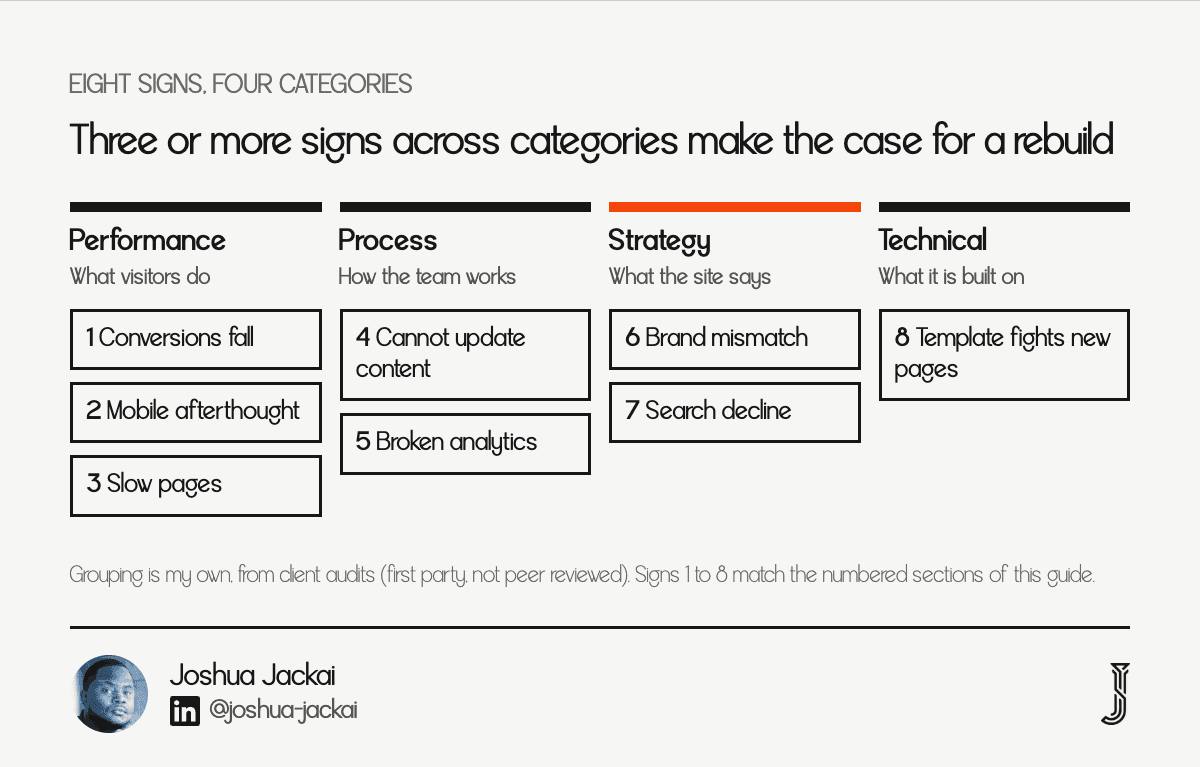
Fix costs here are my estimates from client work, not published figures.
What does it cost to wait?
Waiting costs the leads the site does not capture each month, and that sum is usually larger than the build price. Use the calculator for your own numbers. The defaults are placeholders, not benchmarks: change them to your monthly visitors, your current conversion rate and the rate you think is reachable.
Monthly visitors: 3,000 (placeholder)
Current conversion rate: 1% (placeholder)
Target conversion rate: 3% (placeholder)
Value of a lead: your own number, from your CRM
With those placeholders, 3,000 visitors a month produce 30 leads at 1% and 90 at 3%. The gap is 60 leads a month, or 720 a year. Multiply 720 by your lead value and compare it with a build between $3,250 and $14,999. If one qualified lead is worth $2,000 to you, 60 leads a month is a large number against the price.
That arithmetic is mine and rests on your inputs. A conversion target of 3% is not a promise, so treat it as a question: what would it be worth if it were true? The website redesign cost guide breaks the build price down, and the timeline guide shows how long the work takes.
When is a redesign the wrong answer?
A redesign is the wrong answer when one or two signs are true and the platform is sound. Fix those first: a faster host, a rewritten hero, tracking that works. A rebuild earns its cost when the problems are structural and interlocking, meaning they share a cause and a fix in one place does not hold.
If you are unsure which case you are in, the redesign checklist will tell you quickly. Run it against your top five pages, and count signs, not feelings. I would rather tell you that three fixes are enough than sell you a rebuild you do not need, and I have done that on more than one scoping call.
Frequently asked questions
How do I know if the site or the traffic is the problem?
Split conversion rate by source and device. If good traffic arrives and does not convert, the site is the problem. If one campaign fell and the others held, the targeting is. Volume tells you little, because conversion is the ratio that separates a site problem from a traffic problem.
My site looks fine. Can it still need a redesign?
Yes. Looking fine and working are different tests. Structure, speed and conversion paths are invisible in a screenshot. People judge appearance in 50 milliseconds (Lindgaard et al., 2006), but they stay or leave for reasons the screenshot does not show.
How long does a website last before it needs a redesign?
In my experience, four to six years for a well-built site. Sites built on a visual trend age faster, because the trend, not the structure, was the point. This is my rule of thumb from client work, not a published statistic, so use your signs, not the calendar.
How much does a website redesign cost?
At Demand Designer, builds are fixed-price: $3,250, $4,850, $6,950, $9,750 or $14,999, depending on scope (price list, October 2026). Agency quotes usually run higher, and the redesign cost guide compares published ranges with their sources and dates, so you can check any quote against them.
Who can run this test on your site?
I am Joshua Jackai, founder of Demand Designer, a solo web design studio, and I build B2B websites on Framer, WordPress, Shopify and HubSpot at fixed prices from $3,250 to $14,999. I start by counting which of these eight signs apply, and the scoping call tells you whether you need a rebuild or three fixes.
To see where your site leaks leads before you spend anything, start with the Pipeline Leak Scorecard, a fifteen minute check. When you have a count, you can book a free scoping call and send the URL. If the answer is three fixes, that is what you will hear.
Sources
Peer-reviewed research
Lindgaard, G., Fernandes, G., Dudek, C., Brown, J. (2006). Attention web designers: you have 50 milliseconds to make a good first impression! Behaviour and Information Technology, 25(2). doi.org/10.1080/01449290500330448
Nah, F. (2004). A study on tolerable waiting time: how long are Web users willing to wait? Behaviour and Information Technology. doi.org/10.1080/01449290410001669914
Galletta, D., Henry, R., McCoy, S., Polak, P. (2004). Web site delays: how tolerant are users? Journal of the Association for Information Systems. doi.org/10.17705/1jais.00044
Fogg, B. J., Soohoo, C., Danielson, D., Marable, L. (2003). How do users evaluate the credibility of Web sites? Proceedings of the 2003 Conference on Designing for User Experiences. doi.org/10.1145/997078.997097
Kohavi, R., Longbotham, R., Sommerfield, D., Henne, R. (2008). Controlled experiments on the web: survey and practical guide. Data Mining and Knowledge Discovery. doi.org/10.1007/s10618-008-0114-1
Erlikh, L. (2000). Leveraging legacy system dollars for e-business. IT Professional. doi.org/10.1109/6294.846201
Monat, J. P. (2011). Industrial sales lead conversion modeling. Marketing Intelligence and Planning. doi.org/10.1108/02634501111117610
Banker, R. D., Datar, S. M., Kemerer, C. F., Zweig, D. (1993). Software complexity and maintenance costs. Communications of the ACM. doi.org/10.1145/163359.163375
Industry, vendor and first-party
Social Media Today, 4 telltale signs you need a website redesign, read 25 October 2026 (trade publication reporting a Google study, not peer reviewed). socialmediatoday.com
Demand Designer build prices, the fix-cost estimates, the four to six year rule of thumb and the Advisor Websites result are from my own client work and price list, October 2026 (first party, not peer reviewed). demanddesigner.com/pricing
Free workbook
Pipeline Leak Scorecard
Find the leaks between your traffic and your pipeline. Score your site in about fifteen minutes, with it open in front of you.
12 questions, 8 pages, 15 minutes. Free.