Web Design
6 Website Redesign Timelines Compared: 2026 Field Guide

Joshua Jackai
17 min

Published September 2026 · Last updated and fact-checked 23 October 2026
Short answer: A website redesign takes Demand Designer two to eight weeks on fixed-price projects, while Webstacks puts a standard B2B redesign at three to four months (Webstacks, updated 21 October 2026). Clique Studios reports projects running 30 to 50 percent over estimate when content is late or approvals are slow, so reply speed can move the date.
My clock runs from kickoff to live. Agency figures usually include discovery and the wait for a start date, which Design Studio UI/UX puts at two to four weeks after signing, so compare the two with that in mind.
Most timeline guides give you one number and a shrug. The number that matters is the one for your project type, and it changes by weeks depending on four things you control: how ready the copy is, how fast your team replies, how many people approve, and whether you also change platforms. This guide gives six timelines, from a focused marketing site to an ecommerce replatform, and shows where each one stretches.
I am Joshua Jackai, founder of Demand Designer, a solo web design studio. The timelines for my own work come from the projects I have run, including a Figma to HubSpot build for Snappy Kraken in 21 days. I have no dataset of other studios, so the agency figures are vendor estimates read on the dates shown and labelled as such. I wrote this for founders and heads of marketing at B2B companies selling in the United States, many of them running on EOS (not affiliated with EOS Worldwide). Once you know your timeline, the website redesign process guide explains what happens in each stage, and the redesign checklist lists what to have ready.
Key takeaways
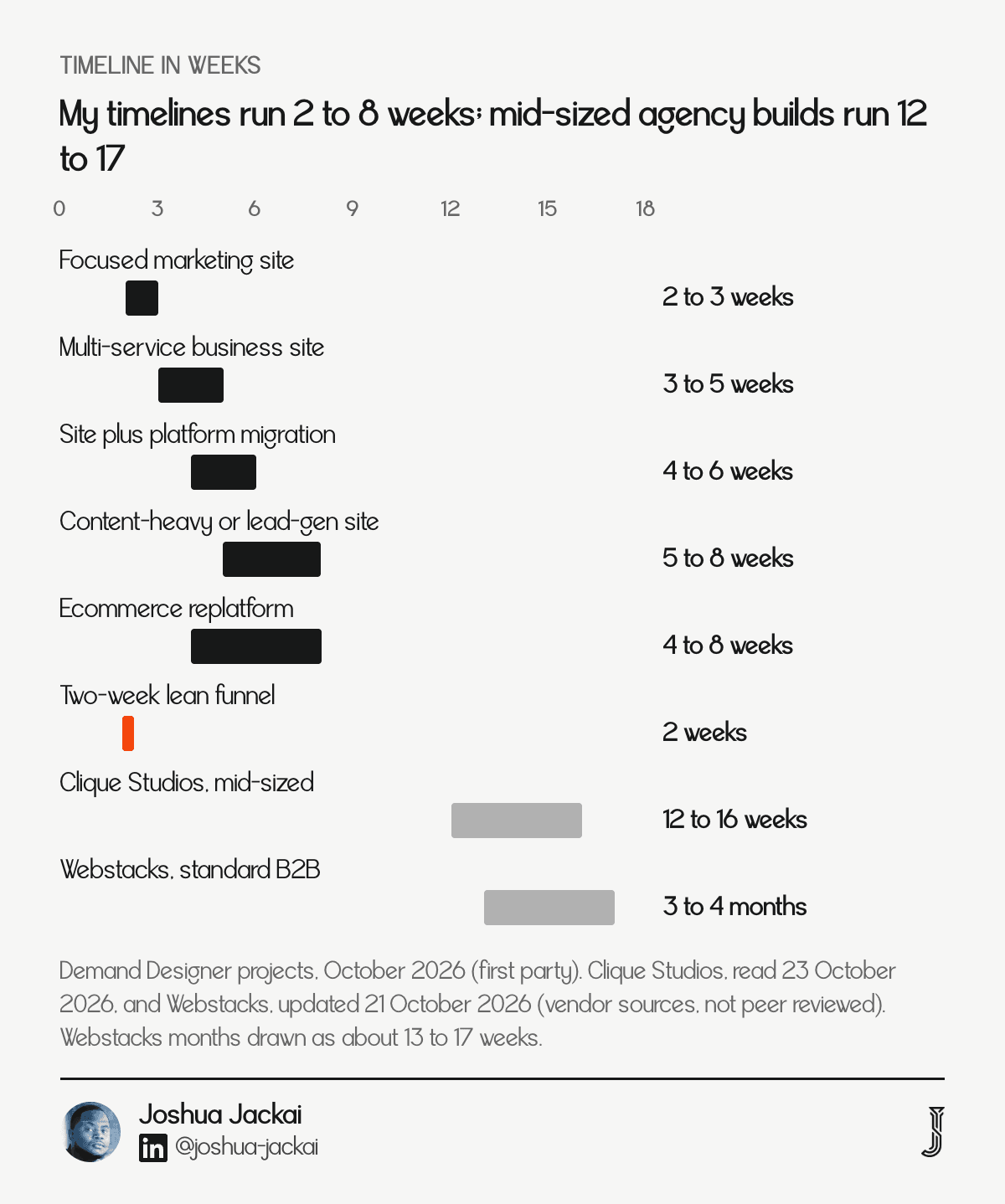
My timelines run 2 to 8 weeks, from a lean funnel to a content-heavy or ecommerce site, measured from kickoff to live.
Webstacks puts a focused redesign at six to eight weeks and a standard B2B redesign at three to four months, so the same firm quotes a different range for a different scope (Webstacks, updated 21 October 2026).
Clique Studios reports projects running 30 to 50 percent past their estimates when stakeholders delay decisions or content is not ready (Clique Studios, read 23 October 2026).
A platform migration adds one to two weeks on my projects, and Atiba puts it at two to three months on larger agency builds (Atiba, updated 30 March 2026).
Fixed-price builds at Demand Designer run from $3,250 to $14,999, and the timeline depends on scope and reply speed, not on the price tier.
People who plan from the plan alone underestimate how long tasks take, even when they know similar tasks ran late before (Buehler, Griffin and Ross, 1994).
Project type | My timeline | Main variable | Agency estimate |
|---|---|---|---|
1. Focused marketing site | 2 to 3 weeks | Copy readiness | 4 to 6 weeks for 5 to 15 pages |
2. Multi-service business site | 3 to 5 weeks | Page count and templates | 8 to 12 weeks for 10 to 20 pages |
3. Site plus platform migration | 4 to 6 weeks | Content volume and redirects | Adds 2 to 3 months |
4. Content-heavy or lead-gen site | 5 to 8 weeks | CMS architecture | 3 to 4 months |
5. Ecommerce replatform | 4 to 8 weeks | Product and order data | Redirect work scales with products |
6. Two-week lean funnel | 2 weeks | Fixed scope, fixed date | 6 to 10 weeks for essential pages |
1. Focused marketing site: best for a launch inside three weeks
A focused marketing site takes me two to three weeks from kickoff to live, as long as the copy is ready on day one. Agencies quote longer: Design Studio UI/UX puts a 5 to 15 page site at four to six weeks. Copy readiness is the one variable that moves the date more than any other.
My timeline: 2 to 3 weeks, kickoff to live
Main variable: copy readiness
Agency estimate: 4 to 6 weeks for 5 to 15 pages (Design Studio UI/UX, 10 August 2026)
Fits: one offer for one audience, with the message already decided
Breaks when: copy arrives after design has started
The reason this type is quick is that nothing in it needs inventing. The offer, the audience and the proof already exist, so design is a matter of arranging them, and the build is a handful of templates. The days go missing when the words are not finished. A designer cannot size a headline that has not been written, so every late paragraph pushes layout work back with it. I ask for the copy, or an agreed outline of it, before the first design day, and I price copywriting into the scope when a client does not have it. Cuberto, a design studio, gives a similar picture: it estimates a focused visual refresh at four to six weeks and a small custom marketing site at one and a half to two months (Cuberto, read 23 October 2026). My two to three weeks is shorter because I work alone, with no handoffs between roles.
"I ask for the copy, or an agreed outline of it, before the first design day," said Joshua Jackai, founder of Demand Designer.
2. Multi-service business site: best for teams with several offers to explain
A multi-service site takes me three to five weeks. Page count and the number of distinct page templates set the pace, because each template needs its own design and build. Clique Studios puts a 10 to 20 page small business site at eight to twelve weeks, so a quote from an agency can run well above my range.
My timeline: 3 to 5 weeks, kickoff to live
Main variable: page count and number of templates
Agency estimate: 8 to 12 weeks for 10 to 20 pages (Clique Studios, read 23 October 2026)
Fits: three to six services, each needing a page of its own
Breaks when: every service page is designed as a one-off
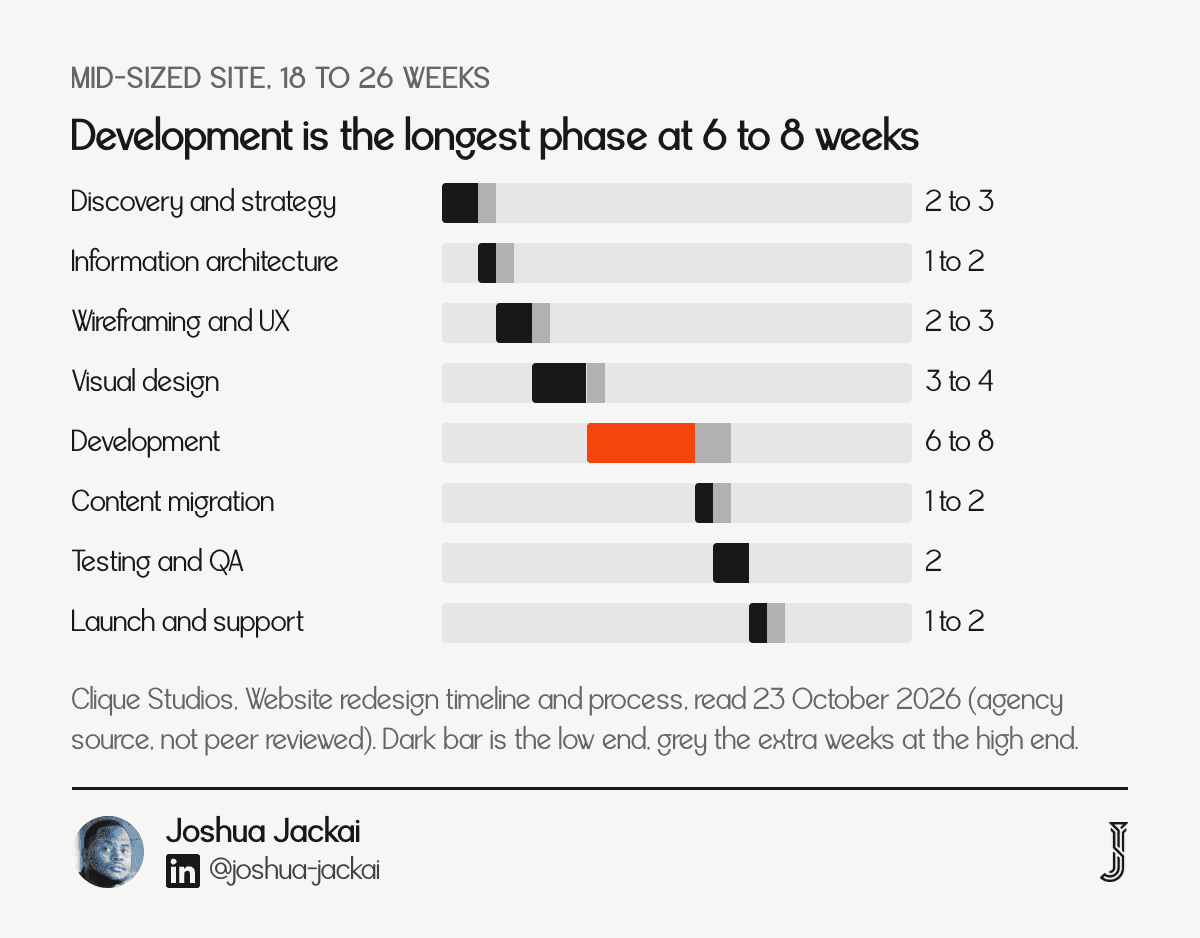
Page count is a weaker driver than template count. Ten pages built from two templates take less time than six pages that each have a custom layout. I sketch the page types first, usually a home page, a service page, a proof page and a contact page, and build one reusable template per type. A new service later becomes a copy exercise, not a design project. That is also where the extra week or two goes if you let it: a client who wants each service page to look different pays for it in calendar time. Clique Studios lists a mid-sized site at 12 to 16 weeks for 30 to 75 pages, and the same page totals a phase breakdown for a mid-sized site at 18 to 26 weeks, so treat its figures as a spread, not a promise. The phases are: discovery 2 to 3 weeks, information architecture 1 to 2, wireframing 2 to 3, visual design 3 to 4, development 6 to 8, content migration 1 to 2, testing 2 and launch 1 to 2 (Clique Studios, read 23 October 2026). My shorter figure holds because I run those phases in parallel where one person can. When a client adds a service mid-project, the template is already there, so the change costs a day of copy and review instead of a week of design.
"I sketch the page types first and build one reusable template per type," said Joshua Jackai, founder of Demand Designer.
3. Site plus platform migration: best for teams leaving WordPress, Webflow or a legacy CMS
Moving platforms adds one to two weeks on my projects, which puts a redesign with migration at four to six weeks. Content volume and redirect mapping are the work. Atiba, a web agency, says a CMS migration can add two to three months to a larger build.
My timeline: 4 to 6 weeks, kickoff to live
Main variable: content volume and redirects
Agency estimate: adds 2 to 3 months (Atiba, updated 30 March 2026)
Fits: a site stuck on a platform the team cannot edit
Breaks when: nobody owns the list of old URLs
A migration is two projects wearing one invoice. The redesign decides how the site looks and what it says. The migration decides what moves, what merges, what is retired and where each old address points. The second is slower than it looks, because every old URL that earned a ranking needs a permanent redirect, and a missing one costs search traffic. Atiba names the pattern: its example is a move from HubSpot to WordPress, and it flags sites with thousands of pages needing adjustment during development as the ones that run long (Atiba, updated 30 March 2026). I start with a crawl and a keep, merge or retire decision on every URL, which is covered in the WordPress to HubSpot migration guide and the WordPress to Framer migration guide. The audit takes one to two days and shortens the rest. Without it, redirect mapping happens at the end, under launch pressure, when mistakes are hardest to catch and most expensive to reverse.
"A migration is two projects wearing one invoice," said Joshua Jackai, founder of Demand Designer.
4. Content-heavy or lead-gen site: best for B2B teams with a content engine
A content-heavy or lead-generation site takes me five to eight weeks. The CMS architecture sets the pace: how many content types, how they relate, and how forms feed the CRM. Webstacks puts a standard B2B redesign at three to four months, a ninety to one hundred and twenty day range.
My timeline: 5 to 8 weeks, kickoff to live
Main variable: CMS architecture
Agency estimate: 3 to 4 months, a 90 to 120 day range (Webstacks, updated 21 October 2026)
Fits: a blog, resource library, gated assets and several lead forms
Breaks when: content types are decided after the templates are built
This is the type where decisions pile up fastest. A blog needs categories, authors and templates. A resource library needs filters. Gated assets need forms that pass the right fields to the CRM, and the CRM needs the same field names on both sides. Each connection is a small decision, and each decision waits on someone. Webstacks calls its standard B2B redesign 3 to 4 months, about 13 to 17 weeks, and a focused redesign six to eight weeks, which shows the same firm quoting by scope (Webstacks, updated 21 October 2026). I land at the short end of my range when the content model is fixed before design begins, and at the long end when it is argued over during the build. On Snappy Kraken I built the site from Figma to HubSpot in 21 days. Content models are cheap to change on paper and expensive to change in templates. That is why I fix the model, the field names and the form destinations in the first week, and ask the sales team to sign them off.
"Content models are cheap to change on paper and expensive to change in templates," said Joshua Jackai, founder of Demand Designer.
5. Ecommerce replatform: best for stores moving to a platform the team can run
An ecommerce replatform takes me four to eight weeks. Product and order data decide where in that range it lands. Atiba points out that a store with hundreds of products needs a redirect for each one (Atiba, updated 30 March 2026), and thousands of pages need adjustment during development.
My timeline: 4 to 8 weeks, kickoff to live
Main variable: product and order data
Agency note: one redirect per product, which scales with catalogue size (Atiba, updated 30 March 2026)
Fits: a store whose current platform limits checkout or catalogue control
Breaks when: product data is messy before the export
Design is the smaller part of a replatform. The slow part is getting products, variants, customers and order history from one system into another without losing the fields that matter. Clean data moves in a day. Product data with inconsistent names, missing images or duplicate entries needs a cleaning pass first, and that pass belongs to the store owner, who knows which entries are real. I ask for an export of the catalogue in the first week and run a test import before design is signed off, because a data problem found late costs more calendar time than any design change. Redirects follow the same rule: one per product, mapped from the export, checked in a crawl before the domain changes, and kept in a sheet the store owner can read. The WooCommerce to Shopify migration guide covers that path. I also schedule the final order-data sync for the week of launch, so the new store opens with current orders.
"A data problem found late costs more calendar time than any design change," said Joshua Jackai, founder of Demand Designer.
6. Two-week lean funnel: best for a fixed date and a fixed scope
The two-week lean funnel is a landing page plus the pages that support one offer, delivered in two weeks. The scope is fixed and the date is fixed, so nothing grows. Design Studio UI/UX puts the fastest realistic redesign at six to ten weeks for essential pages.
My timeline: 2 weeks
Main variable: fixed scope, fixed date
Agency estimate: 6 to 10 weeks for essential pages (Design Studio UI/UX, 10 August 2026)
Fits: one offer, one audience, one conversion action
Breaks when: someone asks for "just one more page"
Two weeks works because the project has no room for discovery or debate. The offer is decided, the copy is provided and one person approves. Anything that does not serve the single conversion goes on a phase-two list, not into the build. Design Studio UI/UX describes a minimum viable approach to a redesign as the fastest realistic path, at six to ten weeks (Design Studio UI/UX, 10 August 2026). My explanation for the gap is that the lean format removes decisions, which is my reading and not a vendor finding. It is also why I treat the two-week timeline as a scope promise more than a speed promise. Researchers describe the usual planning mistake: decision makers take an inside view that "anchors predictions on plans and scenarios" and ignore the record of similar projects (Kahneman and Lovallo, Management Science, 1993). In my practice a fixed scope guards against it, which is my inference and not theirs. The phase-two list keeps good ideas from being lost, and it keeps the launch date from moving.
"Overly optimistic forecasts result from the adoption of an inside view of the problem, which anchors predictions on plans and scenarios," wrote Daniel Kahneman and Dan Lovallo (Management Science, 1993).
"I treat the two-week timeline as a scope promise more than a speed promise," said Joshua Jackai, founder of Demand Designer.
What stretches a website redesign timeline?
Five things stretch a redesign: late content, slow feedback, scope added mid-project, custom functionality and approval by committee. Clique Studios reports overruns of 30 to 50 percent from these causes, and notes that feedback delays of two weeks or more add weeks to the schedule (Clique Studios, read 23 October 2026).
Content. Waiting on copy is the single most common delay, and it is almost always on the client side.
Feedback cycles. A two-day turnaround and a two-week turnaround are the difference between a three-week and a six-week project.
Scope added mid-project. Every "while we are in there" has a timeline cost, even when it is small.
Custom functionality. Booking systems, calculators and gated content are projects inside the project.
Approval by committee. Each additional approver adds days, not hours.
The same research recommends review rounds of three to five business days and says engaged, decisive clients finish 30 to 40 percent faster than clients who take weeks to reply. Those are vendor figures from one agency, so read them as a direction, not a law. A peer-reviewed result points the same way. Nidumolu studied 64 software projects and found that coordination run by authorized entities, such as a project manager or steering committee, reduced project uncertainty and residual performance risk, while day-to-day communication between users and the technical team had a direct positive effect on performance (Nidumolu, Information Systems Research, 1995). Translated for a website project, my inference and not the paper's finding: name one decision maker and keep the conversation direct.
What does a rushed website redesign timeline quietly cut?
A compressed schedule rarely cuts the design. It cuts research, structure and testing, because those are invisible in a review. Clique Studios says rush projects finish 25 to 30 percent faster and trade that against strategy, price and stress (Clique Studios, read 23 October 2026).
That trade is how a site ships on time and performs like the one it replaced. The website redesign process guide explains which stages carry the load, and the website redesign guide covers the decision as a whole. If the date is fixed by a trade show or a campaign, cut pages, never the audit or the testing. A smaller site that works beats a larger one that launches untested. I keep a phase-two list for everything removed, so a short schedule defers work and does not delete it.
Which website redesign timeline fits your project?
Match your project to one of the six types, then adjust for migration and how fast your team replies. The matrix puts all six side by side, so you can see which variable decides the date and what each costs in calendar time when it goes wrong.
Project type | My timeline | Main variable | What stretches it | Agency source |
|---|---|---|---|---|
Focused marketing site | 2 to 3 weeks | Copy readiness | Late copy | Design Studio UI/UX: 4 to 6 weeks |
Multi-service business site | 3 to 5 weeks | Page count and templates | One-off page designs | Clique Studios: 8 to 12 weeks |
Site plus platform migration | 4 to 6 weeks | Content volume and redirects | No owner for old URLs | Atiba: adds 2 to 3 months |
Content-heavy or lead-gen site | 5 to 8 weeks | CMS architecture | Content model changes mid-build | Webstacks: 3 to 4 months |
Ecommerce replatform | 4 to 8 weeks | Product and order data | Messy product data | Atiba: one redirect per product |
Two-week lean funnel | 2 weeks | Fixed scope, fixed date | Extra pages | Design Studio UI/UX: 6 to 10 weeks |
How long will your own redesign take?
Take the timeline for your project type, add one to two weeks if you are changing platforms, then add the weeks your review rounds cost. Assume three review rounds, and count every day past two that your team takes to reply. This is my planning arithmetic, not a measured law, and the defaults are placeholders.
For a multi-service site at the three to five week range, a team that replies in seven days instead of two adds five days across each of three rounds. That is fifteen working days, or three weeks, so a four week project becomes a seven week project. Clique Studios gives the same warning in other words: feedback delays of two weeks or more add weeks to the timeline. Run the same sum with your own reply time before you agree a launch date.
"A four week project becomes a seven week project when review rounds take seven days instead of two," said Joshua Jackai, founder of Demand Designer.
How do you move a redesign faster, safely?
Prepare before the project starts. Four moves shorten almost any timeline without cutting the stages that matter: have the copy ready, name one decision maker, agree a reply time in days and freeze scope at structure sign-off. None of them removes research or testing.
Arrive prepared. The redesign checklist is most of the trick.
Name one decision maker and agree a feedback turnaround in days.
Have copy ready, or buy copywriting as part of the scope instead of discovering the gap later.
Freeze scope at the structure sign-off and keep a list for phase two.
Buehler, Griffin and Ross found that people underestimate their own task completion times even when they know past similar tasks took longer than planned (Buehler, Griffin and Ross, Journal of Personality and Social Psychology, 1994). Writing the agreed reply time into the contract is my practical answer to that optimism, because it replaces a hope with a date. The paper documents the bias and does not test this fix.
Frequently asked questions
How long does a website redesign take?
Two to eight weeks on my fixed-price projects, measured from kickoff to live. Webstacks puts a standard B2B redesign at three to four months, and Clique Studios puts enterprise builds with complex integrations at six to twelve months. Scope, reply speed and platform changes decide where yours lands.
Can a website be redesigned in a week?
A landing page or a very focused site, yes. A full business site in a week means something important was skipped. The fastest realistic redesign I run is the two-week lean funnel, which works because scope and date are fixed before the project starts.
Why do agencies quote three to six months?
Agencies quote three to six months because of larger teams, more approval layers and longer discovery phases. Atiba puts a typical redesign at three to six months. In my experience the work rarely needs that long for a business marketing site.
Does migrating platforms add time?
Migrating platforms adds one to two weeks on my projects, mostly for content migration and redirect mapping. Atiba says a CMS migration can add two to three months to a larger build. Content volume and the number of old URLs that need permanent redirects set the difference.
When should I start before my launch date?
For a standard agency B2B project, start about 90 to 120 days ahead; for my fixed-scope projects, book the kickoff date first. Design Studio UI/UX puts the gap between signing and kickoff at two to four weeks, and Clique Studios adds a holiday buffer of one to two weeks.
Who can run a website redesign on a fixed date for a B2B team?
Demand Designer, a solo web design studio founded by Joshua Jackai, runs fixed-price redesigns from $3,250 to $14,999 with a launch date stated up front and the assumptions written beside it. I start by asking who approves, how fast they reply and whether the copy exists.
To see where your current site loses leads before you plan a redesign, start with the Pipeline Leak Scorecard, a fifteen minute check, or book a free scoping call.
Sources
Peer-reviewed research
Buehler, R., Griffin, D., Ross, M. (1994). Exploring the "planning fallacy": why people underestimate their task completion times. Journal of Personality and Social Psychology. doi.org/10.1037/0022-3514.67.3.366
Kahneman, D., Lovallo, D. (1993). Timid choices and bold forecasts: a cognitive perspective on risk taking. Management Science. doi.org/10.1287/mnsc.39.1.17
Nidumolu, S. (1995). The effect of coordination and uncertainty on software project performance: residual performance risk as an intervening variable. Information Systems Research. doi.org/10.1287/isre.6.3.191
Industry, vendor and first-party
Webstacks, How long should a website redesign take, updated 21 October 2026 (vendor source, not peer reviewed). webstacks.com
Clique Studios, Website redesign timeline and process, read 23 October 2026 (agency source, not peer reviewed). cliquestudios.com
Atiba, How long does it take to redesign a website, updated 30 March 2026 (agency source, not peer reviewed). atiba.com
Design Studio UI/UX, How long does a website redesign take, published 10 August 2026 (agency source, not peer reviewed). designstudiouiux.com
Cuberto, How long does a website redesign take, read 23 October 2026 (agency source, not peer reviewed). cuberto.com
Demand Designer timelines, the Snappy Kraken build and fixed prices are from my own client work and pricing, October 2026 (first party, not peer reviewed). demanddesigner.com/pricing
Free workbook
Pipeline Leak Scorecard
Find the leaks between your traffic and your pipeline. Score your site in about fifteen minutes, with it open in front of you.
12 questions, 8 pages, 15 minutes. Free.