Web Design
Website Redesign Cost in 2026: Real Prices and a Budget Worksheet

Joshua Jackai
17 min

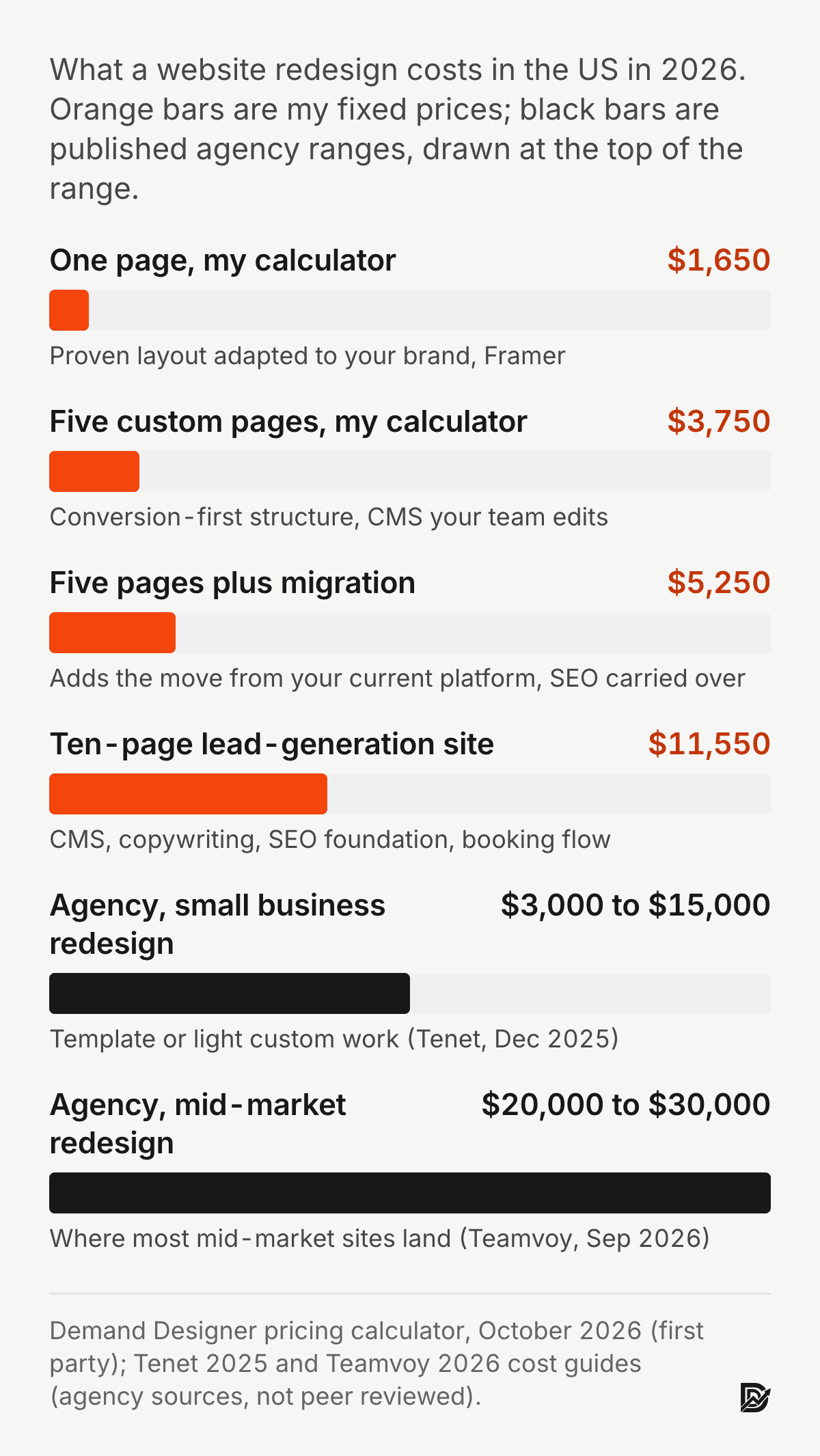
Short answer: A website redesign costs $3,000 to $160,000+ at US agencies in 2026 (Tenet, December 2025). Small business redesigns land between $3,000 and $15,000, and most mid-market B2B redesigns between $20,000 and $30,000 (Teamvoy, September 2026). My fixed prices start at $1,650 for one page and $3,750 for five custom pages.
Most cost guides hedge with “it depends.” This one gives you my actual price ladder, the ranges US agencies publish, what each price buys, and a worksheet to build your own budget before a sales call. I run Demand Designer, a solo web design studio, and I quote fixed prices, so every number of mine here is one I would put on an invoice.
Key takeaways
A professional redesign starts at $1,650 on my Framer calculator; five custom pages are $3,750 and a ten-page lead-generation site is $11,550.
US agencies publish ranges from $3,000 to $160,000+, with small business redesigns at $3,000 to $15,000 and most mid-market sites at $20,000 to $30,000.
Four things move the price: page templates, content migration, custom functionality and integrations.
A refresh costs a fraction of a redesign, and a rebuild on a new platform often costs about the same as deep surgery on an old one.
The cheapest quote is rarely the cheapest outcome. In one lab study, people rated a site’s visual appeal after 50 milliseconds (Lindgaard et al., 2006), and lost rankings never appear on the invoice.
What does a website redesign cost with me? My price ladder
These are real quotes from my pricing calculator for Framer builds on the standard timeline. The same scope costs about 20% more on WordPress and 30% more on HubSpot, because those platforms carry more setup and migration work:
Scope | Price | What it covers | Typical fit |
|---|---|---|---|
Starter | $1,650 | One page on a proven layout, adapted to your brand | Placeholder or single-offer sites |
Focused site | $3,750 | Redesign of five custom pages, conversion-first structure | Service businesses with a focused site |
Focused site with migration | $5,250 | Adds migration from your current platform with SEO carried over | Businesses replatforming |
Lead-generation site | $11,550 | Ten pages, CMS, conversion copywriting, SEO foundation, booking flow | Content-heavy or lead-gen sites |
Large site | $25,350 | Twenty pages, bespoke design system, CMS, copy, SEO, booking flow, motion | Teams treating the site as a sales asset |
Market context: US agencies publish redesign ranges from $3,000 to $160,000+ (Tenet, December 2025), most mid-market redesigns at $20,000 to $30,000 (Teamvoy, September 2026), and DIY redesigns at $100 to $3,500 (310 Creative, July 2026). The difference is rarely the pixels. It is whether anyone on the project is accountable for what the site produces after launch.
What makes a website redesign cost more?
Page count and templates. Ten pages built from four templates costs far less than ten bespoke pages. Most sites need fewer unique templates than their owners think.
Content migration. Moving 40 blog posts with their SEO intact is real work. Moving 400 is a project of its own. This is the most common source of surprise quotes.
Custom functionality. Booking systems, calculators, gated content, member areas. Each is a line item, not a rounding error.
Integrations. CRM, email platform, analytics, payment. Connecting them properly, with tracking that actually fires, is part of what separates a redesign from a reskin.
How much does a redesign cost on each platform?
A redesign costs about 20% more on WordPress and 30% more on HubSpot than the same scope on Framer. I build on all four, so these link to full per-platform breakdowns:
Framer website cost: typically the fastest and most cost-efficient for marketing sites. No plugin licensing, hosting included.
Shopify redesign cost: theme customization versus custom build is the fork in the road; apps add recurring costs.
HubSpot website cost: the highest-ticket category. Market rates for CMS Hub migrations run $16,000 to $63,000 at agencies; on my calculator, a five-page HubSpot site with migration is $6,825.
WordPress redesign cost: the widest price spread of any platform, because “WordPress redesign” can mean anything from a theme swap to a custom build.
Not sure which platform you should even be on? Start with the platform comparison instead; choosing the platform first changes every number on this page.
What do you get at each price level?
Under $3,000, you are almost always buying a template implementation: your content poured into someone else’s structure. That can be fine for a placeholder site. It is not a redesign.
From $3,000 to $8,000, you should expect custom design decisions, conversion structure, mobile-first build quality, on-page SEO carried over, and analytics that work on day one. If a quote in this range does not mention redirects or SEO preservation, ask why. Losing your rankings is the most expensive line item never written on an invoice; my migration guides explain what SEO-safe moves involve. Pricing a new build rather than a redesign? The B2B website cost guide covers that, and the website redesign guide covers the rest of the decision.
Above $10,000, you are buying strategy plus execution: research, funnel design, copy direction, and marketing infrastructure around the site. If a five-figure quote is only design and development, you are paying agency overhead, not getting more site.
Website redesign pricing: what is the average cost of redesigning a website?
Agency redesigns in 2026 mostly run $3,000 to $15,000 for small businesses and $20,000 to $30,000 for mid-market companies (Tenet, December 2025; Teamvoy, September 2026). No single average helps, because published ranges run from a $3,000 template refresh to a $160,000 enterprise rebuild. Grouped by company size, they look like this:
Small business, template or light custom work: $3,000 to $15,000 (Tenet, December 2025).
Basic redesign at an agency, by size and complexity: $5,000 to $75,000 (310 Creative, July 2026).
Mid-market business: most land at $20,000 to $30,000 (Teamvoy, September 2026).
Enterprise: above $80,000 at Tenet, and above $100,000 at Teamvoy citing Clique Studios.
DIY on a site builder: $100 to $3,500 in tools and templates, plus your own hours (310 Creative, July 2026).
My ladder sits under the agency mid-market because I work alone, build on Framer by default and do not bill for account management. A five-page custom redesign at $3,750 covers what most small B2B companies in the US need. If your site has 40 pages, a member area and three integrations, expect a number closer to the agency ranges, from me or anyone else.
How much does it cost to update an existing website instead?
Updating an existing website costs far less than a redesign, because you keep the structure, platform and content and change only what is broken. Agencies price standard page work at $200 to $800 a page (Tenet, December 2025), so a page-level update is a different budget line from a redesign.
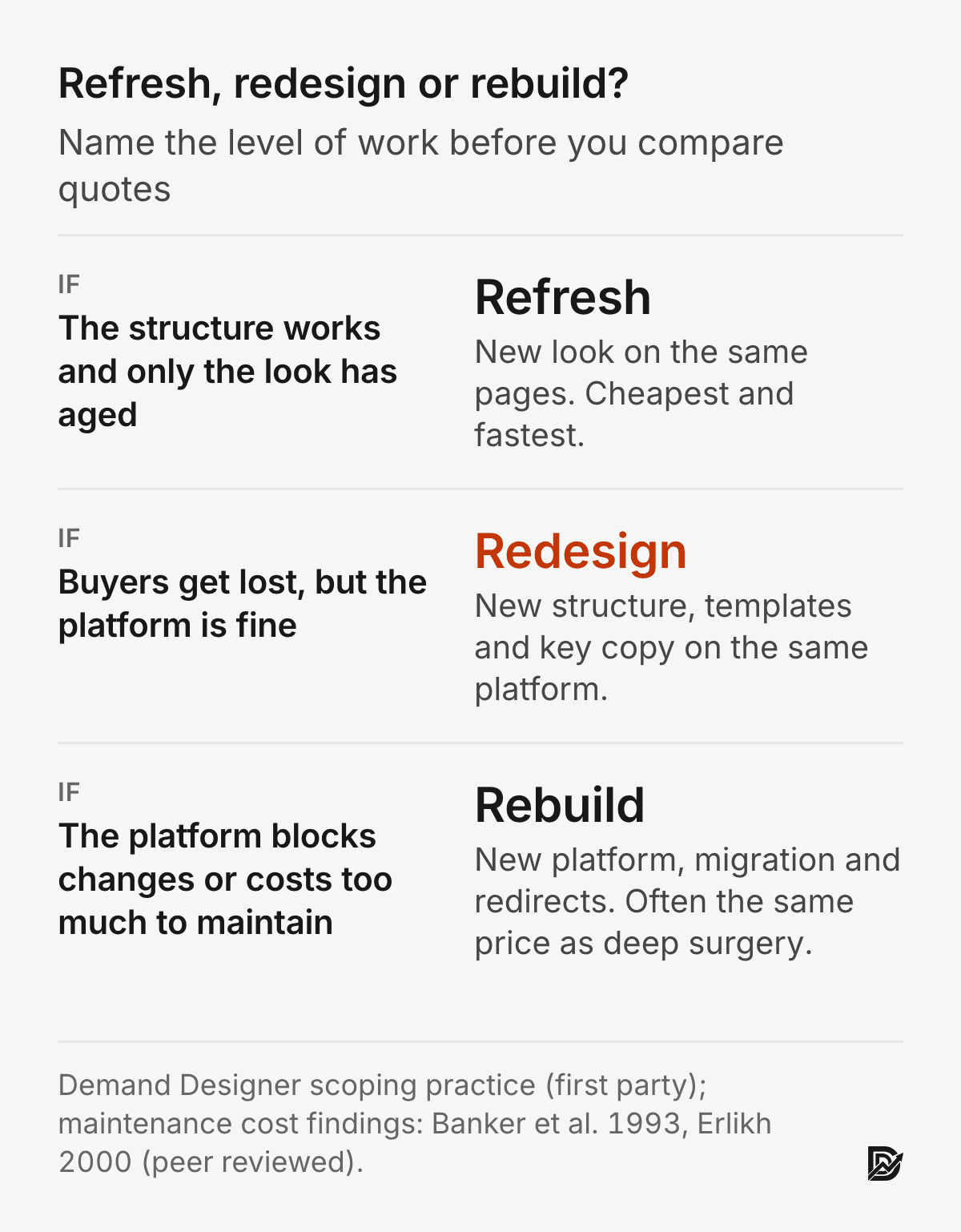
There are three levels of work, and people use the names loosely, so say which one you are buying:
Refresh: new look, same structure
New colours, type, images and copy edits on the pages you already have. It is the cheapest and fastest option, and right when the structure works and only the look has aged. It does not fix a site that confuses buyers.
Redesign: new structure, same platform
New page structure, new templates, rewritten key pages and rebuilt conversion paths. This is what most of this guide prices.
Rebuild: new platform
Everything in a redesign plus a move to a new platform, content migration and redirects. It often costs the same as or less than a deep redesign on an old platform, and ships faster, because nobody works around years of plugins and patches. General software research points the same way, though it studies legacy systems, not websites: complexity raises the cost of every later change (Banker et al., Communications of the ACM, 1993), and maintenance takes 85 to 90 percent of a system’s life-cycle cost (Erlikh, IT Professional, 2000). Treat that as a reason to ask the question, not as a measured website figure.
Is $1,500 a good price for a website?
$1,500 is a fair price for a one-page site on a proven layout, and a low price for a multi-page custom redesign. My one-page starter is $1,650. Below about $3,000 for a multi-page site, you are almost always buying a template with your content poured in.
That can be the right call for a placeholder or a single-offer site. Ask what the money covers: who writes the copy, whether redirects from your old URLs are included, whether analytics will fire on day one, and who fixes it when a form stops sending. A $1,500 site that loses your search traffic will cost you more than it saved.
Why is the look of a redesign worth paying for?
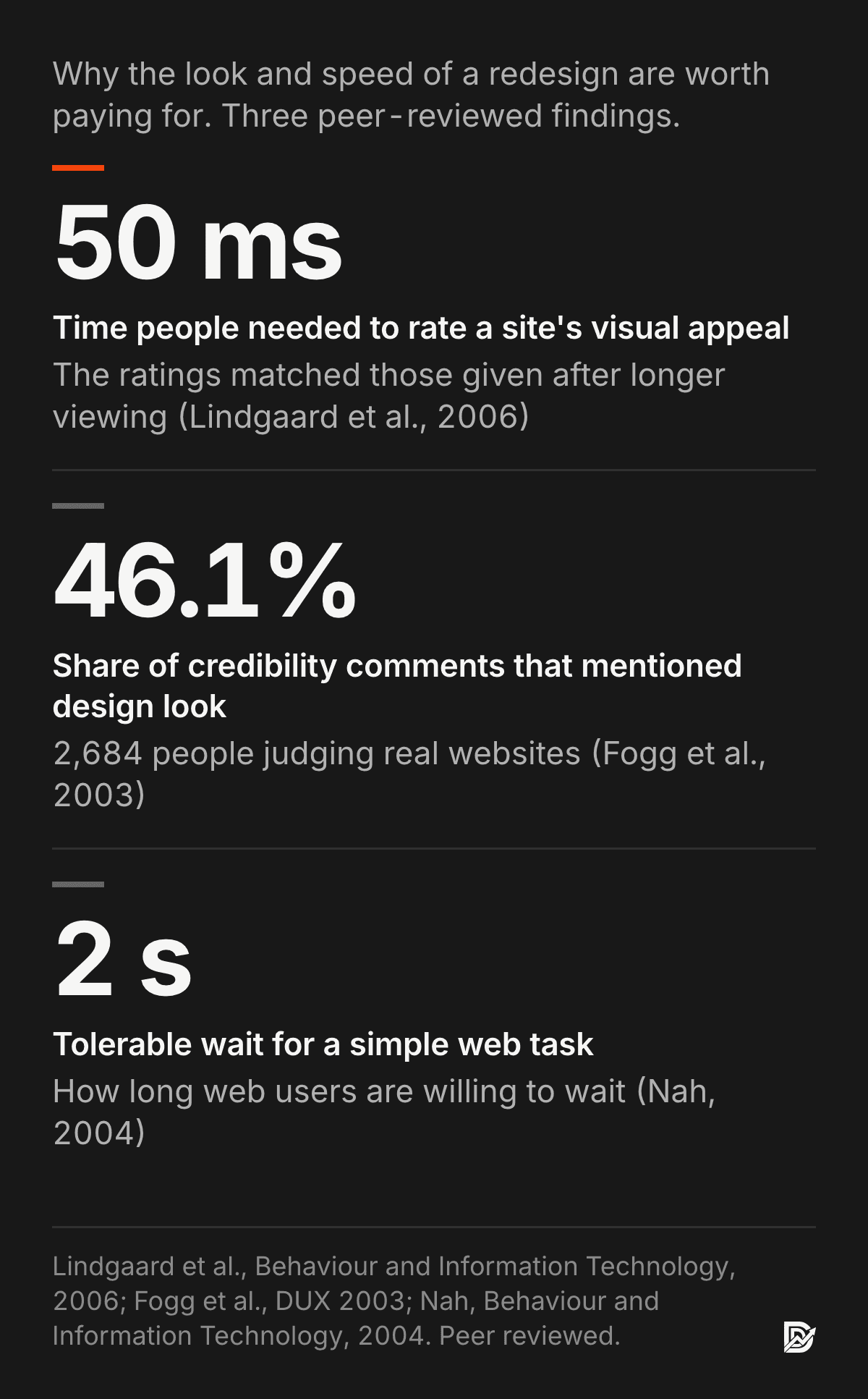
Visitors judge a website’s visual appeal within 50 milliseconds, and that first rating matches the ones they give after longer viewing (Lindgaard et al., Behaviour and Information Technology, 2006).
Tuch and colleagues found that sites with low visual complexity and a layout typical of their category were judged most appealing in those first impressions (Tuch et al., International Journal of Human-Computer Studies, 2012). Typical is the word that matters: a redesign that invents its own navigation pays for it on first view.
Looks also carry trust. In a study of 2,684 people judging real sites, the design look was the factor mentioned most often when they explained a site’s credibility, in 46.1 percent of comments (Fogg et al., DUX 2003). Speed counts too: users tolerate about two seconds of waiting for a simple web task (Nah, Behaviour and Information Technology, 2004), and slower pages lowered task performance, attitudes and intent to return (Galletta et al., Journal of the Association for Information Systems, 2004).
None of this means the most expensive site wins. It means the money should go to clear structure, a familiar layout, fast pages and credible proof, not to effects nobody asked for.
Can AI redesign my existing website?
AI tools can produce a redesign concept or a first-draft page in minutes, and some can rebuild a simple site for free. That lowers the drafting cost. It does not lower the migration, tracking and CRM work that make up much of a redesign’s price, and it cannot decide what your buyers need to see.
Which AI tool is best for a website redesign?
For layout drafts, the AI features built into Framer, Webflow and Wix, and general tools such as ChatGPT, are all usable. I use AI for first drafts of layouts and copy variations, then I check every claim, link and form by hand. Pick the tool that lives on the platform you will keep, so you are not exporting code into a second system.
Can I redesign my website with AI for free?
For a simple site, yes, on most builders’ free tiers, and the cost moves to your hours. The bill for a free AI redesign arrives later: no redirects from old URLs, copy that sounds like every other site, and tracking that does not fire. If the site brings in leads, budget for a person to check the migration and the conversion paths even when AI drafts the pages.
What costs show up after the redesign?
The build quote is one number; running the site is another. Plan for these before you sign:
Platform and hosting. Framer includes hosting in its site plan; WordPress needs separate hosting and plugin licences; Shopify and HubSpot charge monthly plans. My platform cost guides list current prices.
Maintenance. Updates, backups and fixes, done by your team or on a retainer.
Content. New pages, case studies and articles after launch, so the site keeps up with what you sell.
Tracking and testing. Someone has to read the numbers and change what does not work.
Switching later. Moving platforms again costs time, migration work and lost momentum, which is why the platform choice matters as much as the design (Farrell and Klemperer, Handbook of Industrial Organization, 2007).
How do I budget for a website redesign?
Build the budget from your scope, not from a range in a blog post. This is the worksheet I use on scoping calls:

Count templates, not pages. A 30-page site may need only five: home, service, case study, article and contact.
Count the content that has to move: pages, posts, images and PDFs, and decide what to drop before anyone quotes.
List every integration: CRM, email, booking, analytics and payments.
List custom features: calculators, gated content, member areas.
Price the platform for two years, not one, including plugins or apps.
Hold back about 10 percent for changes you will want once you see the first design.
Name who owns results after launch, and what that costs a month.
Put those answers in front of two or three providers and ask each to price the same list. Quotes you can compare line by line are worth more than any average.
What should a website redesign quote include?
A good quote names the deliverables, the timeline and what happens after launch, so you can hold it next to another one line by line. Before you sign, check that it covers:
Discovery: who your buyers are and what they need to see before they contact you.
The page list and templates, with the number of revision rounds.
Copy: who writes it, and whether it is in the price.
SEO carry-over: a redirect map for every old URL, page titles and descriptions, and a check in Search Console after launch.
Analytics and conversion tracking that fire on day one.
Integrations with your CRM and email platform.
Training so your team can edit pages without calling anyone.
Support after launch, and what it costs.
In B2B, several people take part in a purchase, from the people who will use what you sell to the person who signs the budget (Johnston and Bonoma, Journal of Marketing, 1981). Your site has to answer each of them, and a quote that only prices pages has not planned for that.
How do you redesign an existing website?
You redesign an existing website by deciding what it has to do, keeping what already works, and rebuilding the rest in a set order so nothing that ranks or converts gets lost. This is the order I work in, and each step is a line on the quote:
Pull the numbers first. Export every URL, its search traffic and its conversions, so you know which pages earn their place before anyone changes them.
Talk to buyers and sales. Find out what people need to see before they contact you, and which questions sales answers on every call.
Write the page list and templates. Merge thin pages, keep the ones that rank, and map each old URL to its new home.
Design the key templates, starting with the homepage and the main service page, then roll the system out to the rest.
Rewrite the copy for the pages that carry the sale. A new design on old copy is a refresh, not a redesign.
Build, connect and test forms, CRM, analytics and booking on phone, tablet and desktop before launch.
Launch with redirects live, resubmit the sitemap, and watch Search Console and lead volume for the next four to six weeks.
The website redesign process guide walks through each step in more detail, and the redesign checklist is the version to print.
Is paying for web design still worth it in 2026?
Yes, when the site is how buyers check you out before they talk to you, which is true for most B2B companies. Builders and AI tools have made a passable site cheap. They have not made a clear, credible, fast site that answers each person in a buying group cheap, and that is the part a budget pays for. If your site is a placeholder and every lead comes from referrals, spend less and put the money into what does bring in work.
Should you hire an agency, a freelancer or do it yourself?
Hire for the part you cannot do well yourself, and pay for accountability where the site makes money. Each route has a different price and a different failure mode:
Do it yourself
$100 to $3,500 in builders, templates and tools (310 Creative, July 2026), plus your own hours. It works for a placeholder or a one-offer site. It fails when nobody has time to write the copy, set up redirects or check that forms reach the CRM, which is most of the work that makes a redesign pay.
Hire a freelancer or a solo studio
Lower overhead than an agency, and you talk to the person doing the work. That is how I run Demand Designer. The risk is range: ask who handles copy, SEO carry-over and tracking, because one person may only cover design. Ask for a fixed price, a ship date and a written list of deliverables.
Hire an agency
The most expensive route, with mid-market redesigns at $20,000 to $30,000 (Teamvoy, September 2026), and the right one when you need a team at once: research, copy, design, development and paid media together. The risk is paying for account management and process you do not use. Ask who will work on your site day to day, and whether that person was on the sales call.
Whichever you pick, judge the quote on what the site has to do after launch, not on the number of pages.
How do you know if a redesign paid for itself?
A redesign pays for itself when the extra pipeline it creates covers the build cost, so measure leads and their quality, not traffic alone. Write down three numbers before launch: qualified leads a month, the rate at which visitors become leads, and what a closed deal is worth to you.
Then do the payback sum. Divide the build price by the gross profit from the extra deals the new site brings in each month. As an illustration only: if a $11,550 site adds one extra closed deal a quarter worth $15,000 in gross profit, it pays back in about two and a half quarters. If you cannot name what one extra deal is worth, settle that number before you set the budget.
Two of my own client projects show what to watch (first-party results, not peer reviewed). For Snappy Kraken I moved the site from Figma designs to HubSpot in 21 days, and the work contributed to a 30 percent rise in marketing qualified leads and a 28 percent rise in click-through rate. For Advisor Websites my work contributed to a 58 percent rise in organic traffic and a 28 percent rise in the rate at which visitors became marketing qualified leads. In both cases the number that mattered was qualified leads, which is why tracking has to work on day one.
How long does a website redesign take, and does speed change the price?
Most of my redesigns ship in two to eight weeks, depending on page count, content volume and how fast feedback comes back. Rushing rarely saves money: it moves the cost into fixes after launch. What does protect you is a fixed ship date with a penalty attached. If I miss the date for a reason on my side, the final invoice drops 10 percent for each week late, up to 30 percent.
Frequently asked questions
How much does a website redesign cost for a small business?
On my calculator, a five-page custom redesign is $3,750 on Framer, or $5,250 with migration from your current platform. That covers most small business redesigns done properly: custom design, a mobile-first build and SEO carried over.
Why do quotes for the same project vary so much?
Because “redesign” is not a standard scope. One quote means a theme swap; another means research, custom design, migration and marketing setup. Compare deliverables, never headline prices.
Is it cheaper to redesign or rebuild from scratch?
Often a rebuild on a modern platform costs the same or less than deep surgery on an old one, and ships faster.
How long does a website redesign take?
Two to eight weeks for most of my projects. Scope, content volume and how fast feedback comes back control the timeline.
What does maintaining the site cost after launch?
On Framer, hosting is included in the site plan and there are no plugin licences, so the running cost is mostly the plan itself. WordPress and Shopify carry recurring plugin, app and maintenance costs.
How much does a website redesign cost for a B2B company?
For a B2B site with ten to twenty pages, a CRM connection and case studies, my calculator lands between $11,550 and $25,350. US agencies put most mid-market redesigns at $20,000 to $30,000 (Teamvoy, 2026).
How often should you redesign a website?
Redesign when the site stops doing its job, not on a calendar: buyers cannot find what they need, the platform blocks changes, or the look no longer matches what you sell. Between redesigns, keep updating pages.
Can I redesign my website without losing SEO?
Yes. Keep or 301-redirect every URL, keep the page titles and content that rank, and check Search Console in the weeks after launch. Missing redirects are the most common cause of lost traffic I see after other people’s redesigns.
Sources
Peer reviewed
Banker, R. D., Datar, S. M., Kemerer, C. F. and Zweig, D. (1993). Software complexity and maintenance costs. Communications of the ACM. doi.org/10.1145/163359.163375
Erlikh, L. (2000). Leveraging legacy system dollars for e-business. IT Professional. doi.org/10.1109/6294.846201
Farrell, J. and Klemperer, P. (2007). Coordination and lock-in: competition with switching costs and network effects. Handbook of Industrial Organization. doi.org/10.1016/S1573-448X(06)03031-7
Fogg, B. J., Soohoo, C., Danielson, D. R., Marable, L., Stanford, J. and Tauber, E. R. (2003). How do users evaluate the credibility of Web sites? Proceedings of DUX 2003. doi.org/10.1145/997078.997097
Galletta, D. F., Henry, R., McCoy, S. and Polak, P. (2004). Web site delays: how tolerant are users? Journal of the Association for Information Systems. doi.org/10.17705/1jais.00044
Johnston, W. J. and Bonoma, T. V. (1981). The buying center: structure and interaction patterns. Journal of Marketing. doi.org/10.1177/002224298104500312
Lindgaard, G., Fernandes, G., Dudek, C. and Brown, J. (2006). Attention web designers: you have 50 milliseconds to make a good first impression! Behaviour and Information Technology. doi.org/10.1080/01449290500330448
Nah, F. F.-H. (2004). A study on tolerable waiting time: how long are Web users willing to wait? Behaviour and Information Technology. doi.org/10.1080/01449290410001669914
Tuch, A. N., Presslaber, E. E., Stöcklin, M., Opwis, K. and Bargas-Avila, J. A. (2012). The role of visual complexity and prototypicality regarding first impression of websites. International Journal of Human-Computer Studies. doi.org/10.1016/j.ijhcs.2012.06.003
Industry, agency and first-party
Tenet, Website redesign cost, 23 December 2025 (agency source, not peer reviewed). wearetenet.com
Teamvoy, Website redesign cost, updated 16 September 2026, citing Clique Studios and IT Path Solutions (agency source, not peer reviewed). teamvoy.com
310 Creative, How much does a website redesign cost in 2026?, updated 27 July 2026 (agency source, not peer reviewed). 310creative.com
Demand Designer pricing calculator and scoping worksheet, October 2026 (first party). demanddesigner.com/pricing
Free workbook
Pipeline Leak Scorecard
Find the leaks between your traffic and your pipeline. Score your site in about fifteen minutes, with it open in front of you.
12 questions, 8 pages, 15 minutes. Free.


