Web Design
Shopify Website Cost in 2026: Build Prices, Plans, Apps and Fees

Joshua Jackai
15 min

Short answer: A Shopify website costs $29 to $299 a month for the plan billed yearly (Shopify, September 2026), plus apps and card fees, and $5,000 to $19,700 to build on the Demand Designer calculator. Published agency budgets run from $6,000 to $15,000 for a small business store and $15,000 to $40,000 for stores with advanced features (Branded Agency, 2026, an agency source).
Shopify pricing has four layers that get mixed up: what you pay Shopify, what you pay for apps, what you pay per sale, and what you pay a designer. This guide prices each one in US dollars, gives you my real build quotes and the ranges agencies publish, and ends with a year-one budget you can copy. I run Demand Designer, a solo studio, and quote fixed prices, so every number of mine here is one I would put on an invoice.
Key takeaways
The plan is the small part: Shopify costs $29 a month on Basic billed yearly, $79 on Grow and $299 on Advanced; Plus starts at $2,300.
A professional build starts at $5,000 on the Demand Designer calculator; eight pages with a blog and up to 25 products is $10,950, and a 26 to 150 product catalog is $15,000.
Card fees beat plan fees once you sell: on Basic, a $100 sale costs $3.20 in Shopify Payments fees, and a third-party gateway adds 2 percent.
Apps are the cost nobody budgets. In my client work, app subscriptions usually land between $50 and $300 a month.
Spend the build budget where buyers decide: product pages, reviews, filters and the cost shown before checkout, not effects nobody asked for.
What are the cost layers of a Shopify website?
Layer | Typical cost | What moves it |
|---|---|---|
Shopify plan | $29 to $299 /mo billed yearly | Staff accounts, reporting, card rates, monthly or yearly billing |
Apps | $50 to $300 /mo | Reviews, subscriptions, bundles, email, search |
Design and build | From $5,000 | Theme customization versus custom templates |
Migration | Adds $1,875 | Product count, variants, order history |
Should you customize a theme or pay for a custom Shopify build?
This one fork explains most of the price range. A well-chosen premium theme, customized properly, gives you a strong store for a fraction of a custom build, and it stays upgradeable. A custom storefront earns its cost when your merchandising, bundling or brand cannot be expressed in a theme.
In my experience, most smaller brands get more from a customized theme plus real conversion work than from a custom build that leaves no budget for testing and fixes.
How much does it cost to build a Shopify website with me?
Scope | Price | What it covers |
|---|---|---|
Basic store | $5,000 | One page on an adapted theme, up to 25 products |
Storefront with migration | $12,825 | Eight pages with CMS, up to 25 products, plus migration from WooCommerce or another platform |
Catalog | $15,000 | Eight pages with CMS, 26 to 150 products |
Large catalog | $19,700 | Eight pages with CMS, 150 or more products |

At Demand Designer I price a Shopify build at $5,000 for a basic store, $8,150 for five custom pages, $10,950 for eight pages with a blog, $15,000 for 26 to 150 products and $19,700 for 150 or more. Migration from another platform adds $1,875 to any scope, so a 26 to 150 product catalog with migration is $16,875.
Every scope option is priced on the pricing page. Quotes over $15,000 are scoped on a call. For the cross-platform budget picture, see the website redesign cost pillar, and if you are still deciding whether Shopify is right, the platform comparison settles it faster.
How much does Shopify cost per month in 2026?
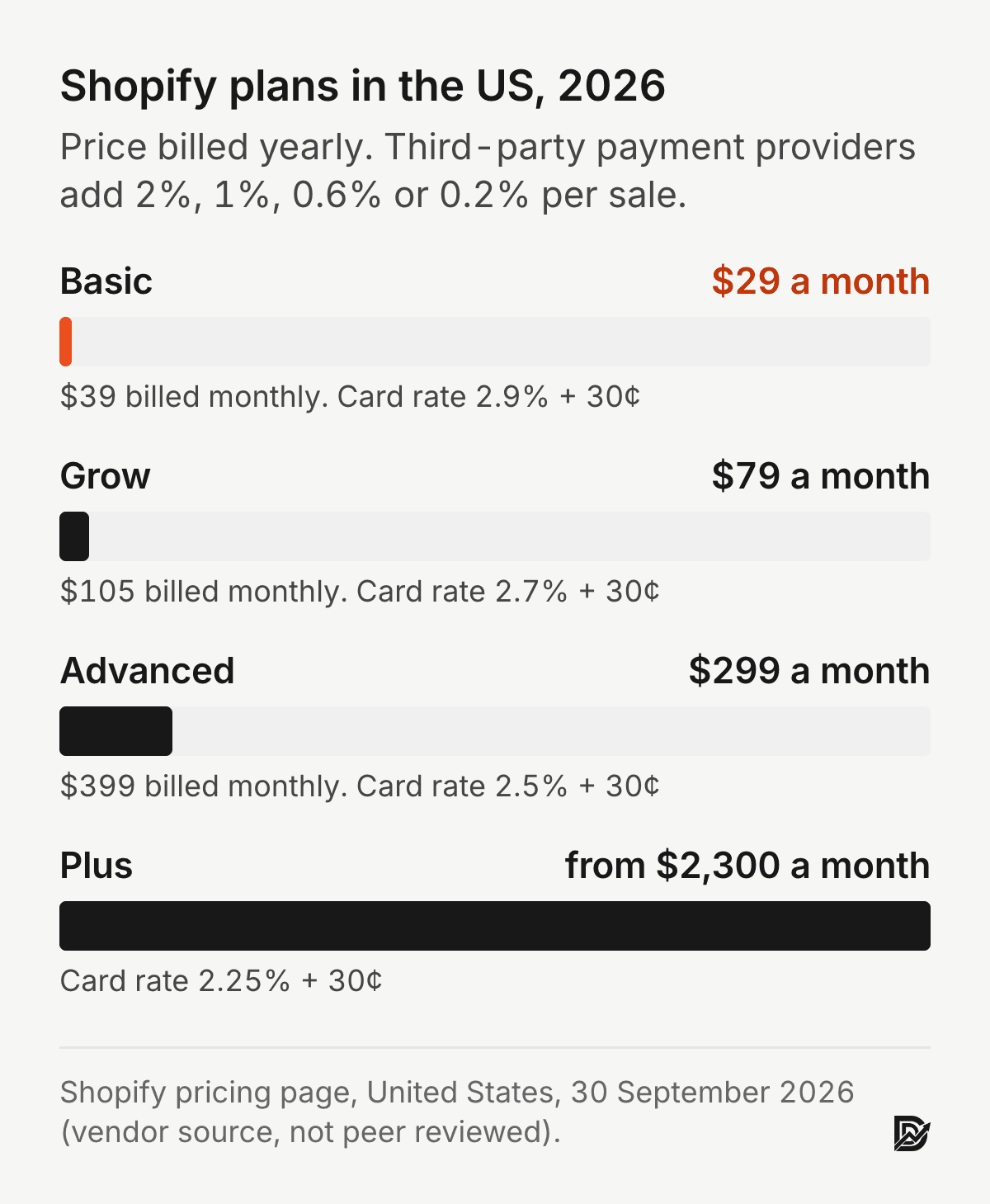
Shopify costs $29 to $299 a month in the US when billed yearly, or $39 to $399 billed monthly, before apps and card fees. Shopify Plus starts at $2,300 a month. These are Shopify’s list prices as published in September 2026 (Shopify, September 2026):
Basic: $29 a month billed yearly, $39 monthly. Online card rate from 2.9% + 30¢. For a solo founder.
Grow: $79 a month billed yearly, $105 monthly. Card rate from 2.7% + 30¢, up to 5 staff accounts.
Advanced: $299 a month billed yearly, $399 monthly. Card rate from 2.5% + 30¢, up to 15 staff accounts and live third-party shipping rates.
Plus: from $2,300 a month. Card rate from 2.25% + 30¢, unlimited staff accounts, a fully customizable checkout and unlimited B2B catalogs.
Hosting, an SSL certificate and unlimited products are included on every plan, so there is no separate hosting bill the way there is on WordPress. Yearly billing saves about 25 percent on Basic and Grow. If you are launching, start on Basic: you can move up a plan in a few clicks when staff accounts or card rates start to matter.
How much does Shopify take from a $100 sale?
On the Basic plan, Shopify Payments takes $3.20 from a $100 online card sale: 2.9 percent plus 30 cents. The same sale costs $3.00 on Grow, $2.80 on Advanced and $2.55 on Plus.
If you use a payment provider other than Shopify Payments, Shopify adds its own transaction fee on top of that provider’s rate: 2 percent on Basic, 1 percent on Grow, 0.6 percent on Advanced and 0.2 percent on Plus. On $20,000 a month in sales, that is $400 a month on Basic before your gateway charges anything. This is why the plan decision is really a card-rate decision once a store sells.
A quick way to choose: multiply your expected monthly online sales by the difference in card rates between two plans, then compare that with the difference in plan price. Moving from Basic to Grow saves 0.2 percent of sales and costs $50 a month more billed yearly, so it pays once you sell about $25,000 a month online.
How much do Shopify apps cost?
In my own client work, app subscriptions usually land between $50 and $300 a month. That is my experience, not a survey; published guides give $50 to $350 a month (Metizsoft, 2026). Reviews, email and SMS, search and filters, subscriptions, bundles and loyalty are the usual line items, and each one is a monthly bill, not a one-time purchase.
Pay for the apps that change what a buyer sees before they decide, and question the rest. Reviews are the clearest case. A study of book sales at Amazon and Barnes and Noble found that better reviews raised a book’s relative sales at that site. A one-star review hurt more than a five-star review helped, and buyers read the review text, not only the star average (Chevalier and Mayzlin, Journal of Marketing Research, 2006). A review app that collects real text reviews earns its fee; a third upsell widget usually does not.
Every app also adds weight to the storefront. Speed is not a nice-to-have: people tolerate about two seconds of waiting for a simple web task (Nah, Behaviour and Information Technology, 2004), and slower pages lowered task performance, attitudes and intent to return in a controlled experiment (Galletta et al., Journal of the Association for Information Systems, 2004). I remove unused apps before I quote any redesign, because their leftover scripts often outlive the subscription.
How much does Shopify website development cost?
A Shopify build costs under $1,000 if you do it yourself, $2,000 to $8,000 with a freelancer and $6,000 to $40,000 or more at an agency, and $5,000 to $19,700 on the Demand Designer calculator. The spread comes from who does the work and how much of the store is custom. Here is what each route costs and where it fails:
Do it yourself: under $1,000 in year one
A plan, a free or premium theme and a few low-cost apps; a first-time seller can launch for under $1,000 in year one (MageDelight, 2026). Premium themes on the Shopify Theme Store cost about $120 to $400 as a one-time purchase. It works for a first product or a test launch. It fails when nobody has time for product photography, copy, shipping rules and tax settings, which is most of the work that makes a store sell.
Freelancer or solo studio: $2,000 to $8,000 published, $5,000 to $10,950 with me
Published guides put freelance Shopify builds at $2,000 to $8,000 (MageDelight, 2026). My range sits from $5,000 for a basic store to $10,950 for eight pages with a blog, because each quote includes conversion structure, product page templates, analytics that fire on day one and SEO carried over. Ask any freelancer who writes the copy, who sets up redirects from your old URLs, and who fixes it when an app breaks the cart.
Agency: about $6,000 to $40,000, more on Plus
Branded Agency publishes illustrative budgets of $6,000 to $15,000 for a standard small business store, $15,000 to $40,000 for stores with advanced features and $40,000 to $150,000+ for Shopify Plus and enterprise work (Branded Agency, 2026). The agency route fits when you need research, photography, copy, development and paid media at once. The risk is paying for account management you do not use.
Why does the number of products change the price?
Product count changes the price because every product needs data, images, variants and a place in the navigation, and a big catalog needs collections, filters and search that work. On the Demand Designer calculator, a storefront of up to 25 products carries about 18 hours of catalog work, 26 to 150 products about 40 hours, and 150 or more about 65 hours.
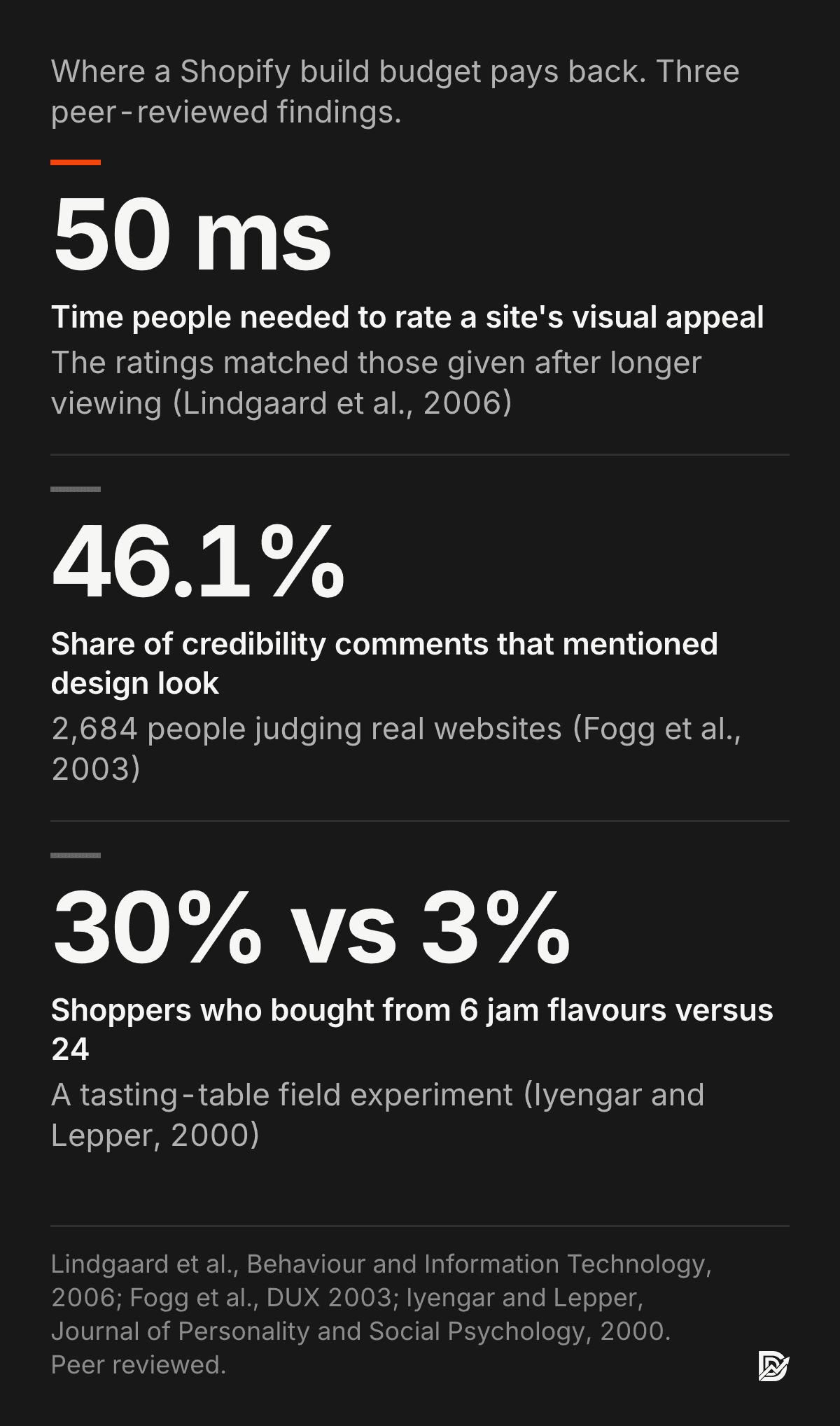
More choice is not always better for the buyer. In a well-known field experiment, shoppers who saw 6 jam flavours were far more likely to buy (30 percent) than shoppers who saw 24 (3 percent) (Iyengar and Lepper, Journal of Personality and Social Psychology, 2000). That was a tasting table, not a website, so treat it as a reason to spend catalog budget on filters, collections and a short list of best sellers, not on showing every product at once.
Why is a credible store design worth paying for?
Design money on a store buys credibility, which is what lets a stranger pay you before they hold the product.
Visitors judge a website’s visual appeal within 50 milliseconds, and that first rating matches the ones they give after longer viewing (Lindgaard et al., Behaviour and Information Technology, 2006). In a study of 2,684 people judging real sites, the design look was the factor mentioned most often when they explained a site’s credibility, in 46.1 percent of comments (Fogg et al., DUX 2003).
For a store this matters twice, because buyers cannot touch the product. Wells, Valacich and Hess found that website quality works as a signal of product quality, and that perceived product quality in turn shapes purchase intention (Wells et al., MIS Quarterly, 2011). Trust carries as much weight as ease of use: in a study of experienced repeat online shoppers, trust in the store was as important to purchase intention as how useful and easy the site was (Gefen, Karahanna and Straub, MIS Quarterly, 2003).
Which pages deserve most of a Shopify build budget?
Put the build budget into the pages where buyers decide: product pages, collection pages, the cart and the first screen of the homepage. Those templates are reused on every product, so an hour spent there pays back across the whole catalog.
Product page template: clear photos, the price and the total cost of delivery near the buy button, real reviews, and answers to the three questions your support inbox gets most.
Collection pages and filters: fewer, better-named collections and filters that match how buyers shop, by use or by size, not by your internal SKU logic.
Cart and shipping rules: show shipping cost and delivery time before checkout, and set a free-shipping threshold you can afford.
Speed: fewer apps, compressed images and no carousel nobody clicks.
Tracking: purchases, add-to-cart and checkout events firing in analytics on launch day, so you can see what the new store changed.
The cart line matters more than it looks. Concern about the total cost of an order, including shipping, is one of the drivers of online cart abandonment, and many shoppers use the cart to research and organise rather than to buy at once (Kukar-Kinney and Close, Journal of the Academy of Marketing Science, 2009). Shipping fees also changed how many customers ordered and how much they bought in a study of an online retailer (Lewis, Journal of Retailing, 2006). Shipping rules are a design decision, so I price them into the build.
How much does a Shopify website cost per year?
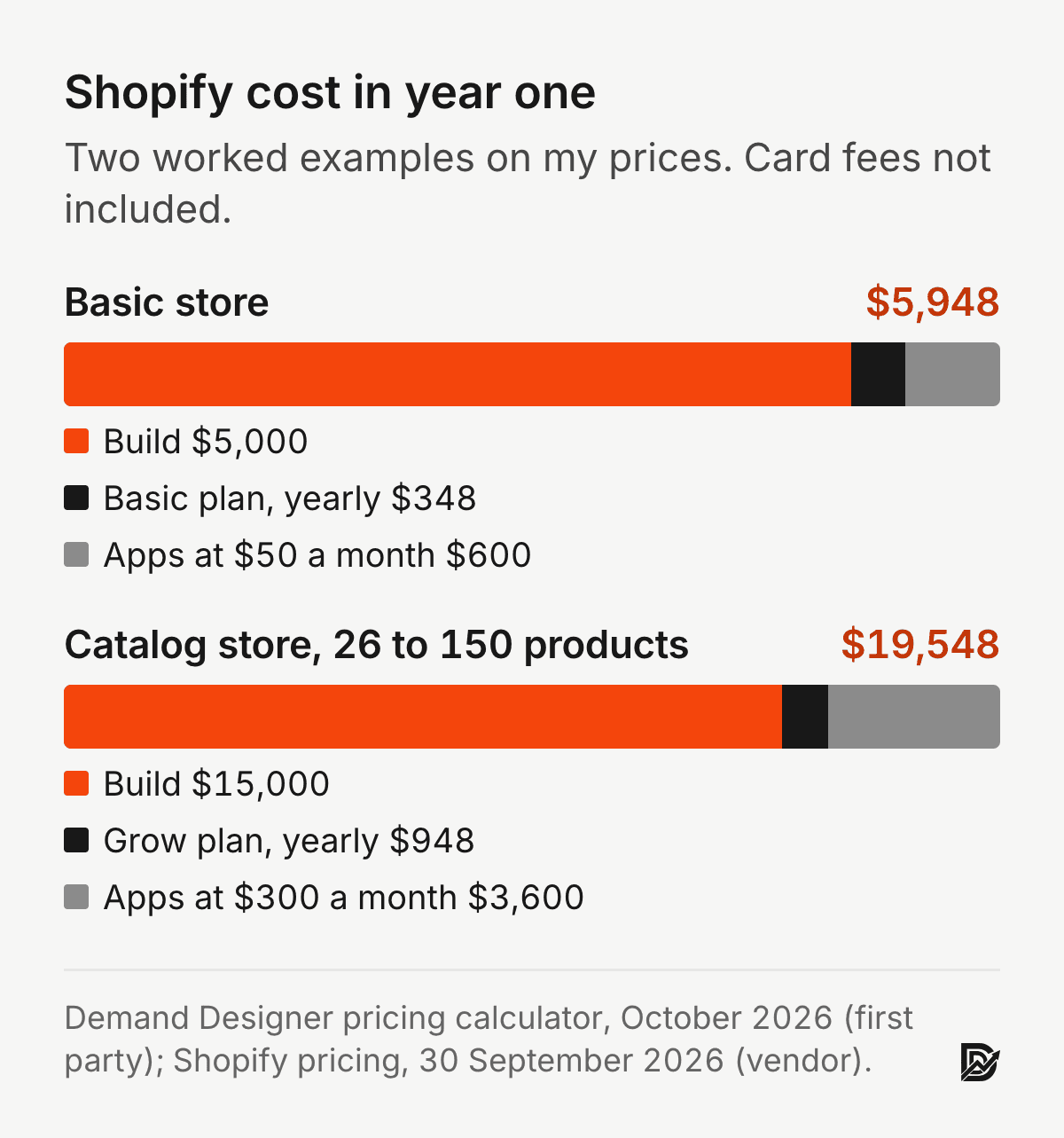
In year one, a professionally built Shopify store costs about $5,950 to $19,550 on Demand Designer prices: the build, a year of the plan and a year of apps, before card fees. After year one, the build cost drops out and you pay the plan, the apps and the fees. Two worked examples:
Basic store: $5,000 build + Basic billed yearly at $348 + $50 a month in apps ($600) = $5,948 in year one, then about $948 a year plus card fees.
Catalog store, 26 to 150 products: $15,000 build + Grow billed yearly at $948 + $300 a month in apps ($3,600) = $19,548 in year one, then about $4,548 a year plus card fees.
Add card fees on top: at 2.9 percent plus 30 cents, $10,000 a month in online sales across 200 orders costs about $350 a month in Shopify Payments fees on Basic. A domain bought through Shopify costs about $14 to $20 a year (MageDelight, 2026).
How much does Shopify website maintenance cost?
Shopify website maintenance costs about $50 to $150 a month for a small store, $150 to $500 for a growing brand and $500 to $1,500 for a large one (Metizsoft, 2026). Shopify runs hosting, security and platform updates, so what you pay for is app upkeep, theme updates, content changes and fixing conflicts.
The hidden maintenance cost is drift: apps added for one campaign and never removed, theme edits that block updates, and tracking that quietly stops firing. A quarterly review of apps, speed and checkout events catches most of it.
Is Shopify cheaper than WooCommerce?
Shopify usually costs more per month and less in upkeep than WooCommerce. WooCommerce itself is free, but you pay for hosting, premium extensions, security and the developer time to keep plugins working together. On the Demand Designer calculator the same scope costs about 4 percent less to build on WordPress than on Shopify, so the build price rarely decides it; the running cost and who maintains the store do.
Switching later is the expensive part. Economists call this lock-in: the more you have built on a platform, the more it costs to leave (Farrell and Klemperer, Handbook of Industrial Organization, 2007). Choose the platform for the next three years, not the next launch. If you are deciding now, the WordPress cost guide prices the other side and the WooCommerce to Shopify migration guide covers the move.
Is Shopify worth it for a small business?
Shopify is worth it for a small business that sells physical products online and wants hosting, checkout and security handled for it. It is less worth it when you sell one or two services, take bookings or need a content-heavy site; a Framer or WordPress site with a payment link usually costs less to build and run.
The checkout is the main reason I recommend it to product brands. Shopify handles PCI compliance and hosting on every plan (Shopify, September 2026), so a small team does not carry that work. Shopify also claims its checkout converts 15 percent better on average than other platforms; that is the vendor’s own claim, not an independent study, so I treat it as marketing, not evidence.
When does Shopify Plus make sense?
Shopify Plus makes sense when the cost of what Advanced cannot do is higher than about $2,000 a month extra. The usual triggers are a fully customized checkout, wholesale and B2B catalogs, many staff accounts, many retail locations or several stores. Below that, Advanced at $299 a month billed yearly covers most growing US stores, and the difference is better spent on the product pages and ads that bring buyers in.
Frequently asked questions
How much does Shopify cost per month?
Plans cost $29 to $299 a month billed yearly, or $39 to $399 billed monthly, and Plus starts at $2,300 (Shopify, September 2026). Add apps, which cost $50 to $300 a month on the stores I work on, and card fees from 2.9 percent plus 30 cents on Basic.
Is a custom Shopify theme worth it?
Only when a premium theme cannot express your merchandising or brand. For most stores, customizing a strong theme and spending the rest on product pages, filters and speed returns more.
How much does it cost to migrate from WooCommerce to Shopify?
On the Demand Designer calculator, migration adds $1,875 to the build, so an eight-page store with up to 25 products comes to $12,825. Product, variant, customer and order data migration is part of that scope, not a separate project.
Do I need a developer for Shopify?
Not for launch. You need one when you want behaviour a theme does not offer, when you move from another platform, or when app conflicts start costing you sales.
Can I build a Shopify store for under $500?
Yes, if you build it yourself on Basic with a free theme and free apps: a year of Basic billed yearly is $348. You still pay card fees on every sale, and your own time for photos, copy and setup.
Do I need to pay for hosting on Shopify?
No. Hosting, an SSL certificate and unlimited products are included in every Shopify plan, which is one of the main cost differences from WooCommerce.
Does a Shopify redesign cost more than a new build?
Usually about the same. A redesign keeps your products and data but has to work around old apps and theme edits; on the Demand Designer calculator it is priced on the same pages and products as a new build, plus migration if you change platforms.
Is Shopify free to start?
Not permanently. After any trial or introductory offer, Basic is $29 a month billed yearly or $39 monthly (Shopify, September 2026). Offers change, so confirm the current terms on Shopify’s pricing page.
Sources
Peer reviewed
Chevalier, J. A. and Mayzlin, D. (2006). The effect of word of mouth on sales: online book reviews. Journal of Marketing Research. doi.org/10.1509/jmkr.43.3.345
Farrell, J. and Klemperer, P. (2007). Coordination and lock-in: competition with switching costs and network effects. Handbook of Industrial Organization. doi.org/10.1016/S1573-448X(06)03031-7
Fogg, B. J., Soohoo, C., Danielson, D. R., Marable, L., Stanford, J. and Tauber, E. R. (2003). How do users evaluate the credibility of Web sites? Proceedings of DUX 2003. doi.org/10.1145/997078.997097
Galletta, D. F., Henry, R., McCoy, S. and Polak, P. (2004). Web site delays: how tolerant are users? Journal of the Association for Information Systems. doi.org/10.17705/1jais.00044
Gefen, D., Karahanna, E. and Straub, D. W. (2003). Trust and TAM in online shopping: an integrated model. MIS Quarterly. doi.org/10.2307/30036519
Iyengar, S. S. and Lepper, M. R. (2000). When choice is demotivating: can one desire too much of a good thing? Journal of Personality and Social Psychology. doi.org/10.1037/0022-3514.79.6.995
Kukar-Kinney, M. and Close, A. G. (2009). The determinants of consumers’ online shopping cart abandonment. Journal of the Academy of Marketing Science. doi.org/10.1007/s11747-009-0141-5
Lewis, M. (2006). The effect of shipping fees on customer acquisition, customer retention, and purchase quantities. Journal of Retailing. doi.org/10.1016/j.jretai.2005.11.005
Lindgaard, G., Fernandes, G., Dudek, C. and Brown, J. (2006). Attention web designers: you have 50 milliseconds to make a good first impression! Behaviour and Information Technology. doi.org/10.1080/01449290500330448
Nah, F. F.-H. (2004). A study on tolerable waiting time: how long are Web users willing to wait? Behaviour and Information Technology. doi.org/10.1080/01449290410001669914
Wells, J. D., Valacich, J. S. and Hess, T. J. (2011). What signal are you sending? How website quality influences perceptions of product quality and purchase intentions. MIS Quarterly. doi.org/10.2307/23044048
Industry, vendor and first-party
Shopify, Pricing (United States), as published 30 September 2026 (vendor source, not peer reviewed). shopify.com/pricing
Branded Agency, Shopify website costs in 2026, read 11 October 2026 (agency source, not peer reviewed). brandedagency.com
MageDelight, How much does it cost to build a Shopify website, read 11 October 2026 (agency source, not peer reviewed). magedelight.com
Metizsoft, Shopify website design pricing, read 11 October 2026 (agency source, not peer reviewed). metizsoft.com
Demand Designer pricing calculator, October 2026 (first party). demanddesigner.com/pricing
Free workbook
Pipeline Leak Scorecard
Find the leaks between your traffic and your pipeline. Score your site in about fifteen minutes, with it open in front of you.
12 questions, 8 pages, 15 minutes. Free.


