Web Design
WordPress Website Cost in 2026: Build Prices and Yearly Totals

Joshua Jackai
17 min

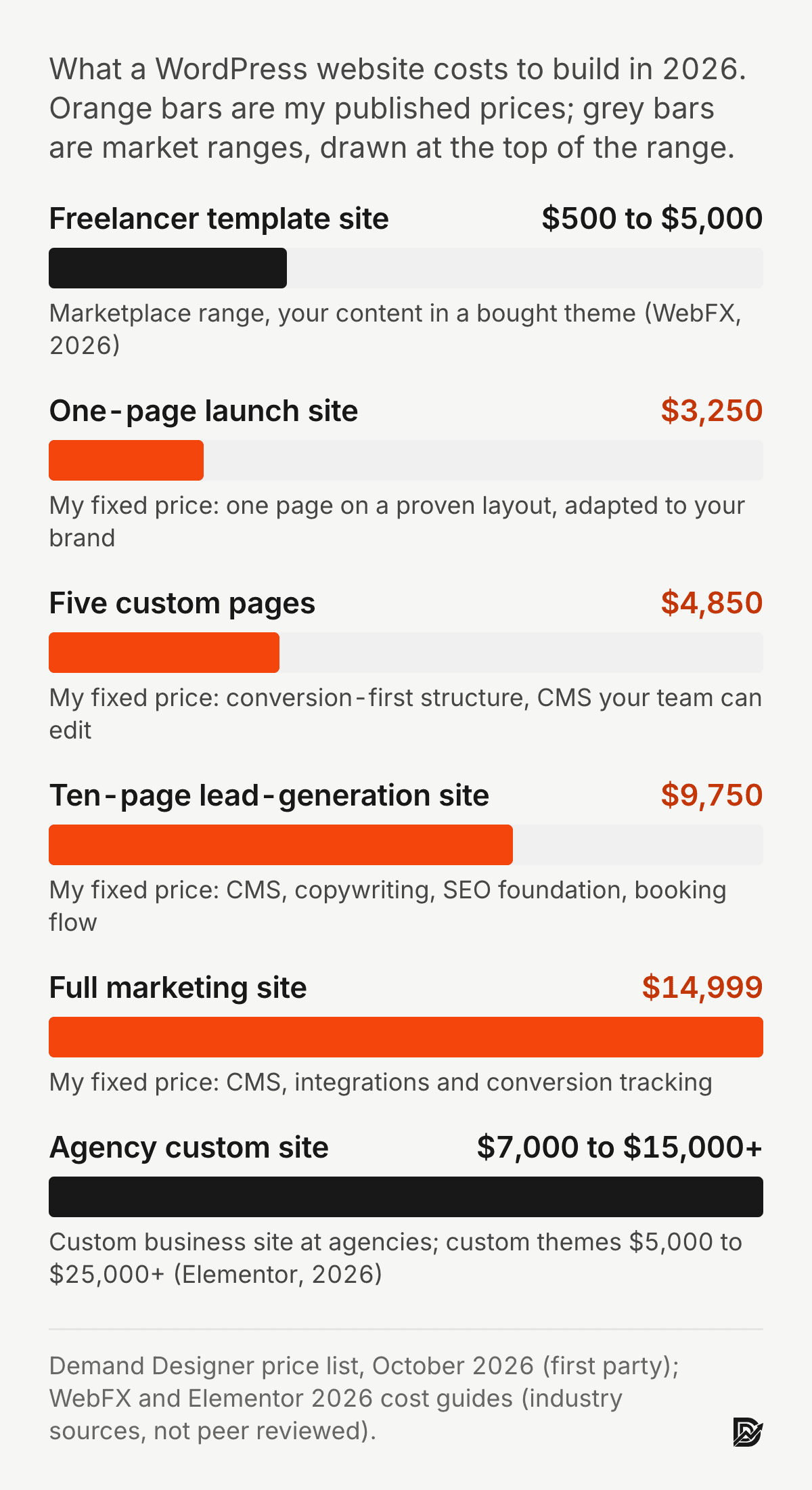
Short answer: A professional WordPress website costs $3,250 to $14,999 to build at my studio in 2026, and $375 to $3,270 a year to run once hosting, plugin licences, security and someone’s hours on updates are counted. The software is free. Owning the site is not, and the running cost is the line most quotes leave out.
WordPress quotes are the hardest to compare of any platform, because the same word covers installing a $69 theme and engineering a custom block library. This page puts real numbers on both ends. Build prices are mine, fixed and published. Hosting, plugin and theme prices come from each vendor’s own pricing page on 9 October 2026, and I label them as vendor prices because they change often. Where I make a claim about why a cost matters, I cite the study behind it.
Key takeaways
Build: my fixed prices run from $3,250 for a one-page launch site to $14,999 for a full marketing site with CMS, integrations and conversion tracking. Freelancer marketplaces quote $500 to $5,000 and agencies $3,000 to $100,000 for WordPress work (WebFX, 2026).
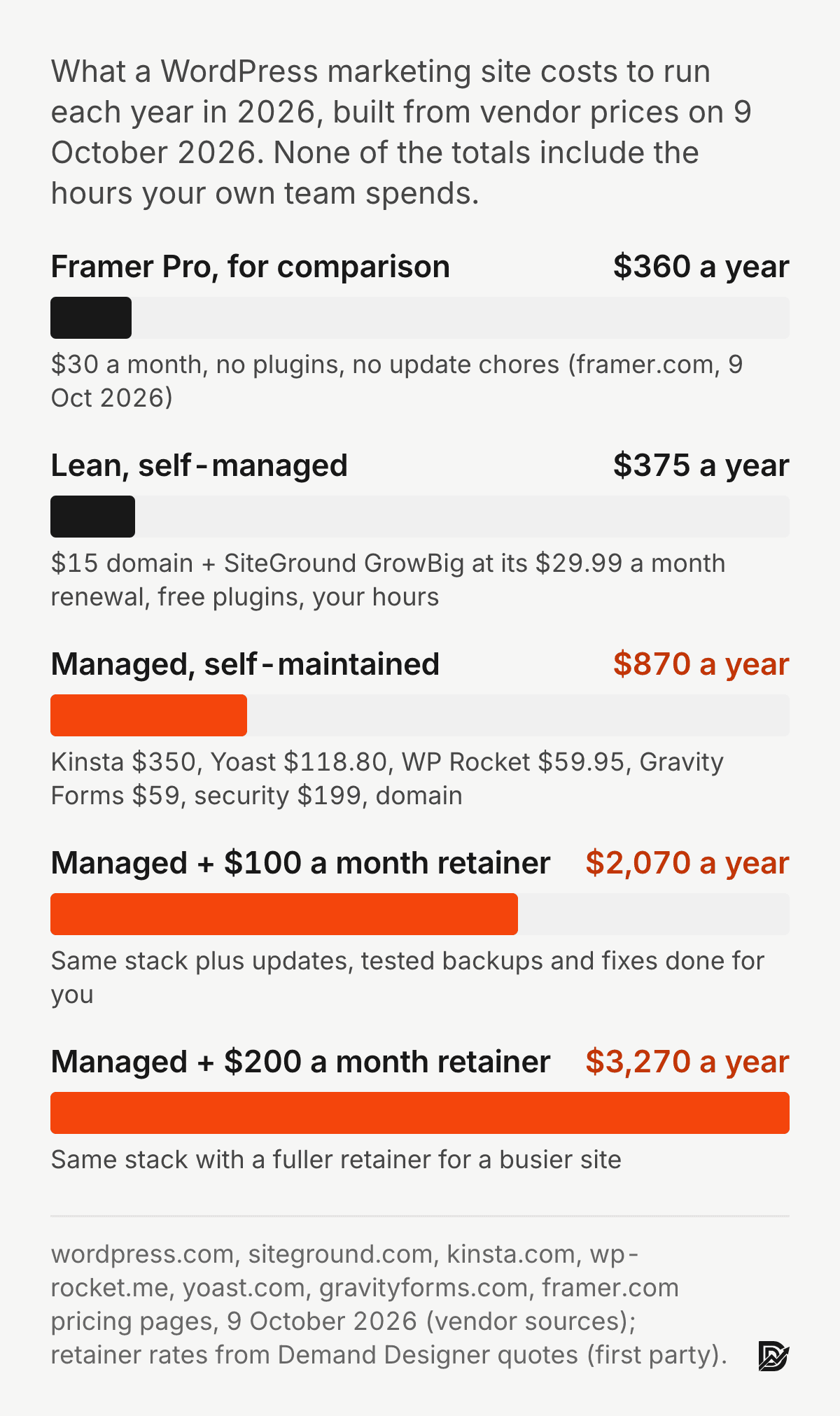
Run: $375 a year if you self-host on a renewed shared plan and do the updates yourself, about $870 on managed hosting with the usual premium plugins, and $2,070 to $3,270 once a $100 to $200 a month maintenance retainer is added.
Per month that is roughly $31, $73 or $170 to $273, and none of it includes the hours someone spends applying updates.
Maintenance is not a footnote. Erlikh’s review of software life-cycle costs put maintenance at 85 to 90 percent of the total, and a WordPress site is software.
If your site is a marketing site with no plugin you cannot live without, the same build budget on a hosted platform usually buys a better outcome with a running cost of $120 to $360 a year and no update chores.
Build cost by approach
Approach | Typical cost | What you actually get |
|---|---|---|
Theme install | $500 to $2,000 | Your content in someone else’s structure; marketplace freelancers (WebFX, 2026) |
Theme customization | $3,000 to $7,000 | Custom design decisions on a maintained base; Elementor’s 2026 range for a basic informational site |
Custom build | From $9,750 | Bespoke templates and block library; my ten-page lead-generation site, or $7,000 to $15,000 at agencies |
Ecommerce (WooCommerce) | Add 30% to 60% | Products, checkout, tax, shipping, plus $29 to $299 a year per extension |
The running cost most quotes leave out
Line | Typical annual cost | Notes |
|---|---|---|
Hosting | $75 to $900 | Shared renews at $216 to $540 a year; managed starts at $336 to $420 |
Premium plugins | $150 to $500 | Renewals, not one-time purchases; SEO, caching, forms, custom fields |
Security and backups | $70 to $200 | Or the cost of not having them when a plugin is exploited |
Maintenance | $0 to $2,400 | A $50 to $200 a month retainer, or your own hours |
Sample quotes by scope
Scope | Price | What it covers |
|---|---|---|
Starter | $3,250 | One page on a proven layout, adapted to your brand |
Focused site | $4,850 | Five custom pages with a conversion-first structure |
Focused site with migration | $6,950 | Adds migration from your current platform with SEO carried over |
Lead-generation site | $9,750 | Ten pages, CMS, conversion copywriting, SEO foundation, booking flow with email automation |
Is WordPress free?
The software is free. The site is not. WordPress.org gives you the code at no charge, and everything else that makes it a working website is a paid line: a domain, hosting, a theme, the plugins that add forms and SEO, backups, and the hours someone spends keeping it patched. Lavazza made this point about open-source software in general: total cost of ownership has to count training, support, maintenance and integration, not the licence alone (Lavazza, International Conference on Software Engineering Advances, 2007). WordPress is the clearest case of it I know.
There are two WordPresses, and the confusion costs people money. WordPress.org is the free, self-hosted software. WordPress.com is a hosted service run by Automattic that bundles hosting with the software on a subscription. On 9 October 2026 its pricing page lists Personal at $4 a month, Premium at $8, Business at $25 and Commerce at $45, all billed yearly, or $9, $18, $40 and $70 billed monthly. Plugins need the Business plan or above, so a WordPress.com site that behaves like a self-hosted one starts at $300 a year before any plugin licence.
How much does a WordPress website cost per month?
Between $31 and $273 a month in 2026, depending on the hosting tier and whether anyone is paid to maintain it. The low number is a shared plan at its renewal price with free plugins and your own hours. The high number is managed hosting, the usual premium plugins and a $200 a month maintenance retainer. The monthly figure hides the renewal trap: shared hosts sell the first year at an introductory rate and renew at four to six times that.
The renewal numbers from SiteGround’s WordPress hosting page on 9 October 2026 show the pattern. StartUp is $2.99 a month on the first term and renews at $17.99. GrowBig is $4.99 and renews at $29.99. GoGeek is $7.99 and renews at $44.99. Budget on the renewal price, because that is what year two costs.
How much does a WordPress website cost per year?
Three honest yearly totals, built from vendor prices on 9 October 2026 and my own maintenance quotes. Lean and self-managed: a $15 domain plus a SiteGround GrowBig renewal at $360 a year, free plugins, your own hours, about $375. Managed and self-maintained: Kinsta from $350 a year, Yoast SEO Premium at $118.80, WP Rocket at $59.95, Gravity Forms Basic at $59, a $199 security platform and the domain, about $870. Managed with a retainer: the same stack plus $100 to $200 a month for updates, backups checked and fixes, $2,070 to $3,270.
Those totals are for a marketing site with a handful of plugins. Add WooCommerce and the hosting line rises to $25 to $350 a month on WooCommerce.com’s own guidance, extensions run $29 to $299 a year each, and card processing takes 2.9 percent plus 30 cents per transaction through WooPayments. A store rarely runs under $1,500 a year all in.
How much does WordPress hosting cost?
Shared hosting is $3 to $15 a month at introductory rates and $18 to $45 a month on renewal. Managed WordPress hosting starts at $28 to $35 a month: WP Engine’s Essential plan is $28 a month billed annually ($336 a year) and Kinsta’s single-site plan is $35 a month or $350 a year, both checked 9 October 2026. The difference buys server-side caching, daily backups, staging and a support desk that knows WordPress.
Cheap hosting has a cost that never appears on the invoice. Nah found that web users’ tolerable waiting time without feedback was about 2 seconds for a simple task (Nah, Behaviour and Information Technology, 2004). A $3 shared plan with a page-builder theme and twenty plugins routinely takes longer than that on a phone. The visitors who leave in those seconds are the ones the site was built to convert. Wehner and colleagues also found that Google’s Core Web Vitals only partly line up with what users perceive as quality, so a green Lighthouse score is not proof the page feels fast (Wehner, Seufert, Schatz and Hoßfeld, Quality and User Experience, 2023). Test on a real phone, on cellular, before signing the hosting contract.
What do premium plugins and themes cost?
Budget $150 to $500 a year for licences on a marketing site, renewed every year. The named prices on 9 October 2026: Yoast SEO Premium $118.80 a year, WP Rocket $59.95 a year for one site, Advanced Custom Fields Pro $49 a year, Gravity Forms $59 (Basic), $159 (Pro) or $259 (Elite) a year, Astra Pro $69 a year, and Elementor Pro from $60 a year. A premium theme on its own is $40 to $100 one time with six to twelve months of updates (Elementor, 2026). Every one of these is a subscription in practice, because a plugin that stops receiving updates becomes the hole an attacker walks through.
That is not a scare line. Mesa and colleagues went through the WordPress vulnerability bulletins in the National Vulnerability Database and the matching plugin patches. They found that plugin vulnerabilities can stay unnoticed for years before they are fixed, while the fixes themselves are usually small and local (Mesa, Vieira, Viana, Durelli, Cirilo, Kalinowski and Lucena, Proceedings of the 22nd International Systems and Software Product Line Conference, 2018). The risk lives in the plugins, not in core, and the defence is someone applying updates on a schedule. Fewer plugins is the cheapest security measure there is.
How much does WordPress maintenance cost?
A maintenance retainer costs $50 to $200 a month in 2026 (Elementor, 2026), with WebFX putting the full range at $50 to $10,000 a year depending on how much custom code is involved. It covers core, theme and plugin updates, a backup that is actually tested, uptime monitoring and the small fixes that follow an update. Doing it yourself is free in cash and costs two to four hours a month if nothing breaks. It is never zero. It is money or your hours.
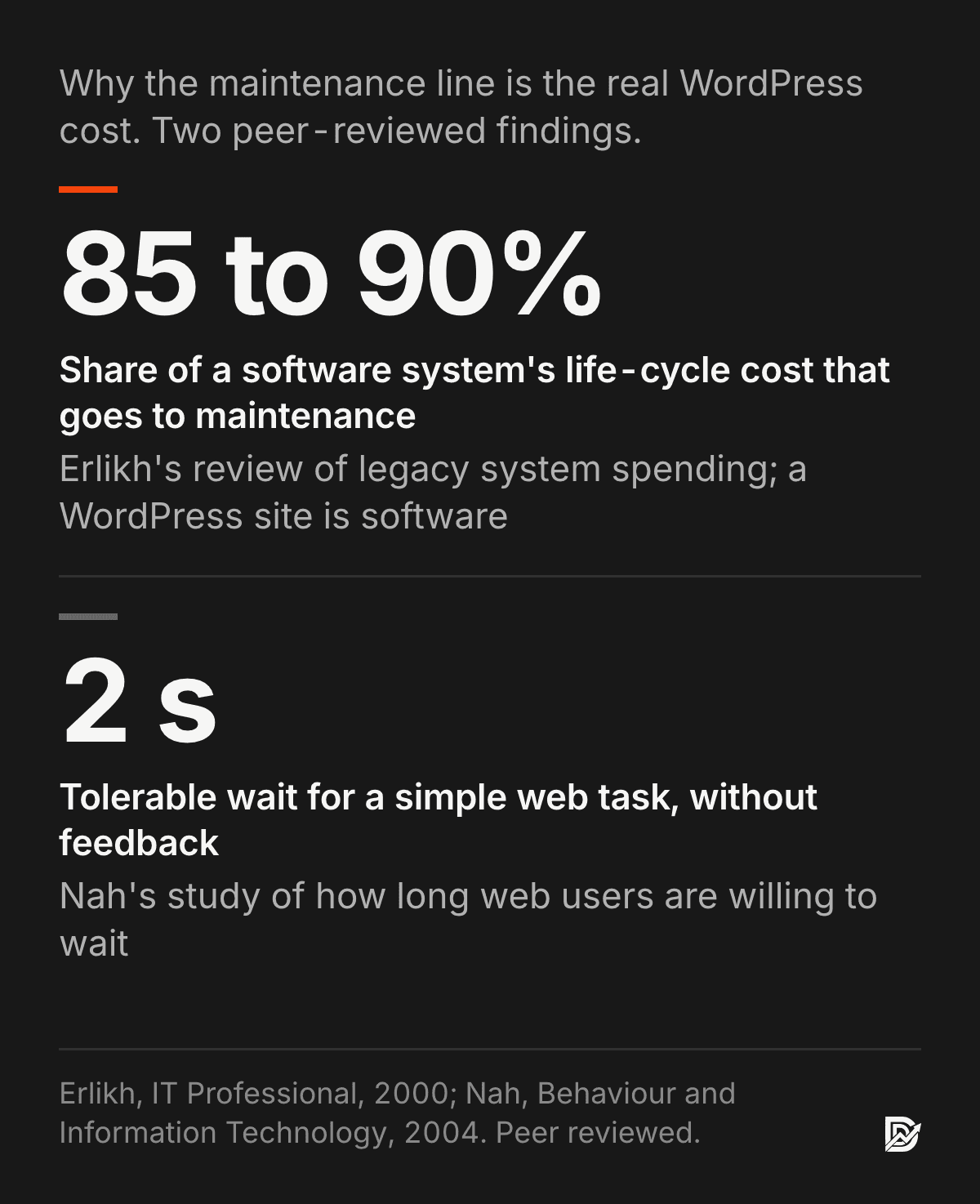
The research on software costs says the retainer is the honest line, not the extra. Erlikh’s review of life-cycle spending put maintenance at 85 to 90 percent of the total cost of a software system (Erlikh, IT Professional, 2000). Banker, Datar, Kemerer and Zweig showed in commercial application systems that more complex code costs measurably more to maintain (Banker, Datar, Kemerer and Zweig, Communications of the ACM, 1993), which is the economic case for fewer plugins and a lighter theme. And Nugroho, Visser and Kuipers modelled deferred quality work as a debt that accrues interest, so every month of skipped updates makes the eventual fix dearer (Nugroho, Visser and Kuipers, Proceedings of the 2nd Workshop on Managing Technical Debt, 2011). A WordPress site with forty plugins and no retainer is carrying debt at a rate nobody wrote down.
How much does a custom WordPress website cost?
A custom WordPress website costs $4,850 to $14,999 at my studio and $7,000 to $15,000 at a typical agency, with a basic custom theme built from scratch quoted at $5,000 to $10,000 and complex ones above $25,000 (Elementor, 2026). Custom means the page structures, block library and templates are designed for your offer rather than adapted from a marketplace theme. The gap between a $1,500 theme install and a $9,750 custom build is not pixels. It is the conversion structure, the CMS set up so your team can publish without a developer, the tracking that works on day one, and the SEO carried over if there is an old site.
Design quality is a budget line because visitors price it in before they read a word. Lindgaard and colleagues found that people form a reliable judgement of a web page’s visual appeal within 50 milliseconds, and the judgement holds when they get longer to look (Lindgaard, Fernandes, Dudek and Brown, Behaviour and Information Technology, 2006). In Fogg’s study of 2,684 people evaluating websites, design look was the most frequently mentioned factor in credibility judgements, at 46.1 percent of comments (Fogg, Soohoo, Danielson, Marable, Stanford and Tauber, Proceedings of the 2003 conference on Designing for User Experiences, 2003). A theme install bought for $800 can pass those tests. It usually does not, because the theme was designed for nobody in particular.
What does a WordPress ecommerce website cost?
Add 30 to 60 percent to the build price for WooCommerce, then budget $1,500 to $5,000 a year to run it. WooCommerce itself is free. The store costs come from hosting that can take checkout traffic ($25 to $350 a month on WooCommerce.com’s own pricing guidance, 9 October 2026), extensions for subscriptions, shipping and tax at $29 to $299 a year each, and payment processing at 2.9 percent plus 30 cents a transaction. Elementor’s 2026 guide puts a professional store build at $8,000 to $25,000 and up, and WebFX puts ecommerce ongoing costs at $1,000 to $3,000 a year. If the catalogue is under 50 products and the brand is not selling a regulated category, I usually point founders at Shopify instead; the WooCommerce to Shopify migration guide explains when that is the cheaper total.
WordPress vs Framer vs HubSpot: what three years cost
Over three years a managed WordPress marketing site with a $100 a month retainer costs about $6,200 to run, before the build. Framer Pro costs $1,080 for the same three years and Framer Basic $360, at the plan prices in my Framer guide. HubSpot’s subscription and build numbers are on their own page, because they depend on which Hub tier the sales team already pays for. The build price barely moves between platforms on my price list, because the hours go into structure, copy and integrations, not into the CMS. What moves is the running line and who has to touch the site each month.
Two studies explain why people stay on WordPress past the point where it pays. Farrell and Klemperer’s review shows that once a buyer has invested in one platform, the cost of moving keeps them there even when a rival is better, and that firms price with that in mind (Farrell and Klemperer, Handbook of Industrial Organization, 2007). And Angelopoulos and Kitsios catalogued the criteria organisations use when choosing a content management system and found cost sits beside functionality, usability and support rather than deciding on its own (Angelopoulos and Kitsios, 48th Hawaii International Conference on System Sciences, 2015). Boulanger’s survey of open-source and proprietary software found no evidence that either model is inherently more reliable or secure; what mattered was how each system was maintained (Boulanger, IBM Systems Journal, 2005). WordPress is not the risky choice. Unmaintained WordPress is.
The platform-by-platform comparison is on the website platforms page, the Framer numbers are in the Framer website cost guide, the HubSpot numbers in the HubSpot website cost guide, and if the choice is between the two hosted tools, read Framer vs Webflow.
Should I stay on WordPress or move?
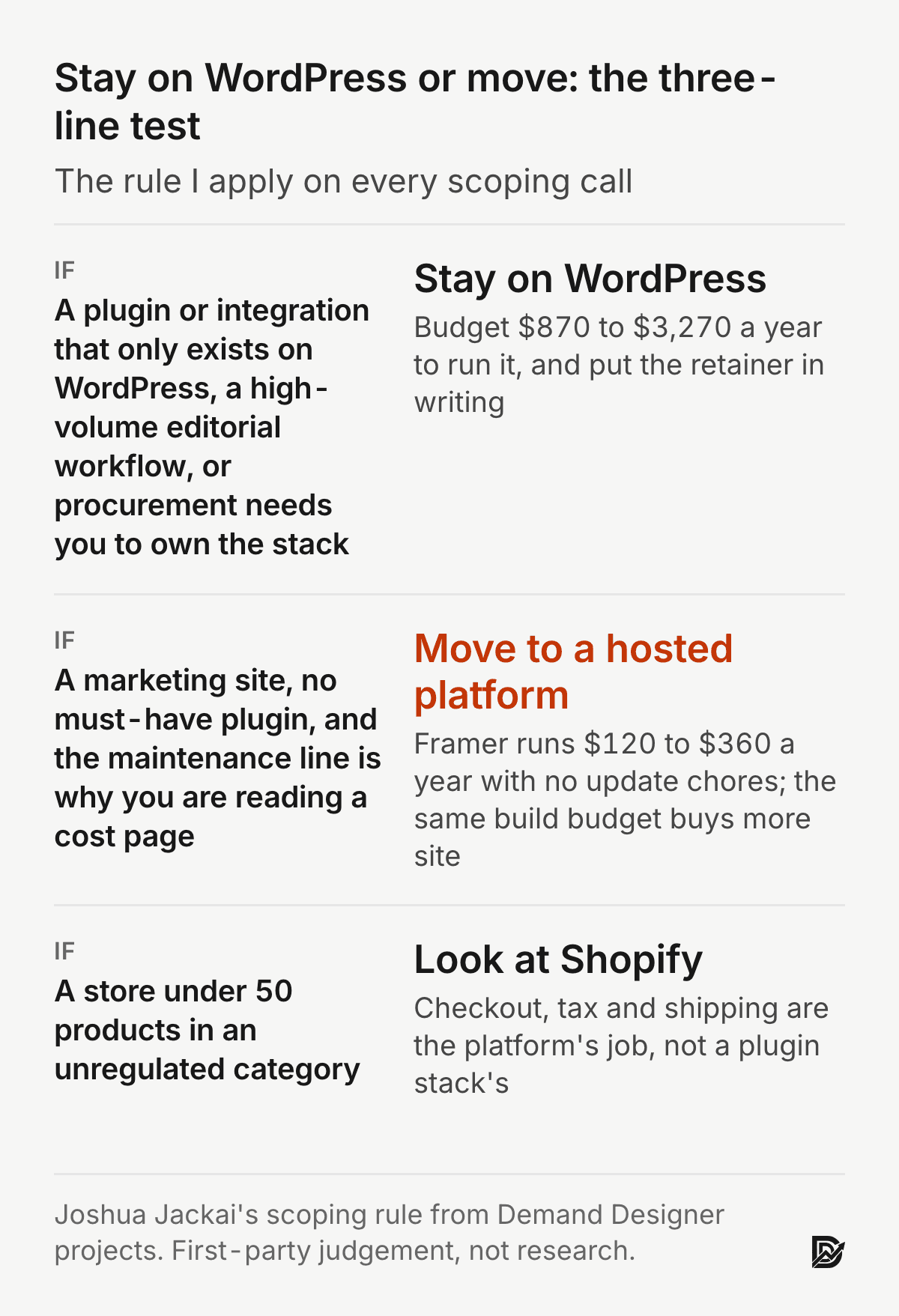
Stay if the site depends on a plugin or an integration that only exists on WordPress, if your team publishes at a volume that needs real editorial workflow, or if owning the stack outright matters to legal or procurement. Move if the site is a marketing site, nobody on the team enjoys the update email, and the maintenance line is the reason you are reading a cost page. That is my three-line test and I apply it on every scoping call.
If you move, the WordPress to Framer migration guide covers the redirects, the content export and what SEO carries over, and the migrations overview covers HubSpot and Shopify as destinations. If you stay, the rest of this page is your budget.
A WordPress cost worksheet
Six lines, filled in before you compare quotes. One: build price, with the deliverables written down next to it. Two: hosting at the renewal price, not the first-year price. Three: plugin and theme licences, each one a yearly renewal. Four: security and backups, either a plugin licence or a line in the retainer. Five: maintenance, as a retainer or as named hours on a named person. Six: the hours your own team will spend editing content, because a site nobody can edit without a developer is a cost too. Add lines two to six and multiply by three. That is the number to put beside the build price.
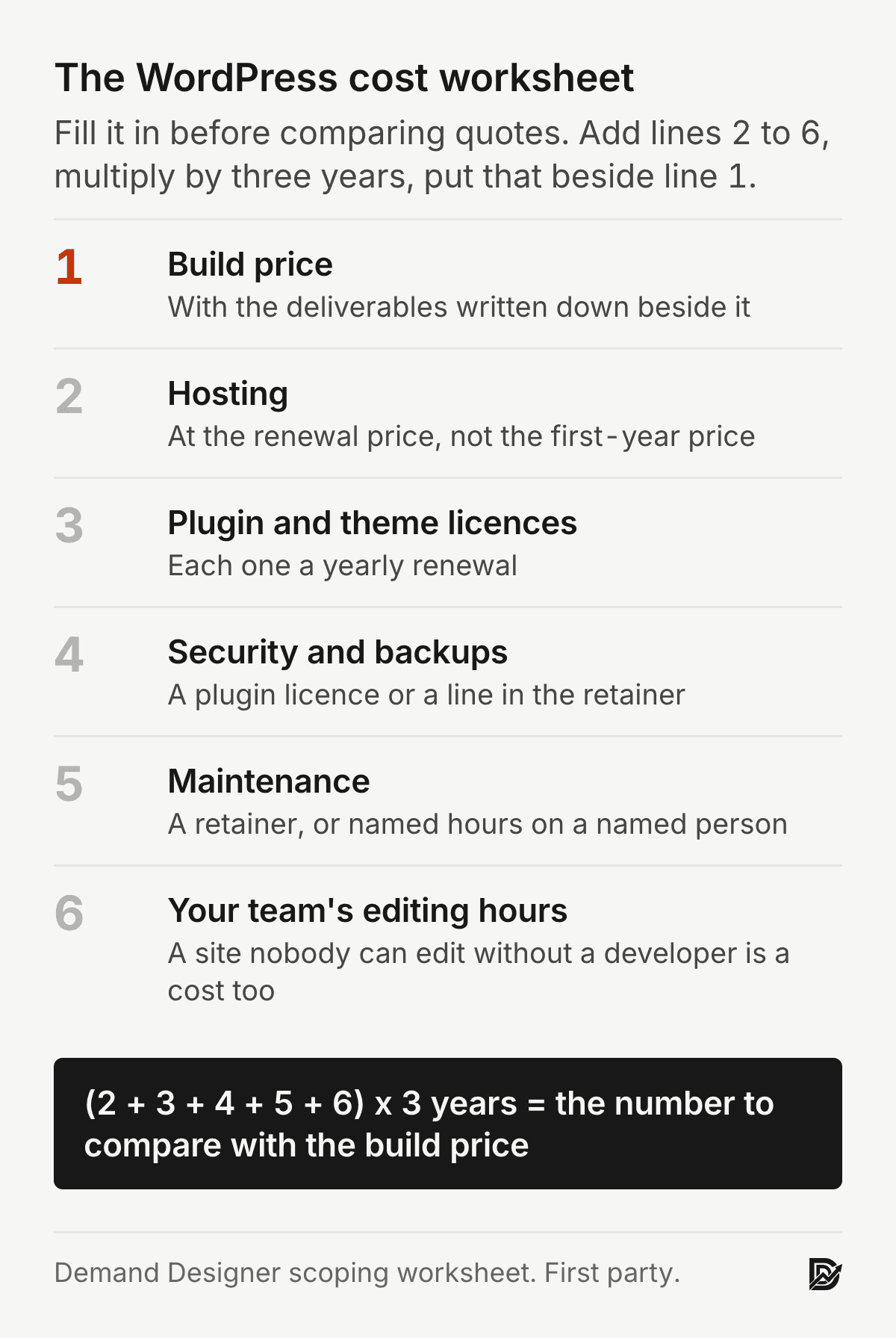
Two $5,000 quotes can describe completely different sites. The worksheet turns the headline number into something you can compare, and it usually shows that the cheapest build on paper is the dearest site to own. My pricing page shows the exact number for your scope before you pay anything, and the Pipeline Leak Scorecard tells you whether the site you already have is worth maintaining at all.
The cross-platform view is in the website redesign cost pillar. If the maintenance line is what is pushing you to look elsewhere, the WordPress to Framer migration guide covers the move, and the platform comparison covers whether you should.
Frequently asked questions
Is WordPress actually free?
The software is. The site is not. A self-hosted WordPress site needs a domain, hosting, usually a premium theme and plugins, backups and someone’s time to keep it patched. On 9 October 2026 that adds up to about $375 a year at the lean end and $3,270 with managed hosting and a retainer.
Why do WordPress quotes vary so much?
Because the word covers a theme install and a custom block library. A $500 quote is your content poured into someone else’s structure. A $9,750 quote is custom page structures, a CMS your team can edit, tracking that works and SEO carried over. Compare what is being built, not the headline number.
How much does WordPress maintenance cost?
Between $0 and about $2,400 a year, depending on whether you do it or pay a $50 to $200 a month retainer. Erlikh put maintenance at 85 to 90 percent of a software system’s life-cycle cost, and a WordPress site is software. It is never genuinely zero; it is either money or your hours.
Should I move off WordPress?
If your site is a marketing site and the maintenance burden is not buying you anything, usually yes. If you rely on a plugin or integration that only exists on WordPress, publish at a volume that needs editorial workflow, or need to own the stack for procurement reasons, no.
How much does a WordPress website cost per month?
Roughly $31 a month self-hosted on a renewed shared plan, about $73 on managed hosting with the usual premium plugins, and $170 to $273 once a maintenance retainer is included. Budget on the hosting renewal price, not the introductory one.
How much does a WordPress website cost per year?
About $375 a year lean and self-managed, about $870 on managed hosting with premium plugins, and $2,070 to $3,270 with a $100 to $200 a month maintenance retainer, at vendor prices on 9 October 2026. A WooCommerce store adds $1,500 to $5,000 a year on top.
Is WordPress.com cheaper than self-hosted WordPress?
At the low end, yes: WordPress.com Personal is $4 a month billed yearly. Once you need plugins it is the Business plan at $25 a month, $300 a year, which is close to managed hosting for a self-hosted site that gives you more control. Prices from wordpress.com/pricing on 9 October 2026.
How much does WordPress hosting cost?
Shared hosting is $3 to $15 a month on the first term and $18 to $45 a month on renewal. Managed WordPress hosting starts at $28 a month billed annually at WP Engine and $35 a month at Kinsta, checked 9 October 2026. Managed buys caching, daily backups, staging and support that knows WordPress.
How much does a custom WordPress theme cost?
A basic custom theme built from scratch is $5,000 to $10,000 at agencies and complex ones run above $25,000 (Elementor, 2026). On my price list a five-page custom site is $4,850 and a ten-page lead-generation site is $9,750, with the theme, block library and templates included.
Do I have to pay for WordPress plugins every year?
For premium plugins, yes. Yoast SEO Premium, WP Rocket, Advanced Custom Fields Pro, Gravity Forms and Astra Pro are all yearly licences at $49 to $259 a year on 9 October 2026. A licence that lapses stops receiving updates, and unpatched plugins are where most WordPress vulnerabilities live.
Sources
Peer reviewed
Lavazza, L. Beyond Total Cost of Ownership: Applying Balanced Scorecards to Open-Source Software. International Conference on Software Engineering Advances, 2007. https://doi.org/10.1109/icsea.2007.19
Nah, F. F.-H. A study on tolerable waiting time: how long are Web users willing to wait? Behaviour and Information Technology, 2004. https://doi.org/10.1080/01449290410001669914
Wehner, N., Seufert, M., Schatz, R., Hoßfeld, T. Do you agree? Contrasting Google’s Core Web Vitals and the impact of cookie consent banners with actual web QoE. Quality and User Experience, 2023. https://doi.org/10.1007/s41233-023-00058-3
Mesa, O., Vieira, R., Viana, M., Durelli, V. H. S., Cirilo, E., Kalinowski, M., Lucena, C. Understanding vulnerabilities in plugin-based web systems: an exploratory study of WordPress. Proceedings of the 22nd International Systems and Software Product Line Conference, 2018. https://doi.org/10.1145/3233027.3233042
Erlikh, L. Leveraging legacy system dollars for e-business. IT Professional, 2000. https://doi.org/10.1109/6294.846201
Banker, R. D., Datar, S. M., Kemerer, C. F., Zweig, D. Software complexity and maintenance costs. Communications of the ACM, 1993. https://doi.org/10.1145/163359.163375
Nugroho, A., Visser, J., Kuipers, T. An empirical model of technical debt and interest. Proceedings of the 2nd Workshop on Managing Technical Debt, 2011. https://doi.org/10.1145/1985362.1985364
Lindgaard, G., Fernandes, G., Dudek, C., Brown, J. Attention web designers: You have 50 milliseconds to make a good first impression! Behaviour and Information Technology, 2006. https://doi.org/10.1080/01449290500330448
Fogg, B. J., Soohoo, C., Danielson, D. R., Marable, L., Stanford, J., Tauber, E. R. How do users evaluate the credibility of Web sites? Proceedings of the 2003 conference on Designing for User Experiences, 2003. https://doi.org/10.1145/997078.997097
Farrell, J., Klemperer, P. Coordination and Lock-In: Competition with Switching Costs and Network Effects. Handbook of Industrial Organization, 2007. https://doi.org/10.1016/S1573-448X(06)03031-7
Angelopoulos, S., Kitsios, F. Decision Making for Content Management Systems: Criteria Identification and Categorisation. 48th Hawaii International Conference on System Sciences, 2015. https://doi.org/10.1109/hicss.2015.150
Boulanger, A. Open-source versus proprietary software: Is one more reliable and secure than the other? IBM Systems Journal, 2005. https://doi.org/10.1147/sj.442.0239
Industry, vendor and first-party
Vendor pricing pages checked 9 October 2026, not peer reviewed and subject to change: wordpress.com/pricing (Personal $4, Premium $8, Business $25, Commerce $45 a month billed yearly); siteground.com WordPress hosting (StartUp $2.99 renewing at $17.99, GrowBig $4.99 renewing at $29.99, GoGeek $7.99 renewing at $44.99 a month); kinsta.com/plans (from $35 a month or $350 a year); wpengine.com/plans (Essential from $28 a month billed annually, $336 a year); wp-rocket.me ($59.95 a year); yoast.com (SEO Premium $118.80 a year); advancedcustomfields.com (Pro $49 a year); gravityforms.com ($59, $159, $259 a year); wpastra.com (Astra Pro $69 a year); elementor.com (Pro from $60 a year); woocommerce.com/pricing (hosting $25 to $350 a month, extensions $29 to $299 a year, WooPayments 2.9% plus 30 cents).
WebFX, WordPress Costs: How Much Does a WordPress Website Cost in 2026? (industry guide, no update date shown): agency $3,000 to $100,000, freelancer $500 to $5,000, maintenance $50 to $10,000 a year, ecommerce ongoing $1,000 to $3,000 a year. https://www.webfx.com/web-design/pricing/wordpress-cost/
Elementor, WordPress Website Cost in 2026: A Definitive Pricing Breakdown (vendor guide, updated 29 June 2026): freelancer $50 to $150 an hour, basic informational site $3,000 to $7,000, custom business site $7,000 to $15,000, store $8,000 to $25,000 and up, custom theme $5,000 to $10,000, maintenance service $50 to $200 a month, premium theme $40 to $100. https://elementor.com/blog/wordpress-website-cost-guide/
Demand Designer price list (first party, October 2026): one-page launch site $3,250, five custom pages $4,850, five pages with migration $6,950, ten-page lead-generation site $9,750, full marketing site with CMS, integrations and conversion tracking $14,999; maintenance retainers quoted at $100 to $200 a month.
Free workbook
Pipeline Leak Scorecard
Find the leaks between your traffic and your pipeline. Score your site in about fifteen minutes, with it open in front of you.
12 questions, 8 pages, 15 minutes. Free.


