Web Design
4 WordPress vs HubSpot vs Shopify vs Framer Compared

Joshua Jackai
16 min

Published 17 September 2026 · Last updated and fact-checked 23 October 2026
Short answer: For WordPress vs HubSpot, pick HubSpot Content Hub when your sales team lives in HubSpot CRM, and WordPress for content at scale or full ownership. Pick Shopify to sell products and Framer for a B2B marketing site at about $360 a year. WordPress carries the most upkeep (Mesa et al., 2018).
Most platform comparisons rank four tools on features you will never use. This one ranks them on the question I get from US heads of marketing and founders: which platform will cost me the least trouble over three years, given what the site has to do?
I build on all four at Demand Designer, a solo web design and ad creative studio, so the opinions come from client work, and every price below carries the date I checked it. If you only want the WordPress vs HubSpot answer, read items 1 and 2 and the decision path. If you are choosing among all four, read the whole page.
Key takeaways
Framer Pro is $30 a month on yearly billing, about $1,080 over three years in platform fees, level with Shopify Basic at $1,044 and the cheapest fit for a marketing site.
WordPress software is free, but a working site runs $375 to $3,270 a year once hosting, plugins and maintenance are counted.
HubSpot Content Hub starts at $20 a seat a month, and the premium tier at $450 a month is justified mainly by CRM reporting your team already uses.
Shopify's plans run $29 to $299 a month, and its content features are the weakest of the four.
Users judge a site in 50 milliseconds (Lindgaard et al., 2006), so the platform matters less than speed, clarity and a working lead path.
Platform | Best for | Platform fees from | Upkeep | Ownership |
|---|---|---|---|---|
1. WordPress | Content at scale, full control | $375 a year self-managed | Permanent | Fully yours |
2. HubSpot Content Hub | B2B with CRM reporting | $20 a seat a month | Low | Hosted |
3. Shopify | Selling products | $29 a month | Low | Hosted |
4. Framer | Fast marketing sites | $10 a month Basic, $30 Pro | Near zero | Hosted |
1. WordPress: best for content at scale and full ownership
WordPress, the open-source content management system, is software you host yourself or buy as managed hosting. It suits publishers, large blogs and teams that want to own every file. The software costs nothing, but a working business site runs $375 to $3,270 a year once hosting, premium plugins and maintenance are included.
Platform cost: $375 a year self-hosted and self-managed, about $870 on managed hosting with the usual premium plugins
With maintenance: $2,070 to $3,270 a year once a $100 to $200 a month retainer is added
Strongest at: content volume, custom post types, plugins for almost anything
Weakest at: upkeep, since plugins and themes need constant updates
Ownership: you hold the files, database and hosting account
WordPress has the deepest ecosystem of the four, and that is both its draw and its cost. Every plugin is a dependency someone must update, and the research agrees on the risk.
"plugin-related vulnerabilities tend to be recurrent, exploitable and hard to be detected," wrote Mesa and colleagues in the 2018 paper's abstract.
That is a reason to budget for maintenance, not a reason to avoid WordPress. A site with a retainer and a short plugin list is safe and fast. A WordPress site with forty plugins and no retainer is carrying debt at a rate nobody wrote down.
"A WordPress site with forty plugins and no retainer is carrying debt at a rate nobody wrote down," said Joshua Jackai, founder of Demand Designer.
Choose WordPress when the site is mainly content, when you need a model Framer or HubSpot cannot hold, or when owning the whole stack matters to your legal or security team. For the full price breakdown, see what a WordPress website costs in 2026.
Data point: Managed WordPress hosting starts at $28 a month billed annually at WP Engine and $35 a month at Kinsta, checked 9 October 2026 (vendor pricing, not peer reviewed).
2. HubSpot Content Hub: best for B2B teams that report from the CRM
HubSpot Content Hub, formerly HubSpot CMS, is a hosted website platform inside the HubSpot CRM. It suits B2B companies whose marketing and sales teams already work in HubSpot. Pages are priced per seat, from $20 a seat a month on Starter to $1,500 a month on Enterprise.
Platform cost: Free at $0 for up to 2 users, Starter at $20 a seat a month, Professional from $450 a month, Enterprise from $1,500 a month
Strongest at: closed-loop reporting from first page view to closed deal
Weakest at: price, and ecommerce, which is limited next to Shopify
Upkeep: low, since HubSpot hosts, patches and secures the site
Ownership: hosted, so you rent the platform and keep the content
The reason to pay more is not the page editor, which is capable but not special. It is that a visitor, a form fill and a closed deal sit in one record, so marketing and sales argue about one set of numbers. That alignment is hard to get in practice, and researchers have noted how little is known about it.
"Little is known about the interface between separate marketing units and sales units," wrote Homburg, Jensen and Krohmer in their 2008 abstract.
Most small B2B sites I see could live on Starter for a year. If your CRM is somewhere else, HubSpot hosting buys you little: you pay a premium for a reporting loop you are not using, and WordPress or Framer with a form integration is the cheaper route. I took Snappy Kraken from Figma to a live HubSpot site in 21 days. For the tier-by-tier numbers, see what a HubSpot website costs. If you are leaving WordPress for it, the WordPress to HubSpot migration guide covers redirects and templates.
"Most small B2B sites I see could live on Starter for a year," said Joshua Jackai, founder of Demand Designer.
Data point: On 22 October 2026 HubSpot priced Content Hub Professional from $450 a month with 3 core seats, converted from Canadian dollars at 1.3 (HubSpot pricing page, vendor source, not peer reviewed).
3. Shopify: best for selling products first
Shopify is a hosted store platform with plans from $29 to $299 a month on yearly billing. It suits any business where the checkout is the main job of the site. It is the weakest of the four for content programmes, so brands with a serious blog usually run a separate marketing site beside the store.
Platform cost: Basic $29, Grow $79, Advanced $299 a month on yearly billing; Plus from $2,300 a month
Strongest at: checkout, inventory, payments and an app ecosystem for stores
Weakest at: content architecture and blog depth
Upkeep: low, though unused apps leave scripts behind
Ownership: hosted; products and customer data export, the theme logic does not
Shopify wins on one thing: it removes the risk from taking money, with a checkout, payments and tax handling that already work. Plan fees are the smaller part once you sell, because card fees and paid apps add to the bill. Design still matters to conversion, because shoppers read site quality as a signal about the product.
"This research proposes a model to investigate website quality as a potential signal of product quality," wrote Wells, Valacich and Hess in their abstract (MIS Quarterly, 2011).
That is why a clean theme and fast pages matter more to a store than a crowded template at the same price, even when both run on the same plan. I remove unused apps before I quote any redesign, because their leftover scripts often outlive the subscription. If the site is not a store, Shopify is the wrong tool. If it is a store, read what a Shopify website costs before you pick a plan.
"I remove unused apps before I quote any redesign, because their leftover scripts often outlive the subscription," said Joshua Jackai, founder of Demand Designer.
Data point: Basic is $29 a month billed yearly and $39 billed monthly (Shopify pricing page, archived 30 September 2026, vendor source, not peer reviewed).
4. Framer: best for fast B2B marketing sites
Framer is a design canvas that publishes the site directly, with a built-in CMS. It suits B2B marketing sites where speed to launch and low running cost matter more than complex application logic. Pro is $30 a month on yearly billing, which is about $360 a year.
Platform cost: Basic $10 a month and Pro $30 a month on yearly billing; localization $20 per locale a month
Strongest at: launch speed, design control, near-zero maintenance
Weakest at: native ecommerce, which it does not have, and complex server-side logic
Upkeep: near zero, with no plugins or patches to run
Ownership: hosted; you keep the content and domain, not the platform
Framer launches faster than the other three because it has no plugin stack to load.
"what constitutes an acceptable and tolerable waiting time for Web users," wrote Fiona Nah, framing the question her 2004 experiment set out to answer.
A site the marketing team finds hard to edit becomes a site the marketing team stops editing, and I have inherited several of those. Marketing teams edit a Framer site without a developer, which is the main reason most of the moves I am asked to make go to Framer from other tools. A designer who knows Figma is productive on the canvas within a day, because auto layout, components and breakpoints behave the way Figma taught them. The limits are real, and I would rather name them than sell around them: if you need a checkout, a membership system or custom backend logic, pair Framer with another tool or pick a different platform. For comparisons with a close rival, see Framer vs Webflow and moving from WordPress to Framer.
"A site the marketing team finds hard to edit becomes a site the marketing team stops editing, and I have inherited several of those," said Joshua Jackai, founder of Demand Designer.
Data point: On yearly billing, Framer Basic is $10 a month and Pro is $30 a month, checked 16 October 2026 (Framer pricing, vendor source, not peer reviewed).
WordPress vs HubSpot: which should you choose?
Choose HubSpot Content Hub if your sales team already works in HubSpot CRM and you want one record from first page view to closed deal. Choose WordPress if the site is mainly content, needs a custom model, or must be owned end to end. The rest of the decision is price and upkeep.
HubSpot costs more per month, from $20 a seat on Starter and $450 a month on Professional (HubSpot pricing page, read 22 October 2026), and asks little of you after launch. WordPress costs $375 to $3,270 a year once hosting, plugins and maintenance are counted, and asks for upkeep forever. If your CRM is not HubSpot, WordPress or Framer with a form integration is usually the cheaper route.
WordPress | HubSpot Content Hub | |
|---|---|---|
Three-year platform fees | $1,125 to $2,610 | $2,160 to $16,200 |
Upkeep | Permanent | Low |
Best when | Content volume, ownership | The CRM is HubSpot |
How do speed, trust and lock-in change the choice?
Three forces sit under every platform decision: how fast the page loads, whether buyers trust what they see, and how hard it is to leave. The platform changes the first, barely touches the second, and decides the third. Weigh them before the price.
Speed. Nah (2004) studied how long Web users will wait, so test your own page speed instead of trusting a platform label, and note that users form a first impression in about 50 milliseconds (Lindgaard et al., 2006). A plugin-heavy WordPress theme has more to load than a Framer page, so it needs deliberate caching and image work to match. Managed hosting buys that work, which is part of why the managed rows cost more.
Trust. Buyers judge design before they read a word. In a study of how users evaluate credibility, the look of the site came up more than anything else.
"the “design look” of the site was mentioned most frequently, being present in 46.1% of the comments," wrote Fogg and colleagues in the 2003 study's abstract.
No platform produces trust on its own. A clear headline, proof and one obvious next step do, on any of the four, and I would rather spend a budget on those than on a premium tier.
Lock-in. HubSpot ties pages to the CRM, Shopify ties products to its checkout, and WordPress ties you to whoever knows your plugin stack. Framer ties you to its canvas, though the content and domain stay yours. Ask each vendor one question before you sign: what do I take with me if I leave in three years?

Which platform fits your business model? A decision path
Match the platform to the job the site must do, in this order: sell products, then report from the CRM, then publish at scale, then launch fast. The first yes decides it. Each step below names the trade you accept when you take that route.
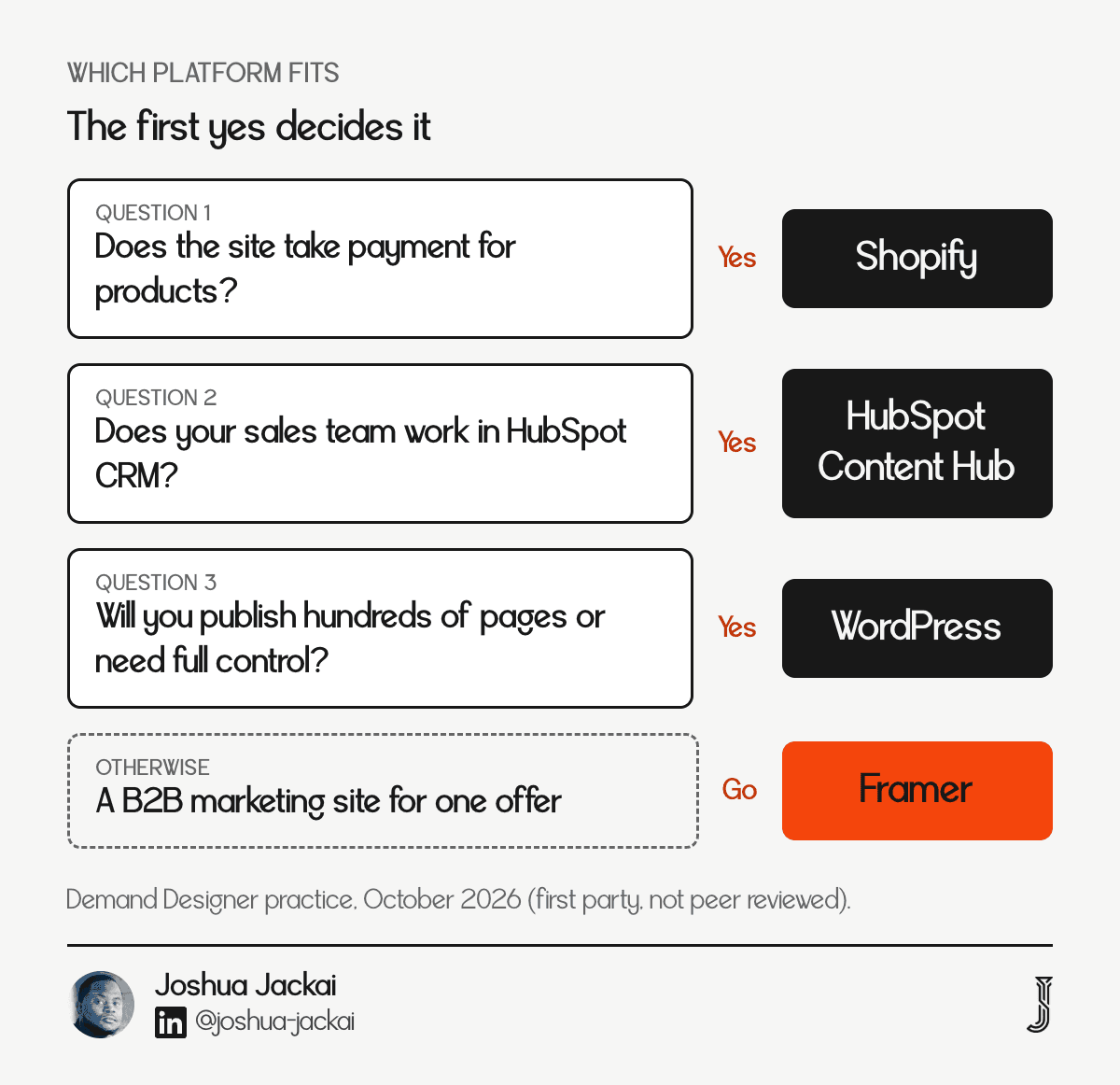
Does the site take payment for products? Choose Shopify, and run any serious blog on a separate marketing site.
Does your sales team work in HubSpot CRM today? Choose HubSpot Content Hub, and accept the per-seat price for closed-loop reporting.
Will you publish hundreds of pages or need full control of the stack? Choose WordPress, and budget for a maintenance retainer.
Is the site mainly a marketing site for a B2B offer? Choose Framer, and accept that it has no native checkout.
Angelopoulos and Kitsios studied this decision as a problem of criteria identification and categorisation for content management systems, and the order above is my own judgment from client work, not a result from that paper. Switching later is possible but not free: Farrell and Klemperer's work on coordination and lock-in discusses why switching costs shape platform choices, so pick the one you can live with for three years.
What do the four platforms cost over three years?
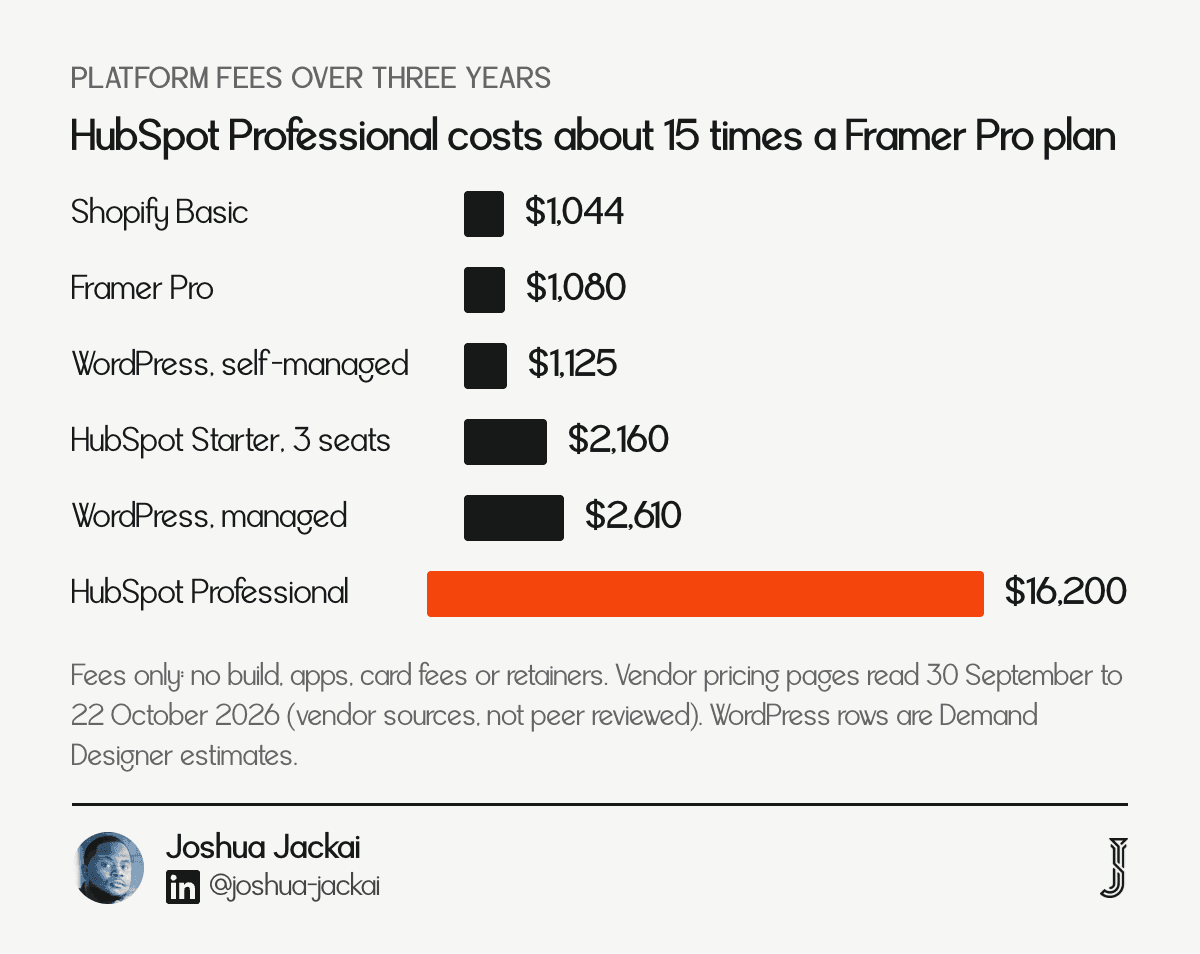
For a marketing site, platform fees over three years run from about $1,044 on Shopify Basic and $1,080 on Framer Pro to $16,200 on HubSpot Professional, before any build or design cost. The chart counts fees only, with no apps, card fees or retainers. The WordPress rows apply the idea of total cost of ownership.
"the Total Cost of Ownership (TCO) addresses the cost of acquiring, adapting and operating OSS," wrote Luigi Lavazza in Beyond Total Cost of Ownership, 2007.
Platform and plan | Per year | Three years | Source and date |
|---|---|---|---|
Framer Pro | $360 | $1,080 | Framer pricing, 16 October 2026 |
Shopify Basic | $348 | $1,044 | Shopify pricing, 30 September 2026 |
WordPress, self-managed | $375 | $1,125 | Demand Designer estimate, 9 October 2026 |
WordPress, managed hosting | $870 | $2,610 | Demand Designer estimate, 9 October 2026 |
HubSpot Starter, 3 seats | $720 | $2,160 | HubSpot pricing, 22 October 2026 |
HubSpot Professional | $5,400 | $16,200 | HubSpot pricing, 22 October 2026 |
On fees alone, HubSpot Professional costs about 15 times a Framer Pro plan over the same three years. Platform fees are the smaller part of the bill. My fixed-price builds run $3,250 to $14,999, and my prices on HubSpot are about 30 percent above the same scope on Framer. Staff time to edit the site and fix what breaks is the cost most comparisons leave out.
"My prices on HubSpot are about 30 percent above the same scope on Framer," said Joshua Jackai, founder of Demand Designer.
Four arguments people get wrong about these platforms
Four claims come up in almost every platform conversation I have. Each one is half true, and the half that is missing changes the choice. Here is how I answer each of them, in the words I use with clients, so you can test your own assumptions against them.
"WordPress is free"
The software is free. The site is not. Hosting, premium plugin renewals, security and maintenance hours are the real cost, and they recur every year. Compare three-year totals, not sticker prices.
"Hosted platforms mean you do not own your site"
You own your content, your domain and your data, and you can export and migrate. What you give up is running arbitrary server-side code. For a marketing site, that is a trade most businesses should accept.
"Shopify can do a content site too"
It can, badly. Shopify's blogging and content architecture is its weakest area, and brands with serious content programmes usually run a separate marketing site beside the store.
"HubSpot is too expensive"
It is expensive, which is different. If it removes a reporting problem that costs your team a week a month, it pays. If your CRM is elsewhere, it does not.
How do the four platforms compare by job?
The matrix lists each platform against the jobs I get asked about most, such as ecommerce, CRM reporting and content at scale. Read the row for the platform you are leaning towards and the column for the job that matters most. Nothing wins every row, which is the point of the exercise.
Platform | Ecommerce | CRM reporting | Content at scale | Upkeep | Typical launch |
|---|---|---|---|---|---|
WordPress | Plugin (WooCommerce) | Via integration | Strongest | Permanent | 4 to 10 weeks |
HubSpot Content Hub | Limited | Native, closed loop | Good | Low | 4 to 8 weeks |
Shopify | Native, strongest | Via integration | Weakest | Low | 4 to 8 weeks |
Framer | None native | Via integration | Good for marketing | Near zero | 2 to 4 weeks |
Launch times are my typical ranges on client builds, not a vendor claim. The fastest I have shipped on HubSpot was Snappy Kraken, from Figma to a live HubSpot site in 21 days.
How do I work out my three-year platform cost?
Work out three-year cost by multiplying the monthly plan fee by 36 months and adding the upkeep hours you expect to spend. Use the plan fee, the seats if the plan is per seat, and the monthly hours at your internal hourly rate. The table values are placeholders, so replace them with your own numbers.
Input | Placeholder value | Where it comes from |
|---|---|---|
Plan fee | $30 a month | The vendor pricing page |
Seats | 1 | Your team |
Upkeep hours a month | 2 | Your timesheets |
Hourly rate | $50 | Your payroll |
Result | $4,680 over 36 months | ($30 x 1 + 2 x $50) x 36 |
Frequently asked questions
Is HubSpot better than WordPress?
Neither wins outright. HubSpot Content Hub is better when your CRM is HubSpot and you want closed-loop reporting with low upkeep. WordPress is better for content volume, custom builds and full ownership. For a B2B marketing site on another CRM, WordPress or Framer is usually cheaper.
Which platform is best for SEO?
All four can rank. Framer and WordPress give the most direct control over technical SEO, Framer starts fast with no plugin stack, and WordPress has the deepest tooling. Shopify and HubSpot are good but more constrained. Page quality, speed and content decide rankings more than the platform.
Which website platform is cheapest overall?
Framer, for a marketing site: about $1,080 in platform fees over three years against $2,610 for managed WordPress and $2,160 for three HubSpot Starter seats. Shopify Basic is level at $1,044 but is built for stores. These are fees only, not build or design.
Can I move platforms later?
Yes. Migrations between all four are doable with redirect discipline: map every old URL to its new one and check Search Console after launch. The cost is time and a short risk window, not a rebuild from nothing, and I price the redirect map as its own line.
What do you build on most?
Framer for B2B marketing sites, Shopify for stores, HubSpot when the CRM demands it, and WordPress when flexibility or ownership is the requirement. I would rather tell you a platform I do not sell fits better than build the wrong one.
Who sets this up
I build fixed-price B2B sites, from $3,250 to $14,999, on all four platforms and will say when the right answer is one I do not sell. To see where your current site loses leads before you choose, the free Pipeline Leak Scorecard takes about fifteen minutes. For the wider platform picture, the website platforms hub sits beside this page.
Sources
Peer-reviewed research
Angelopoulos, S. and Kitsios, F. (2015). Decision making for content management systems: criteria identification and categorisation. 48th Hawaii International Conference on System Sciences. doi.org/10.1109/hicss.2015.150
Farrell, J. and Klemperer, P. (2007). Coordination and lock-in: competition with switching costs and network effects. Handbook of Industrial Organization. doi.org/10.1016/S1573-448X(06)03031-7
Homburg, C., Jensen, O. and Krohmer, H. (2008). Configurations of marketing and sales: a taxonomy. Journal of Marketing. doi.org/10.1509/jmkg.72.2.133
Lavazza, L. (2007). Beyond total cost of ownership: applying balanced scorecards to open-source software. International Conference on Software Engineering Advances. doi.org/10.1109/icsea.2007.19
Lindgaard, G., Fernandes, G., Dudek, C. and Brown, J. (2006). Attention web designers: you have 50 milliseconds to make a good first impression! Behaviour and Information Technology. doi.org/10.1080/01449290500330448
Mesa, O., Vieira, R., Viana, M., Durelli, V. H. S., Cirilo, E., Kalinowski, M. and Lucena, C. (2018). Understanding vulnerabilities in plugin-based web systems: an exploratory study of WordPress. Proceedings of the 22nd International Systems and Software Product Line Conference. doi.org/10.1145/3233027.3233042
Nah, F. F.-H. (2004). A study on tolerable waiting time: how long are Web users willing to wait? Behaviour and Information Technology. doi.org/10.1080/01449290410001669914
Wells, J. D., Valacich, J. S. and Hess, T. J. (2011). What signal are you sending? How website quality influences perceptions of product quality and purchase intentions. MIS Quarterly. doi.org/10.2307/23044048
Industry, vendor and first-party
Framer, Pricing, read 16 October 2026 (vendor source, not peer reviewed). framer.com/pricing
HubSpot, Content Hub pricing, read 22 October 2026, served in Canadian dollars and converted at 1.3 (vendor source, not peer reviewed). hubspot.com/pricing/content
Shopify, Pricing (United States), as archived 30 September 2026 (vendor source, not peer reviewed). shopify.com/pricing
WP Engine and Kinsta managed WordPress hosting plans and shared hosting renewal ranges, checked 9 October 2026 (vendor sources, not peer reviewed), as compiled in my WordPress cost guide.
Demand Designer launch times, build prices and the Snappy Kraken timeline are from my own client work and my pricing calculator, October 2026 (first party, not peer reviewed). demanddesigner.com/pricing
Free workbook
Pipeline Leak Scorecard
Find the leaks between your traffic and your pipeline. Score your site in about fifteen minutes, with it open in front of you.
12 questions, 8 pages, 15 minutes. Free.